





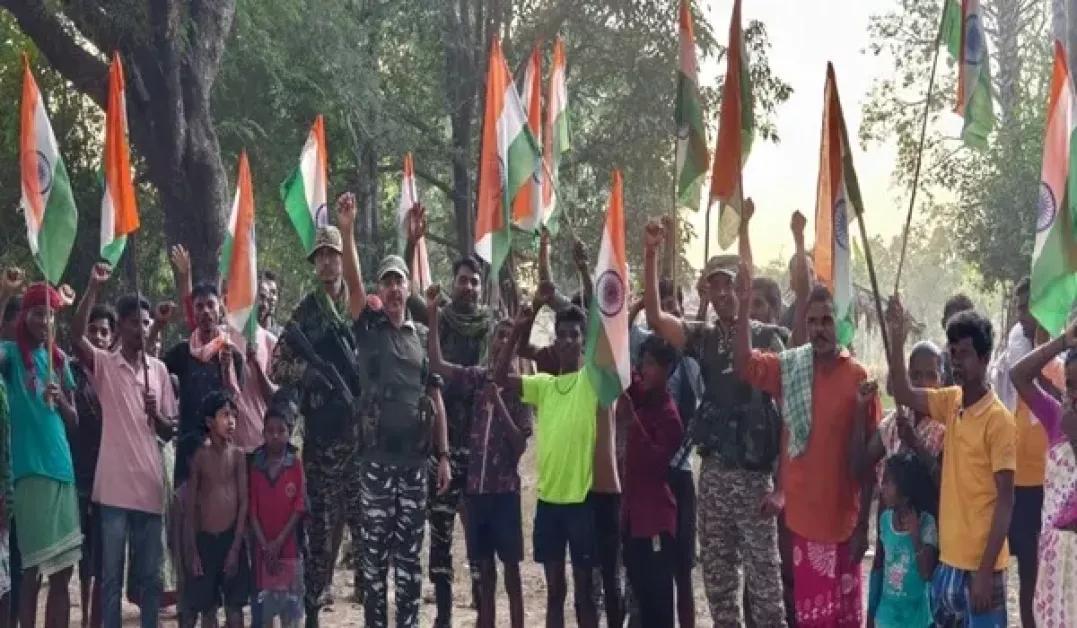
Remote Bastar Villages to Hoist Tricolour After
Decades Amid Maoist Threat
In a historic milestone for the conflict-ridden Bastar region of Chhattisgarh, fourteen remote tribal villages will hoist the Indian Tricolour this Independence Day for the first time in decades. These hamlets—spread across the districts of Bijapur, Narayanpur, and Sukma—have long lived under the shadow of Maoist insurgency, where displaying the national flag was once unthinkable due to fear of violent reprisals.
A Symbolic Step Toward National Integration
The significance of this act cannot be overstated. For communities that have for generations been isolated—geographically, socially, and politically—raising the Indian flag is more than ceremonial. It is a declaration of belonging to the national mainstream and a public rejection of extremist influence.
Local leaders and security officials believe this year’s celebrations will serve as a powerful morale boost for residents, reinforcing their right to freedom, cultural pride, and democratic participation.
Security Measures that Made it Possible
The turning point came earlier this year with the establishment of new security camps in the region. Since late January 2025, the state police and Central Reserve Police Force (CRPF) have worked to secure access roads, clear insurgent hideouts, and create safe zones for administrative work and community activities.
The presence of these camps has not only deterred Maoist movement but also restored villagers’ confidence in government protection. Officials say that the number of Maoist-related incidents in these districts has dropped significantly since the expansion of security infrastructure.
District-Wise Milestones
-
Bijapur: Several hamlets once labeled as “liberated zones” by Maoist groups will see official flag hoisting ceremonies for the first time since India’s independence.
-
Narayanpur: Schools that previously functioned under threat of insurgent control will now serve as venues for Independence Day events.
-
Sukma: Once notorious for ambushes and landmine attacks, select villages are now preparing cultural programs alongside the flag ceremony.
Local Sentiment and Anticipation
Residents, many of whom had never before attended an official flag-hoisting event, are preparing to wear traditional attire, perform folk dances, and participate in patriotic song recitals. Elderly villagers recall a time when even speaking of Independence Day celebrations could invite suspicion or violence.
A teacher from one Sukma village remarked,
“This flag is a sign that we are no longer trapped between fear and silence. It tells our children they have a future.”
Challenges Ahead
While this development marks a hopeful chapter, officials warn that the Maoist threat has not been entirely eliminated. Intelligence reports suggest that insurgents still operate in deep forested zones, capable of launching surprise attacks. Authorities have deployed additional patrol units, aerial surveillance, and coordination with local volunteers to ensure uninterrupted celebrations.
Broader Impact
Experts in conflict resolution view this as part of a gradual shift in Bastar’s socio-political landscape. The state government has paired security measures with development initiatives, including:
-
Road construction projects to improve market access.
-
Healthcare outreach programs in previously inaccessible areas.
-
Education drives aimed at enrolling every child in formal schooling.
If sustained, these efforts could help dismantle the fear-based control Maoists have exercised for decades.
Looking Forward
As the clock ticks down to August 15, 2025, preparations are in full swing. For these fourteen villages, the raising of the Tricolour will not merely be a ritual—it will be a public proclamation of resilience and hope. It signals that even in regions marked by decades of insurgency, the promise of national unity can still prevail.
 Related News
POST A COMMENT (0)
All Comments (0)
Replies (0)