





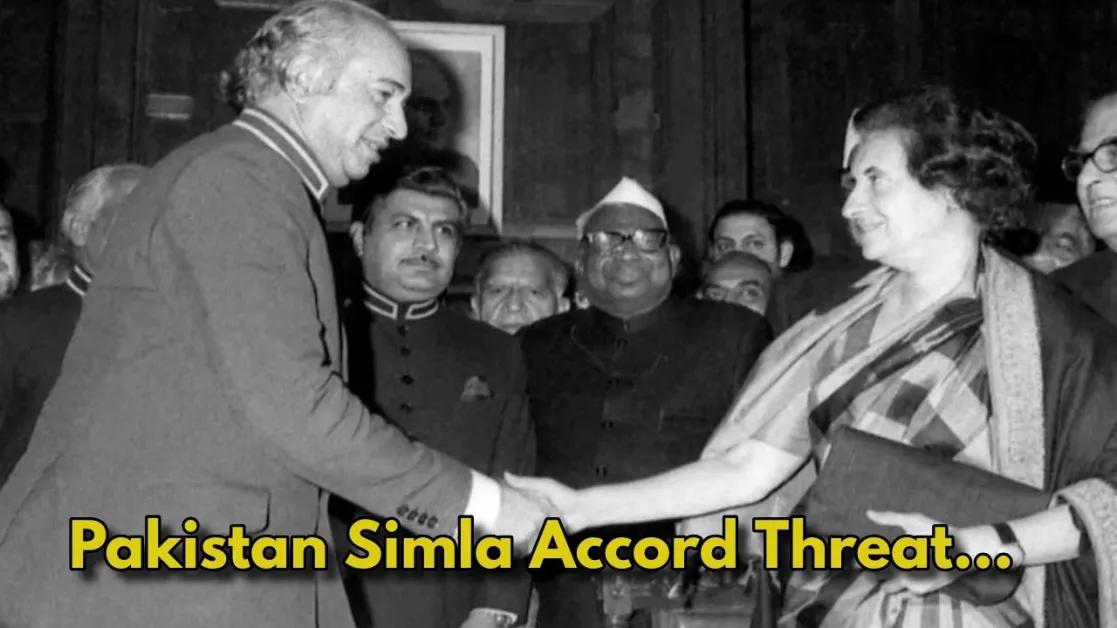
The Simla Agreement, signed on July 2, 1972, between India and Pakistan, stands as a landmark in the history of South Asian diplomacy. Emerging from the aftermath of the 1971 Indo-Pakistani War, which led to the creation of Bangladesh, this treaty was crucial in redefining the border arrangements between the two countries — particularly concerning the sensitive region of Kashmir.
It not only established the Line of Control (LoC), which remains a de facto border to this day, but also set a new tone for future India-Pakistan negotiations, emphasizing bilateralism and peaceful conflict resolution.
The Background: A New Reality After the 1971 War
The 1971 war between India and Pakistan ended with a decisive Indian victory and the birth of a new nation, Bangladesh (formerly East Pakistan). Pakistan suffered a massive blow — both militarily and psychologically — with over 90,000 Pakistani troops taken as prisoners of war by India.
The urgent need for a diplomatic settlement was clear. Pakistan’s newly elected Prime Minister Zulfikar Ali Bhutto and Indian Prime Minister Indira Gandhi met in Simla, the summer capital of Himachal Pradesh, to negotiate the future of their strained relationship.
Key Provisions of the Simla Agreement
-
Redrawing the Ceasefire Line:
-
The 1949 Ceasefire Line in Jammu and Kashmir, established after the first Indo-Pakistani war, was modified slightly and renamed the Line of Control (LoC).
-
Both sides agreed to respect the LoC without altering it unilaterally, thereby attempting to freeze military positions and promote stability.
-
-
Commitment to Bilateralism:
-
India and Pakistan agreed to resolve all disputes — including Kashmir — bilaterally, without involving third parties or international organizations.
-
This was a significant diplomatic win for India, which had long opposed internationalizing the Kashmir issue.
-
-
Withdrawal of Troops:
-
Indian and Pakistani forces agreed to pull back to pre-conflict positions, with minor adjustments, except in Kashmir where the LoC was formalized.
-
-
Respect for Sovereignty:
-
Both nations pledged to respect each other’s territorial integrity and sovereignty, promoting peaceful coexistence.
-
-
Normalization of Relations:
-
Steps were agreed upon to restore diplomatic ties, open communications, and work towards peaceful relations over time.
-
How It Redefined the India-Pakistan Border
Before 1972, the ceasefire line was viewed as a temporary arrangement, pending a UN-mandated plebiscite in Kashmir. After the Simla Agreement, the Line of Control was accepted by both countries as the practical border in Jammu and Kashmir — even if it was not formally recognized as an international boundary.
This was a significant shift:
-
De facto Border: The LoC became a militarized, monitored boundary that still defines Indian and Pakistani control in Kashmir today.
-
Reduced International Interference: By emphasizing bilateralism, the Simla Agreement marginalized international players like the United Nations from direct involvement in Kashmir, an Indian diplomatic objective.
-
Stabilization Efforts: Though tensions continued, the agreement brought a measure of stability to the heavily contested region compared to previous decades.
Achievements and Limitations
Achievements
-
Short-term stability: It helped prevent immediate large-scale conflict after the 1971 war.
-
Diplomatic framework: Provided a roadmap for future dialogue, including the later Lahore Declaration (1999).
Limitations
-
No resolution on Kashmir: While the LoC stabilized the situation on the ground, it did not resolve the underlying dispute over Kashmir.
-
Frequent Violations: Ceasefire violations along the LoC have continued sporadically, leading to loss of lives on both sides.
-
Fragile Peace: Trust deficits between the two nations meant that the spirit of Simla was often overshadowed by political and military confrontations.
The Legacy of the Simla Agreement
Today, the Simla Agreement remains a foundational document governing India-Pakistan relations. Despite its limitations, it continues to define the parameters for negotiations and military engagement, especially concerning Kashmir.
For India, the agreement cemented the principle that Kashmir is a bilateral issue, effectively reducing Pakistan’s ability to internationalize the dispute. For Pakistan, despite accepting the LoC, the hope of a final settlement on Kashmir persisted.
In a region characterized by deep-seated mistrust and hostility, the Simla Agreement's emphasis on dialogue and peaceful resolution, even if only partially successful, remains a relevant aspiration.
Conclusion
The Simla Agreement of 1972 fundamentally redefined the India-Pakistan border by formalizing the Line of Control and committing both countries to a bilateral approach to resolving disputes. It stands as a testament to diplomatic pragmatism in the shadow of devastating war, offering lessons even today on the possibilities — and the limits — of negotiation between historic rivals.
As India and Pakistan continue to navigate their complex relationship, the spirit of Simla — dialogue over confrontation — remains an ideal worth striving for.
 Related News
POST A COMMENT (0)
All Comments (0)
Replies (0)