What Is Swarm Intelligence? A Simple Guide
Nature offers many examples of simple individuals working together to achieve remarkable results. Ants find the shortest paths to food, birds fly in coordinated flocks, bees build complex hives, and schools of fish move as if they are a single organism. Although each individual follows relatively simple rules, their collective behavior leads to intelligent outcomes.
Swarm intelligence applies this idea to artificial intelligence and computer science. Instead of relying on one central controller, swarm intelligence uses many simple agents that cooperate, communicate, and adapt to solve complex problems.
Today, swarm intelligence is widely used in optimization, robotics, logistics, telecommunications, manufacturing, autonomous systems, and scientific research. While swarm algorithms can discover efficient solutions, human experts remain responsible for designing the algorithms, selecting parameters, and validating results.
What Is Swarm Intelligence?
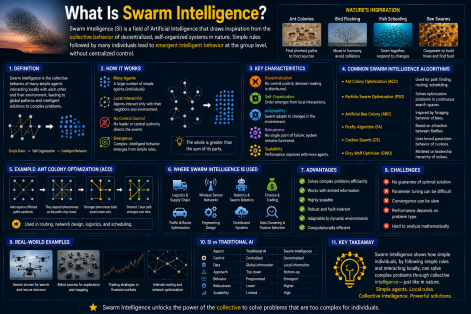
Swarm intelligence is a branch of artificial intelligence in which multiple simple agents work together to solve problems through decentralized cooperation and collective behavior.
Each agent follows a set of simple rules and interacts with other agents or the surrounding environment. There is no single leader directing the group. Instead, intelligent behavior emerges from the combined actions of all agents.
This approach is inspired by natural systems such as ant colonies, bee swarms, bird flocks, fish schools, and termite colonies.
How Does Swarm Intelligence Work?
Swarm intelligence follows a decentralized and collaborative process.
1. Create Multiple Agents
The system consists of many independent agents.
Examples include:
-
Software agents
-
Robots
-
Virtual particles
-
Simulated insects
-
Autonomous drones
Each agent operates independently.
2. Follow Simple Rules
Every agent follows straightforward behavioral rules, such as:
-
Move toward a goal
-
Avoid collisions
-
Share local information
-
Explore new areas
-
Respond to environmental changes
3. Interact with Other Agents
Agents exchange information directly or indirectly through the environment.
These interactions allow the group to coordinate without centralized control.
4. Reach a Collective Solution
As agents continuously adapt and cooperate, the swarm gradually converges toward an effective solution for the problem.
Common Types of Swarm Intelligence Algorithms
1. Particle Swarm Optimization (PSO)
Inspired by bird flocking and fish schooling, PSO uses particles that move through a search space while sharing information to locate optimal solutions.
2. Ant Colony Optimization (ACO)
Inspired by ants leaving pheromone trails, ACO identifies efficient paths for routing and optimization problems.
3. Artificial Bee Colony (ABC)
Based on the foraging behavior of honeybees, this algorithm balances exploration and exploitation while searching for optimal solutions.
4. Firefly Algorithm
Inspired by the flashing behavior of fireflies, agents move toward brighter and more attractive solutions during optimization.
Key Characteristics of Swarm Intelligence
1. Decentralized Control
There is no central authority controlling every agent.
2. Collective Intelligence
Complex solutions emerge from simple interactions among many agents.
3. Self-Organization
The swarm automatically adapts to changing conditions.
4. Scalability
Swarm systems can often handle increasing numbers of agents efficiently.
5. Robustness
The system can continue functioning even if some agents fail.
Common Applications of Swarm Intelligence
Swarm intelligence is widely used in:
-
Robotics
-
Drone coordination
-
Route optimization
-
Supply chain management
-
Traffic management
-
Telecommunications
-
Manufacturing optimization
-
Computer networks
-
Resource allocation
-
Data clustering
-
Autonomous vehicles
-
Scientific optimization
Benefits of Swarm Intelligence
Solves Complex Optimization Problems
Swarm algorithms can efficiently search large solution spaces.
Highly Scalable
Adding more agents often improves exploration without requiring centralized control.
Fault Tolerant
The failure of individual agents usually has little impact on overall system performance.
Adaptive
Swarm systems respond well to changing environments and dynamic conditions.
Simple Individual Rules
Each agent follows relatively simple behaviors while the group collectively produces sophisticated outcomes.
Challenges of Swarm Intelligence
Parameter Tuning
Algorithm performance depends on selecting appropriate parameters.
Convergence Speed
Some swarm algorithms may require many iterations to reach high-quality solutions.
Local Optima
The swarm may become trapped in suboptimal solutions if diversity decreases.
Computational Cost
Large-scale simulations involving thousands of agents can require substantial computing resources.
Human Expertise Required
Developers must carefully design swarm behavior, evaluate performance, and verify that solutions meet real-world requirements.
Swarm Intelligence vs Traditional AI
| Feature | Traditional AI | Swarm Intelligence |
|---|---|---|
| Control | Often centralized | Decentralized |
| Decision Making | Single model or controller | Collective behavior |
| Inspiration | Statistical learning or logic | Natural swarms |
| Scalability | Varies by model | Generally high |
| Best For | Prediction and reasoning | Optimization and coordination |
Best Practices for Swarm Intelligence
Choose the Right Algorithm
Select PSO, ACO, ABC, or another swarm algorithm based on the problem.
Maintain Agent Diversity
Encourage exploration to avoid premature convergence.
Optimize Parameters
Carefully tune settings such as population size, learning factors, and iteration limits.
Evaluate Performance
Compare swarm solutions with alternative optimization methods.
Continuously Improve the Model
Update parameters and strategies as the application evolves.
Future of Swarm Intelligence
Swarm intelligence is expected to become increasingly important as industries deploy larger networks of autonomous systems. Advances in robotics, drone technology, Internet of Things (IoT) devices, and distributed computing are creating new opportunities for decentralized coordination based on swarm principles.
Researchers are also combining swarm intelligence with machine learning, reinforcement learning, digital twins, and edge computing to develop more adaptive optimization systems. These hybrid approaches can improve resource allocation, route planning, energy management, disaster response, and large-scale autonomous operations.
As artificial intelligence continues to advance, swarm intelligence will remain a valuable technique for solving complex optimization and coordination problems. Combined with human expertise, responsible system design, and rigorous evaluation, it will support more efficient and resilient AI-powered solutions across many industries.
Conclusion
Swarm intelligence is an artificial intelligence approach inspired by the collective behavior of natural systems such as ant colonies, bird flocks, and bee swarms. By allowing many simple agents to cooperate without centralized control, it enables AI systems to solve complex optimization and coordination problems efficiently.
From robotics and logistics to telecommunications and scientific research, swarm intelligence has become a powerful method for tackling challenges that benefit from decentralized decision-making. Its scalability, adaptability, and fault tolerance make it suitable for many real-world applications.
As AI technology evolves, swarm intelligence will continue playing an important role in building intelligent systems capable of coordinating large numbers of autonomous agents while efficiently solving increasingly complex problems.