





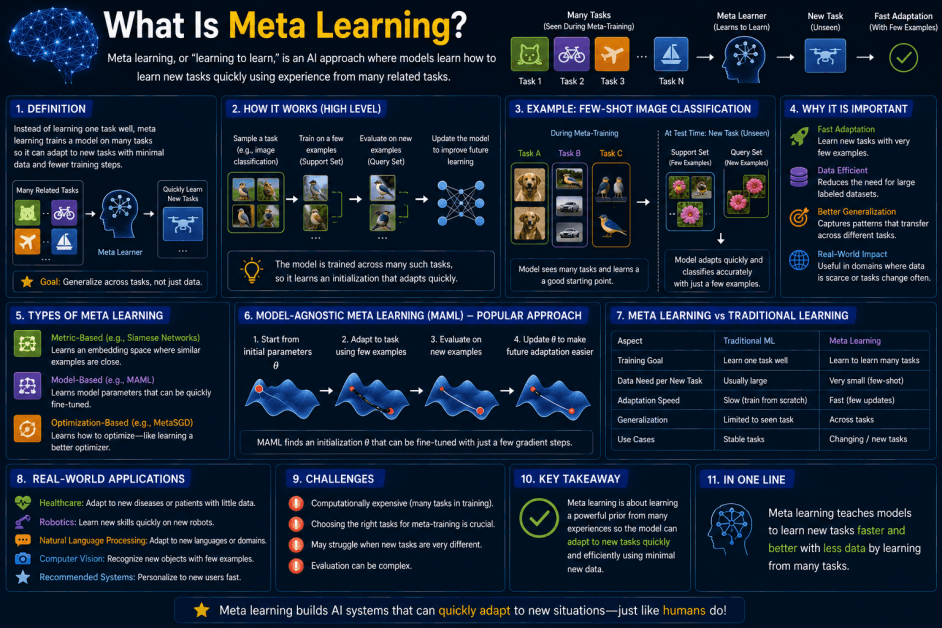
What Is Meta Learning? A Simple Guide
Traditional machine learning models often require large amounts of labeled data and extensive training before they can perform well on a specific task. Humans, however, can frequently learn new skills from only a few examples by applying knowledge gained from previous experiences. Meta learning aims to give AI systems a similar capability.
Often described as "learning to learn," meta learning enables AI models to leverage experience from multiple related tasks so they can quickly adapt to new tasks with minimal additional training. Rather than learning a single problem in isolation, the model learns strategies that make future learning faster and more efficient.
Today, meta learning is used in robotics, computer vision, natural language processing (NLP), healthcare, recommendation systems, autonomous systems, and scientific research. While it can significantly reduce the amount of task-specific data required, human expertise remains essential for designing learning strategies, evaluating performance, and deploying AI systems responsibly.
What Is Meta Learning?
Meta learning is a machine learning approach in which an AI model learns how to learn efficiently by using knowledge gained from solving many related tasks.
Instead of optimizing for only one task, the model is trained across multiple tasks to identify learning strategies that transfer well to new problems.
As a result, when the model encounters a new but related task, it can adapt quickly using only a small amount of new data.
How Does Meta Learning Work?
Meta learning generally involves two stages: meta-training and adaptation.
1. Train on Multiple Tasks
The model learns from many related tasks rather than focusing on a single dataset.
Examples include:
-
Image classification
-
Text classification
-
Speech recognition
-
Robot control
-
Recommendation systems
Each task helps the model develop a broader understanding of how to learn effectively.
2. Learn General Learning Strategies
Instead of memorizing task-specific solutions, the model identifies patterns that make learning easier across different problems.
This knowledge forms the basis for rapid adaptation.
3. Receive a New Task
The trained model is introduced to a previously unseen but related task.
Only a small amount of labeled data may be available.
4. Adapt Quickly
Using the knowledge gained during meta-training, the model fine-tunes itself with minimal additional data and computational effort.
Common Types of Meta Learning
1. Optimization-Based Meta Learning
The model learns parameter initializations that enable rapid adaptation to new tasks using only a few training steps.
2. Metric-Based Meta Learning
The model learns a similarity function that compares new examples with previously learned representations.
This approach is widely used in few-shot image classification.
3. Model-Based Meta Learning
The model incorporates specialized architectures or memory mechanisms that allow it to adapt quickly to new information.
4. Hybrid Meta Learning
Modern AI systems often combine multiple meta learning techniques to improve flexibility and performance.
Key Characteristics of Meta Learning
1. Learns How to Learn
The focus is on improving the learning process itself rather than solving only one task.
2. Adapts Quickly
Models require relatively little new data to learn related tasks.
3. Supports Few-Shot Learning
Meta learning is commonly used in scenarios where only a few labeled examples are available.
4. Transfers Knowledge
Experience gained from previous tasks helps improve performance on future tasks.
5. Improves Learning Efficiency
Models often require fewer training iterations and less labeled data than conventional approaches.
Common Applications of Meta Learning
Meta learning is widely used in:
-
Few-shot learning
-
Computer vision
-
Natural language processing (NLP)
-
Large Language Models (LLMs)
-
Robotics
-
Medical diagnosis support
-
Recommendation systems
-
Autonomous vehicles
-
Drug discovery
-
Financial forecasting
-
Personalized AI systems
-
Scientific research
Benefits of Meta Learning
Faster Adaptation
Models can learn new tasks much more quickly than traditional machine learning systems.
Reduces Data Requirements
Meta learning performs well even when only limited labeled data is available.
Improves Transfer Learning
Knowledge gained from previous tasks helps improve future learning.
Supports Personalized AI
Meta learning allows AI systems to adapt more effectively to individual users or changing environments.
Broad Industry Adoption
Researchers and organizations increasingly use meta learning to build more flexible AI solutions.
Challenges of Meta Learning
Complex Training Process
Training across many related tasks is often more complicated than conventional machine learning.
High Computational Cost
Meta-training may require substantial computing resources and time.
Task Selection Matters
The related tasks used during meta-training strongly influence future performance.
Generalization Limits
Meta learning works best when new tasks are reasonably related to the tasks encountered during training.
Human Expertise Required
Developers must design appropriate task collections, evaluate model behavior, and ensure responsible deployment.
Best Practices for Meta Learning
Use Diverse Training Tasks
Expose the model to a broad range of related tasks during meta-training.
Maintain High-Quality Data
Representative and well-labeled datasets improve adaptation performance.
Evaluate on Unseen Tasks
Measure how effectively the model learns completely new tasks rather than only familiar ones.
Fine-Tune Carefully
Adjust the model using task-specific data while avoiding overfitting.
Monitor Real-World Performance
Continue evaluating the model after deployment to ensure reliable adaptation.
Future of Meta Learning
Meta learning is expected to become increasingly important as AI systems are required to adapt quickly to new environments, users, and tasks. Researchers are developing more efficient meta learning algorithms that reduce computational costs while improving adaptability across a broader range of applications.
Future AI systems are likely to combine meta learning with foundation models, self-supervised learning, reinforcement learning, and multimodal AI to create systems that can continuously acquire new skills with minimal human intervention. These advances could accelerate progress in healthcare, robotics, autonomous systems, education, and scientific discovery.
As artificial intelligence continues to evolve, meta learning will remain a key research area for building flexible and adaptive AI. Together with high-quality data, rigorous evaluation, and responsible human oversight, it will help create intelligent systems capable of learning efficiently in changing real-world environments.
Conclusion
Meta learning is a machine learning approach that teaches AI systems how to learn efficiently across multiple related tasks. By leveraging previous experience, these models can adapt quickly to new challenges using only a small amount of additional data.
From robotics and computer vision to healthcare and personalized AI, meta learning is enabling faster adaptation and more efficient use of training data. Its focus on learning strategies rather than individual tasks makes it a powerful technique for building flexible AI systems.
As artificial intelligence continues to advance, meta learning will play an increasingly important role in developing AI models that can rapidly acquire new knowledge, solve unfamiliar problems, and perform effectively across a wide variety of real-world applications.
 What Is Meta Learning? AI Meta Learning Explained FAQs
POST A COMMENT (0)
All Comments (0)
Replies (0)