





What Is Neuro-Symbolic AI? A Simple Guide
Modern artificial intelligence has achieved remarkable success in tasks such as image recognition, language translation, and speech processing using deep learning. However, neural networks often struggle to explain their decisions or perform complex logical reasoning. Traditional Symbolic AI, on the other hand, excels at reasoning with rules and knowledge but lacks the ability to automatically learn from large amounts of data.
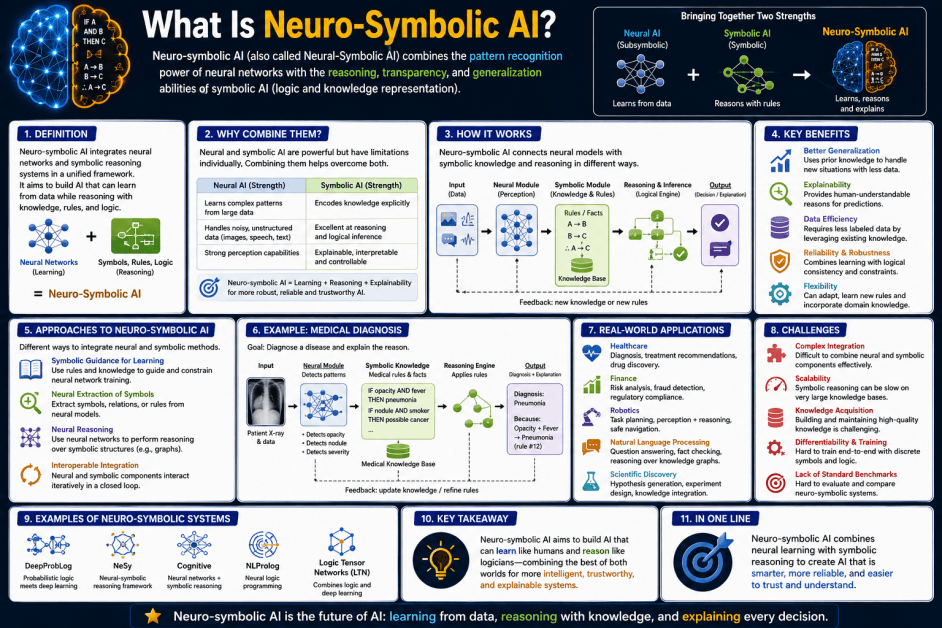
Neuro-Symbolic AI combines the strengths of both approaches. It integrates neural networks, which are excellent at recognizing patterns, with symbolic reasoning systems, which excel at logical thinking and explainable decision-making.
This hybrid approach is gaining attention in fields such as healthcare, robotics, scientific research, finance, autonomous systems, and enterprise AI because it aims to build systems that are both intelligent and transparent. Human experts remain essential for designing symbolic knowledge, validating outputs, and ensuring responsible AI deployment.
What Is Neuro-Symbolic AI?
Neuro-Symbolic AI is a hybrid artificial intelligence approach that combines neural networks with symbolic AI to solve complex problems.
The neural network component learns patterns from data, while the symbolic component applies logical rules, structured knowledge, and reasoning to interpret those patterns and make informed decisions.
This combination allows AI systems to both learn from experience and reason using explicit knowledge.
How Does Neuro-Symbolic AI Work?
Neuro-symbolic AI integrates learning and reasoning into a single workflow.
1. Learn from Data
Neural networks analyze large datasets such as:
-
Images
-
Text
-
Audio
-
Video
-
Sensor data
-
Medical records
They automatically learn patterns and generate meaningful feature representations.
2. Extract Knowledge
Important information identified by the neural network can be converted into structured representations such as:
-
Objects
-
Concepts
-
Relationships
-
Facts
-
Events
3. Apply Symbolic Reasoning
A symbolic reasoning engine uses predefined rules, logical relationships, and knowledge bases to interpret the extracted information.
For example:
-
Medical diagnosis rules
-
Financial compliance rules
-
Scientific knowledge graphs
-
Legal reasoning frameworks
4. Produce Explainable Decisions
The AI system combines learned patterns with logical reasoning to generate predictions that are often easier to interpret and justify than those from neural networks alone.
Key Components of Neuro-Symbolic AI
1. Neural Networks
Learn complex patterns directly from data through training.
2. Knowledge Base
Stores facts, rules, concepts, and relationships about a specific domain.
3. Symbolic Reasoning Engine
Applies logic and inference to the knowledge stored in the knowledge base.
4. Knowledge Representation
Organizes information using symbols, ontologies, semantic networks, or knowledge graphs.
5. Integration Layer
Connects neural learning with symbolic reasoning so both systems work together effectively.
Key Characteristics of Neuro-Symbolic AI
1. Combines Learning and Reasoning
Integrates statistical learning with logical inference.
2. More Explainable
Reasoning steps can often be traced and understood more easily than in purely neural models.
3. Learns from Data
Neural networks automatically identify patterns without requiring manual feature engineering.
4. Uses Explicit Knowledge
Logical rules and structured knowledge guide decision-making where appropriate.
5. Supports Complex Decision-Making
Suitable for applications requiring both perception and reasoning.
Common Applications of Neuro-Symbolic AI
Neuro-symbolic AI is increasingly used in:
-
Healthcare and clinical decision support
-
Scientific research
-
Drug discovery
-
Robotics
-
Autonomous vehicles
-
Legal technology
-
Financial services
-
Cybersecurity
-
Enterprise knowledge management
-
Intelligent virtual assistants
-
Knowledge graph reasoning
-
Manufacturing automation
Benefits of Neuro-Symbolic AI
Better Explainability
Logical reasoning makes decisions easier to interpret and audit.
Strong Pattern Recognition
Neural networks accurately process complex data such as images, speech, and text.
Improved Reasoning
Symbolic logic helps solve problems requiring structured thinking.
Supports Trustworthy AI
Explainable reasoning can improve transparency in high-stakes applications.
Combines Multiple AI Strengths
The hybrid approach takes advantage of both data-driven learning and rule-based reasoning.
Challenges of Neuro-Symbolic AI
Complex Integration
Combining neural networks with symbolic reasoning requires sophisticated system design.
Knowledge Engineering
Building and maintaining high-quality knowledge bases remains time-consuming.
Computational Demands
Running both neural learning and symbolic reasoning can increase computational requirements.
Limited Standardization
Research is ongoing, and there is no single architecture suitable for every application.
Human Expertise Required
Experts are needed to design rules, curate knowledge bases, evaluate model behavior, and ensure responsible deployment.
Neuro-Symbolic AI vs Traditional AI
| Feature | Neural Networks | Symbolic AI | Neuro-Symbolic AI |
|---|---|---|---|
| Learns from Data | Yes | No | Yes |
| Uses Logical Rules | No | Yes | Yes |
| Pattern Recognition | Excellent | Limited | Excellent |
| Explainability | Moderate to Low | High | Higher than purely neural systems |
| Best For | Images, speech, text | Rule-based reasoning | Learning and reasoning together |
Best Practices for Neuro-Symbolic AI
Use High-Quality Training Data
Reliable neural learning begins with representative and well-prepared datasets.
Build Accurate Knowledge Bases
Ensure symbolic knowledge is correct, current, and reviewed by domain experts.
Balance Learning and Reasoning
Allow neural and symbolic components to complement each other rather than compete.
Evaluate Explainability
Test whether reasoning steps remain understandable and consistent.
Continuously Update the System
Improve both learned models and symbolic rules as new data and domain knowledge become available.
Future of Neuro-Symbolic AI
Neuro-symbolic AI is expected to become an increasingly important direction for artificial intelligence as researchers seek systems that combine the adaptability of deep learning with the transparency of symbolic reasoning. Advances in foundation models, large language models, knowledge graphs, and automated reasoning are making these hybrid systems more practical across a wide range of industries.
Future neuro-symbolic AI systems are likely to support more advanced reasoning, better factual consistency, stronger explainability, and improved decision-making in fields such as healthcare, finance, robotics, education, cybersecurity, and scientific discovery. Researchers are also exploring ways to automate the creation of symbolic knowledge from data, reducing the need for manual knowledge engineering.
As AI continues to evolve, neuro-symbolic AI is expected to play a major role in building intelligent systems that can both understand complex information and explain how they arrive at their conclusions. Combined with human expertise, robust governance, and responsible AI practices, it offers a promising path toward more trustworthy and capable artificial intelligence.
Conclusion
Neuro-symbolic AI is a hybrid approach that combines the learning capabilities of neural networks with the reasoning abilities of symbolic AI. By integrating pattern recognition with logical inference, it enables AI systems to make more informed, explainable, and reliable decisions.
From healthcare and scientific research to robotics, finance, and enterprise AI, neuro-symbolic systems are helping solve problems that require both perception and reasoning. This combination addresses many limitations of traditional AI approaches while improving transparency and adaptability.
As artificial intelligence advances, neuro-symbolic AI is expected to become an increasingly important technology for developing trustworthy, explainable, and intelligent systems capable of solving complex real-world challenges.
 What Is Neuro-Symbolic AI? How Neural Networks and Symbolic AI Work Together FAQs
POST A COMMENT (0)
All Comments (0)
Replies (0)