





What Is Multi-Task Learning? A Simple Guide
Traditional machine learning models are typically designed to solve one specific problem at a time. For example, one model may identify objects in images, while another classifies text or predicts customer behavior. However, many real-world tasks are related and can benefit from learning together. Multi-task learning (MTL) enables AI systems to train on several related tasks simultaneously, allowing knowledge gained from one task to improve performance on others.
By sharing information across related tasks, multi-task learning often produces models that are more accurate, efficient, and capable of generalizing better to new data. It also reduces the need to build and maintain separate models for every task.
Today, multi-task learning is widely used in computer vision, natural language processing (NLP), speech recognition, healthcare, autonomous vehicles, recommendation systems, and robotics. Although it improves learning efficiency, human expertise remains essential for selecting compatible tasks, designing model architectures, and evaluating performance.
What Is Multi-Task Learning?
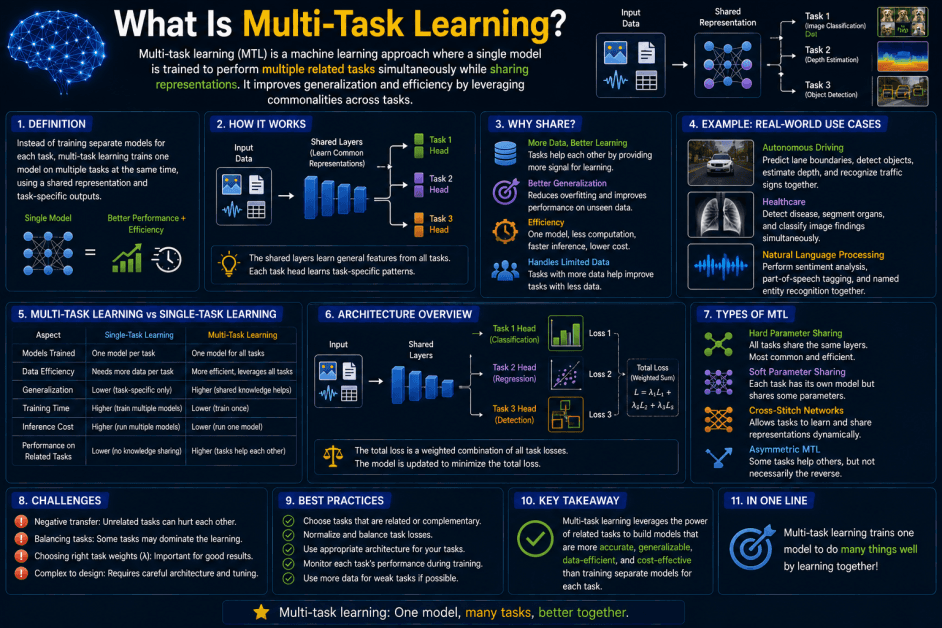
Multi-task learning is a machine learning approach in which a single AI model is trained to perform multiple related tasks at the same time.
Instead of learning each task independently, the model shares part of its knowledge across tasks while also maintaining task-specific components where necessary.
For example, a computer vision model might simultaneously:
-
Detect objects
-
Classify objects
-
Estimate object boundaries
-
Recognize scenes
Learning these tasks together often improves overall performance because they reinforce one another.
How Does Multi-Task Learning Work?
Multi-task learning combines shared learning with task-specific predictions.
1. Collect Training Data
The model receives data that supports multiple related tasks.
Examples include:
-
Images
-
Text documents
-
Audio recordings
-
Medical scans
-
Sensor data
-
Video clips
Each sample may contain labels for one or more tasks.
2. Learn Shared Features
The early layers of the neural network learn general patterns that are useful across multiple tasks.
Examples include:
-
Shapes
-
Language structure
-
Audio characteristics
-
Behavioral patterns
3. Perform Task-Specific Learning
Later parts of the network specialize in individual tasks.
For example, one output layer may classify images while another estimates object locations.
4. Optimize the Model
The model updates its parameters using feedback from all tasks, balancing shared knowledge with task-specific objectives.
Common Types of Multi-Task Learning
1. Hard Parameter Sharing
Several tasks share the same hidden layers, while each task has its own output layer.
This is the most common multi-task learning architecture.
2. Soft Parameter Sharing
Each task has its own model, but the models exchange information by encouraging similar parameters during training.
3. Hierarchical Multi-Task Learning
Tasks are organized according to their relationships, allowing simpler tasks to support more complex ones.
4. Adaptive Multi-Task Learning
Modern AI systems dynamically determine how much information should be shared between tasks during training.
Key Characteristics of Multi-Task Learning
1. Learns Multiple Tasks Simultaneously
A single model solves several related problems during training.
2. Shares Knowledge
Learning from one task helps improve performance on other related tasks.
3. Improves Generalization
Shared learning often reduces overfitting and improves performance on unseen data.
4. Reduces Resource Usage
One model can replace several independent models, reducing storage and maintenance requirements.
5. Supports Scalable AI Systems
Multi-task learning enables efficient deployment across complex applications requiring multiple predictions.
Common Applications of Multi-Task Learning
Multi-task learning is widely used in:
-
Computer vision
-
Image recognition
-
Object detection
-
Natural language processing (NLP)
-
Large Language Models (LLMs)
-
Speech recognition
-
Healthcare
-
Recommendation systems
-
Autonomous vehicles
-
Robotics
-
Financial forecasting
-
Predictive analytics
Benefits of Multi-Task Learning
Improves Model Performance
Related tasks reinforce one another, often leading to better accuracy.
Better Generalization
Shared representations help models perform more effectively on unseen data.
Efficient Resource Utilization
One model can perform multiple functions, reducing computational and storage requirements.
Reduces Training Costs
Organizations may train and maintain fewer models for related applications.
Supports Complex AI Systems
Many real-world AI applications naturally require multiple predictions from the same input.
Challenges of Multi-Task Learning
Task Compatibility
Unrelated tasks may interfere with one another and reduce performance.
Balancing Task Importance
Some tasks may dominate training if their objectives are not properly balanced.
Model Complexity
Designing effective shared and task-specific architectures requires careful planning.
Data Availability
Not every dataset contains labels for all desired tasks.
Human Expertise Required
Developers must choose suitable task combinations, monitor performance, and optimize the balance between shared and specialized learning.
Best Practices for Multi-Task Learning
Group Related Tasks
Combine tasks that naturally share information and underlying patterns.
Balance Training Objectives
Adjust task weights so that no single task dominates learning.
Monitor Individual Performance
Evaluate each task separately throughout training.
Use High-Quality Data
Representative datasets improve both shared and task-specific learning.
Continuously Optimize
Experiment with different architectures and sharing strategies to achieve the best results.
Future of Multi-Task Learning
Multi-task learning is becoming increasingly important as AI systems grow more capable and versatile. Researchers are developing adaptive architectures that automatically determine how much information should be shared between tasks, improving performance while reducing negative interference.
Foundation models and multimodal AI systems increasingly rely on multi-task learning to perform diverse functions such as text generation, translation, image understanding, question answering, speech recognition, and reasoning within a single model. These advances are making AI systems more flexible and efficient across industries.
As artificial intelligence continues to evolve, multi-task learning will remain a key technique for building scalable AI systems that can solve multiple related problems simultaneously. Combined with high-quality data, robust evaluation, and responsible human oversight, it will continue supporting more capable and adaptable machine learning models.
Conclusion
Multi-task learning is a machine learning approach that enables a single AI model to learn multiple related tasks at the same time. By sharing knowledge across tasks, it improves learning efficiency, enhances generalization, and often produces better performance than training separate models independently.
From computer vision and natural language processing to healthcare, robotics, and autonomous vehicles, multi-task learning has become an important technique for developing intelligent systems capable of handling complex real-world applications.
As AI technology advances, multi-task learning will continue playing a central role in building more efficient, scalable, and versatile artificial intelligence systems that can perform multiple functions using shared knowledge and experience.
 What Is Multi-Task Learning? AI Multi-Task Learning Explained FAQs
POST A COMMENT (0)
All Comments (0)
Replies (0)