





What Is Reinforcement Learning from Human Feedback (RLHF)? A Simple Guide
Modern artificial intelligence models can generate text, write code, answer questions, and perform many complex tasks. However, training an AI model only on large datasets does not always ensure that its responses are helpful, accurate, or aligned with human expectations. To address this challenge, researchers developed Reinforcement Learning from Human Feedback (RLHF).
RLHF combines machine learning with human evaluation to improve how AI models respond. Instead of learning only from data, the model also learns from feedback provided by people who rate or compare its outputs. This helps AI systems produce responses that are more useful, safer, and better aligned with human preferences.
Today, RLHF is widely used in large language models (LLMs), conversational AI, coding assistants, search systems, and other generative AI applications. While RLHF significantly improves AI behavior, human oversight remains essential for evaluating model performance, identifying biases, and ensuring responsible deployment.
What Is Reinforcement Learning from Human Feedback?
Reinforcement Learning from Human Feedback (RLHF) is a machine learning technique in which an AI model is improved using evaluations provided by human reviewers.
Rather than relying only on training data, the model receives feedback about which responses people prefer. This feedback is converted into a reward signal that guides the model toward generating more helpful and appropriate outputs.
RLHF combines three important ideas:
-
Supervised learning
-
Human preference feedback
-
Reinforcement learning
Together, these methods help align AI behavior with human expectations.
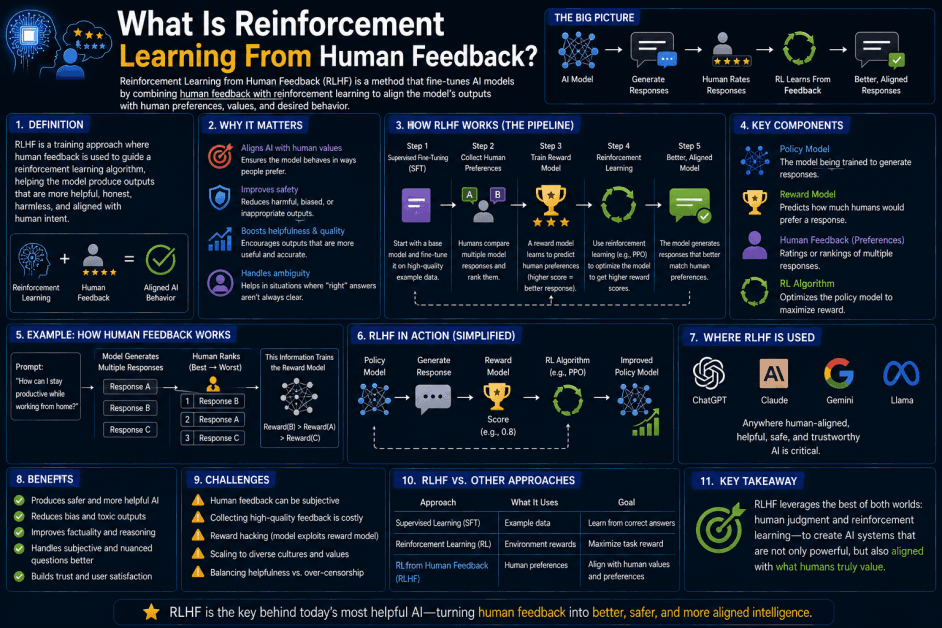
How Does RLHF Work?
RLHF typically follows a multi-stage training process.
1. Pretrain the Model
The AI model is first trained on a large collection of text, images, code, or other data to learn general patterns.
This stage gives the model broad knowledge but does not fully optimize its responses for human preferences.
2. Fine-Tune with Human Examples
Human-created examples are used to further train the model on desired behaviors.
These examples demonstrate how the AI should answer questions or perform tasks.
3. Collect Human Feedback
Human reviewers evaluate multiple responses generated by the model.
They may:
-
Rank responses from best to worst
-
Compare two or more answers
-
Rate helpfulness
-
Assess accuracy
-
Identify unsafe or inappropriate outputs
4. Train a Reward Model
The collected feedback is used to build a reward model that predicts which outputs people are likely to prefer.
This reward model acts as a guide during reinforcement learning.
5. Optimize the AI Model
Using reinforcement learning algorithms, the AI adjusts its behavior to maximize the reward predicted by the reward model.
Over time, the model learns to generate responses that better match human preferences.
Key Components of RLHF
1. Base Model
A pretrained AI model that provides the foundation for learning.
2. Human Feedback
Evaluations from human reviewers that indicate preferred responses.
3. Reward Model
A model that predicts how humans would evaluate AI-generated outputs.
4. Reinforcement Learning
An optimization process that updates the AI model using rewards derived from human feedback.
5. Continuous Evaluation
Regular testing and review help maintain quality, safety, and reliability.
Key Characteristics of RLHF
1. Human-Centered Learning
The model improves based on human judgments rather than relying solely on training data.
2. Preference Optimization
RLHF encourages responses that people find more useful, accurate, and appropriate.
3. Improves Alignment
The technique helps AI behavior better reflect intended human goals and expectations.
4. Supports Safer AI
Human feedback can reduce undesirable or harmful outputs, although it cannot eliminate them completely.
5. Iterative Improvement
The model continues to improve through repeated cycles of evaluation and optimization.
Common Applications of RLHF
Reinforcement Learning from Human Feedback is widely used in:
-
Large Language Models (LLMs)
-
AI chatbots
-
Virtual assistants
-
AI coding assistants
-
Search and question-answering systems
-
Content generation
-
Customer support automation
-
Educational AI tools
-
Translation systems
-
Research assistants
-
Enterprise AI applications
Benefits of RLHF
Produces More Helpful Responses
Human feedback helps AI generate answers that better meet user needs.
Improves AI Alignment
RLHF encourages behavior that is more consistent with human expectations and intended objectives.
Enhances User Experience
Models become more conversational, relevant, and easier to interact with.
Supports Safer AI Systems
Human reviewers can identify problematic behaviors and help reduce undesirable outputs during training.
Enables Continuous Improvement
New feedback can be incorporated over time to refine model performance.
Challenges of RLHF
Requires Extensive Human Effort
Collecting high-quality feedback from reviewers can be expensive and time-consuming.
Feedback Can Be Subjective
Different reviewers may have different opinions about the best response.
Scalability Challenges
Providing human evaluations for increasingly large AI models requires significant resources.
Risk of Bias
If feedback reflects biases, the reward model may also learn those biases.
Not a Complete Solution
RLHF improves AI alignment but does not guarantee perfect accuracy, reasoning, or safety. Ongoing monitoring and evaluation remain necessary.
Best Practices for RLHF
Use Diverse Human Reviewers
A broad range of reviewers helps capture varied perspectives and reduce bias.
Provide Clear Evaluation Guidelines
Consistent review standards improve the quality of collected feedback.
Continuously Update Reward Models
Refresh reward models using new feedback as user expectations evolve.
Monitor Model Performance
Regularly evaluate accuracy, helpfulness, fairness, and safety after deployment.
Combine Multiple Safety Techniques
Use RLHF alongside data quality improvements, model evaluation, safety testing, and responsible AI governance.
Future of Reinforcement Learning from Human Feedback
RLHF is expected to remain a key technique for improving generative AI as models become larger and more capable. Researchers are exploring methods that reduce the amount of human labeling required while maintaining strong alignment with user expectations. These approaches include AI-assisted feedback, constitutional AI, synthetic preference generation, and more efficient reinforcement learning algorithms.
Future AI systems are also expected to combine RLHF with foundation models, retrieval-augmented generation (RAG), neuro-symbolic reasoning, and advanced evaluation methods to improve factual accuracy, reasoning, personalization, and safety. Human oversight will continue to play an important role in reviewing outputs, refining reward models, and ensuring responsible AI deployment.
As artificial intelligence evolves, Reinforcement Learning from Human Feedback will remain an essential part of building AI systems that are more helpful, reliable, and aligned with human values across a wide range of real-world applications.
Conclusion
Reinforcement Learning from Human Feedback is a machine learning technique that improves AI models by incorporating evaluations from human reviewers. Instead of relying only on training data, RLHF teaches AI to generate responses that better reflect human preferences through a reward-based optimization process.
From conversational AI and coding assistants to search systems and enterprise applications, RLHF has become a foundational technique for aligning modern AI models with user expectations. While it does not eliminate every limitation, it significantly enhances the quality, usefulness, and safety of AI-generated responses.
As AI technology continues to advance, RLHF will remain an important approach for developing more trustworthy, user-focused, and responsible artificial intelligence systems.
 What Is Reinforcement Learning from Human Feedback (RLHF)? AI RLHF Explained FAQs
POST A COMMENT (0)
All Comments (0)
Replies (0)