





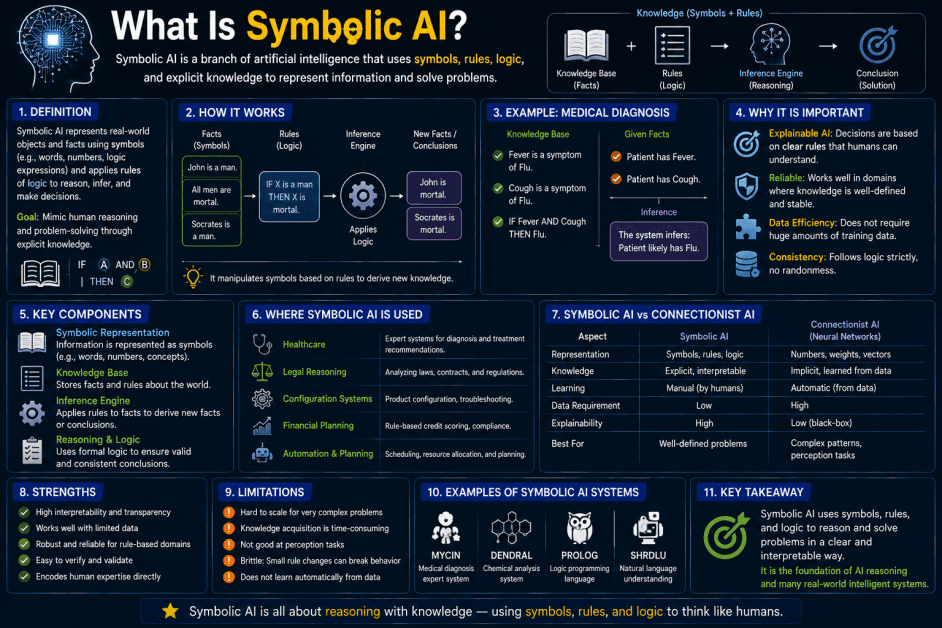
What Is Symbolic AI? A Simple Guide
Artificial intelligence has evolved through several approaches over the decades. While modern AI often relies on machine learning and deep learning, one of the earliest and most influential methods is Symbolic AI. Instead of learning from massive datasets, Symbolic AI uses explicit rules, logic, and knowledge to solve problems.
Often called Good Old-Fashioned Artificial Intelligence (GOFAI), Symbolic AI represents knowledge using symbols and applies logical reasoning to reach conclusions. Every decision is based on predefined rules rather than statistical patterns learned from data.
Although today's AI systems are largely driven by neural networks, Symbolic AI continues to play an important role in expert systems, business rule engines, knowledge graphs, legal reasoning, and applications where transparent decision-making is essential. Human experts remain responsible for creating, updating, and validating the rules that guide these systems.
What Is Symbolic AI?
Symbolic AI is an approach to artificial intelligence that represents knowledge using symbols, logical rules, and facts instead of learning patterns from data.
A Symbolic AI system stores information as structured knowledge and uses reasoning techniques to solve problems or answer questions.
For example, a simple rule might be:
-
If it is raining, then carry an umbrella.
The system follows this rule whenever the specified condition is true.
Unlike machine learning models that improve through training on data, Symbolic AI depends on carefully designed knowledge and logical inference.
How Does Symbolic AI Work?
Symbolic AI follows a structured reasoning process.
1. Represent Knowledge
Experts define facts, concepts, and relationships.
Examples include:
-
Objects
-
Events
-
Rules
-
Categories
-
Relationships
2. Create Logical Rules
The system is provided with rules that describe how decisions should be made.
For example:
-
If a customer has unpaid invoices, then block new orders.
-
If a patient has certain symptoms, then recommend additional tests.
3. Apply an Inference Engine
An inference engine examines the available facts and applies the appropriate rules.
It performs logical reasoning to derive conclusions or recommendations.
4. Produce a Decision
The AI system generates an output based on the matching rules and available knowledge.
Because every step follows explicit logic, the reasoning process can usually be explained and audited.
Key Components of Symbolic AI
1. Knowledge Base
Stores facts, concepts, and relationships about a specific domain.
2. Rules
Logical statements that determine how decisions are made.
3. Inference Engine
Applies logical reasoning to the knowledge base to generate conclusions.
4. Knowledge Representation
Methods such as semantic networks, ontologies, and logical expressions organize information in a structured way.
Key Characteristics of Symbolic AI
1. Rule-Based Decision Making
Every decision is guided by predefined logical rules.
2. Explainable Results
The reasoning behind decisions can usually be traced and understood.
3. Human-Defined Knowledge
Experts manually create and maintain the knowledge base.
4. Logical Reasoning
The system derives conclusions through inference rather than statistical learning.
5. Domain Specific
Symbolic AI performs best in areas with well-defined rules and structured knowledge.
Common Applications of Symbolic AI
Symbolic AI is widely used in:
-
Expert systems
-
Medical decision support
-
Legal reasoning
-
Tax and compliance software
-
Financial rule engines
-
Knowledge graphs
-
Business process automation
-
Industrial control systems
-
Configuration systems
-
Educational tutoring systems
-
Diagnostic systems
-
Intelligent search
Benefits of Symbolic AI
Highly Explainable
Every decision can usually be traced back to specific rules and facts.
Reliable for Rule-Based Problems
It performs well when decisions follow clear logical procedures.
Easy to Audit
Organizations can inspect and verify the reasoning process.
No Massive Training Data Required
Unlike many machine learning models, Symbolic AI does not depend on large datasets for training.
Consistent Decision Making
The same inputs produce the same outputs when the rules remain unchanged.
Challenges of Symbolic AI
Difficult to Scale
Creating and maintaining thousands of rules becomes increasingly complex.
Limited Learning Ability
Traditional Symbolic AI cannot automatically learn from new data or experiences.
Knowledge Engineering Is Time-Consuming
Experts must manually define and update the knowledge base.
Struggles with Ambiguity
Real-world situations often contain uncertainty that is difficult to express using fixed rules.
Less Effective for Unstructured Data
Tasks involving images, speech, or natural language generally require statistical or neural approaches.
Symbolic AI vs Machine Learning
| Feature | Symbolic AI | Machine Learning |
|---|---|---|
| Learning Method | Uses predefined rules | Learns from data |
| Knowledge Source | Human experts | Training datasets |
| Decision Process | Logical reasoning | Statistical prediction |
| Explainability | Usually high | Often lower, depending on the model |
| Best For | Rule-based problems | Pattern recognition and prediction |
Best Practices for Symbolic AI
Build a High-Quality Knowledge Base
Ensure facts and rules are accurate, complete, and regularly updated.
Keep Rules Organized
Structure rules logically to simplify maintenance and reduce conflicts.
Validate Expert Knowledge
Review rules with domain specialists to maintain reliability.
Combine with Modern AI
Use Symbolic AI alongside machine learning when applications require both reasoning and pattern recognition.
Continuously Review Performance
Update rules as regulations, business processes, or domain knowledge evolve.
Future of Symbolic AI
Symbolic AI is experiencing renewed interest as organizations seek AI systems that are more transparent, explainable, and trustworthy. Researchers are increasingly combining symbolic reasoning with machine learning to create neuro-symbolic AI, which blends logical reasoning with the pattern recognition capabilities of neural networks.
These hybrid systems aim to improve reasoning, factual consistency, explainability, and decision-making across applications such as healthcare, finance, scientific research, robotics, and autonomous systems. They also support AI governance by making decisions easier to audit and understand.
As artificial intelligence continues to advance, Symbolic AI will remain an important part of the AI landscape. Together with modern machine learning techniques, it is expected to help build intelligent systems that are both powerful and explainable.
Conclusion
Symbolic AI is one of the foundational approaches to artificial intelligence. Instead of learning from large datasets, it uses symbols, logical rules, and structured knowledge to solve problems and make decisions.
Although modern AI is increasingly driven by machine learning and deep learning, Symbolic AI continues to be valuable in domains where explainability, consistency, and rule-based reasoning are essential. Its ability to produce transparent decisions makes it especially useful in industries such as healthcare, finance, law, and enterprise software.
As AI technology evolves, Symbolic AI is expected to work alongside neural networks through neuro-symbolic approaches, combining human knowledge with data-driven learning to create more capable and trustworthy intelligent systems.
 What Is Symbolic AI? How Rule-Based Artificial Intelligence Works FAQs
POST A COMMENT (0)
All Comments (0)
Replies (0)