What Is Self-Supervised Learning? A Simple Guide
Modern artificial intelligence (AI) systems require enormous amounts of data to learn useful patterns. Traditionally, many machine learning models relied on labeled datasets, where humans manually identify the correct answers for each training example. Creating these labels can be expensive, time-consuming, and difficult to scale.
Self-supervised learning offers a different approach. Instead of relying on manually labeled data, it creates learning tasks directly from the data itself. By predicting missing or hidden parts of the data, AI models can learn meaningful representations that can later be adapted to a wide range of real-world applications.
Today, self-supervised learning is a key technology behind many foundation models, large language models (LLMs), computer vision systems, speech recognition models, and multimodal AI. Although it significantly reduces the need for labeled data, human expertise remains essential for designing training objectives, evaluating performance, and deploying models responsibly.
What Is Self-Supervised Learning?
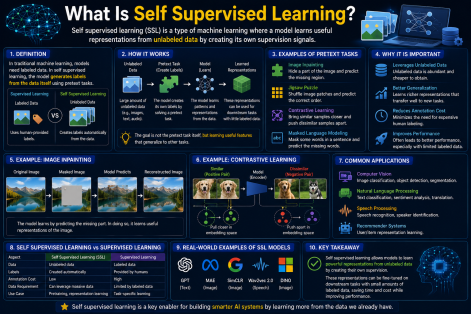
Self-supervised learning is a machine learning approach in which an AI model learns from unlabeled data by generating its own training signals.
Instead of receiving answers from human-created labels, the model creates a prediction task using the data itself. For example, it may predict a missing word in a sentence, estimate a masked portion of an image, or reconstruct missing parts of an audio recording.
By solving these automatically generated tasks, the model learns general knowledge and useful patterns that can later be fine-tuned for specific applications.
How Does Self-Supervised Learning Work?
Self-supervised learning typically follows several stages.
1. Collect Unlabeled Data
The model is trained using large collections of raw data.
Examples include:
-
Text documents
-
Images
-
Audio recordings
-
Videos
-
Sensor data
-
Scientific datasets
2. Create a Learning Task
Instead of human labels, the system automatically creates a prediction objective.
Examples include:
-
Predict the next word in a sentence
-
Fill in missing words
-
Predict masked image regions
-
Reconstruct missing audio segments
-
Match related image and text pairs
3. Learn Representations
The model learns patterns, relationships, and structures by solving these prediction tasks repeatedly.
This stage helps the model build general knowledge that can be reused later.
4. Fine-Tune for Specific Tasks
After self-supervised pretraining, the model can be adapted using a smaller labeled dataset for tasks such as:
-
Text classification
-
Image recognition
-
Speech transcription
-
Medical diagnosis support
-
Fraud detection
Common Types of Self-Supervised Learning
1. Masked Prediction
The model predicts hidden parts of the input.
Examples include masked words in text or masked regions in images.
2. Next-Token Prediction
The model predicts the next word, token, or symbol in a sequence.
This approach is widely used for many generative language models.
3. Contrastive Learning
The model learns to identify similar and dissimilar data samples by comparing different representations.
This technique is widely used in computer vision and multimodal AI.
4. Reconstruction Learning
The model learns to recreate original data after parts have been removed, distorted, or corrupted.
Key Characteristics of Self-Supervised Learning
1. Uses Unlabeled Data
Most training data does not require manual human annotation.
2. Generates Its Own Labels
The model automatically creates prediction tasks from the available data.
3. Learns General Representations
The model develops reusable knowledge that can support many downstream applications.
4. Supports Transfer Learning
Self-supervised models are commonly fine-tuned for specialized tasks.
5. Scales Efficiently
Large quantities of publicly available data can be used without extensive labeling efforts.
Common Applications of Self-Supervised Learning
Self-supervised learning is widely used in:
-
Large Language Models (LLMs)
-
Foundation models
-
Natural language processing (NLP)
-
Computer vision
-
Image recognition
-
Speech recognition
-
Medical imaging
-
Robotics
-
Recommendation systems
-
Autonomous vehicles
-
Scientific research
-
Multimodal AI
Benefits of Self-Supervised Learning
Reduces Labeling Costs
Large amounts of unlabeled data can be used without expensive manual annotation.
Learns Rich Representations
Models develop broad knowledge that transfers well to many tasks.
Improves Performance
Fine-tuned self-supervised models often outperform models trained only on small labeled datasets.
Supports Large AI Models
Self-supervised learning is a foundational training method for many modern foundation models and LLMs.
Scales to Massive Datasets
Organizations can take advantage of vast collections of publicly available or proprietary data.
Challenges of Self-Supervised Learning
High Computational Requirements
Training large self-supervised models often requires significant computing resources.
Designing Effective Learning Tasks
The automatically generated prediction tasks must encourage meaningful learning.
Data Quality Matters
Large amounts of low-quality or biased data can reduce model performance.
Fine-Tuning Is Often Required
Pretrained models usually need additional supervised training for specific applications.
Human Expertise Required
Developers must evaluate model behavior, monitor for bias, and ensure responsible deployment.
Best Practices for Self-Supervised Learning
Use High-Quality Data
Collect diverse and representative datasets to improve learning.
Select Appropriate Pretext Tasks
Choose prediction objectives that encourage meaningful feature learning.
Fine-Tune Carefully
Adapt the pretrained model using high-quality labeled data for the target application.
Evaluate Thoroughly
Measure model performance using independent validation and test datasets.
Monitor Fairness and Reliability
Assess models for bias, robustness, and real-world performance before deployment.
Future of Self-Supervised Learning
Self-supervised learning is becoming one of the most influential training approaches in modern AI. As foundation models continue to grow in scale, researchers are developing more efficient self-supervised methods that require fewer computational resources while learning from increasingly diverse types of data.
Future advances are expected to improve multimodal learning, enabling AI systems to jointly understand text, images, audio, video, and other forms of information. Researchers are also exploring domain-specific self-supervised models for healthcare, scientific discovery, engineering, and climate research, where labeled data is often limited.
As artificial intelligence continues to evolve, self-supervised learning will remain a key technology for building adaptable and scalable AI systems. Combined with high-quality data, responsible evaluation, and human oversight, it will continue driving advances across a wide range of AI applications.
Conclusion
Self-supervised learning is a machine learning approach that enables AI models to learn from unlabeled data by generating their own training tasks. This method reduces the need for manual annotation while allowing models to develop rich, reusable representations that can be adapted to many downstream applications.
From foundation models and large language models to computer vision and speech recognition, self-supervised learning has become a cornerstone of modern AI development. Its ability to scale using vast amounts of available data has accelerated progress across many fields.
As AI systems become more capable and data-intensive, self-supervised learning will continue to play a central role in building intelligent, efficient, and versatile models that can address increasingly complex real-world challenges.