





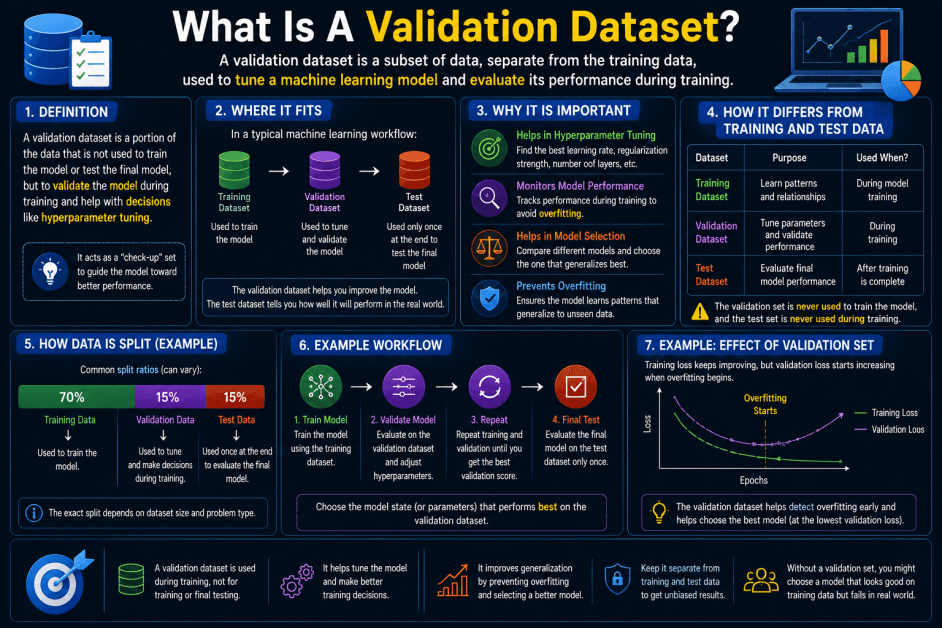
What Is a Validation Dataset? A Simple Guide
Building an accurate artificial intelligence (AI) model involves more than simply training it on large amounts of data. Developers also need a way to evaluate how well the model is learning during training without exposing it to the final testing data. This is where a validation dataset becomes essential.
A validation dataset is a separate portion of data used to evaluate an AI model while it is being trained. It helps developers monitor performance, tune model settings, and detect problems such as overfitting before the model is deployed.
Today, validation datasets are used in nearly every machine learning and deep learning project, including computer vision, natural language processing (NLP), speech recognition, recommendation systems, healthcare, finance, and autonomous vehicles. Although validation data provides valuable feedback, human expertise remains essential for interpreting results and making decisions about model improvements.
What Is a Validation Dataset?
A validation dataset is a subset of labeled data that is kept separate from the training dataset and used to evaluate a machine learning model during the training process.
Unlike the training dataset, the validation dataset is not used to update the model's weights and biases. Instead, it measures how well the model performs on data it has not seen during learning.
Developers use validation results to adjust hyperparameters such as the learning rate, batch size, number of epochs, regularization methods, and neural network architecture.
How Does a Validation Dataset Work?
A validation dataset plays an important role throughout model development.
1. Split the Data
The available dataset is divided into separate portions.
A common split is:
-
Training dataset
-
Validation dataset
-
Test dataset
2. Train the Model
The AI model learns patterns using only the training dataset.
During this stage, the model updates its internal parameters based on prediction errors.
3. Evaluate on Validation Data
After each training cycle (or after several epochs), the model is tested using the validation dataset.
Performance metrics may include:
-
Accuracy
-
Loss
-
Precision
-
Recall
-
F1 Score
These results help developers understand how well the model generalizes.
4. Improve the Model
Based on validation performance, developers may:
-
Adjust the learning rate
-
Change the batch size
-
Modify the model architecture
-
Add regularization
-
Apply early stopping
-
Continue or stop training
This process repeats until satisfactory validation performance is achieved.
Difference Between Training, Validation, and Test Datasets
Training Dataset
-
Used to teach the AI model.
-
Updates model weights and biases.
-
Usually the largest portion of the data.
Validation Dataset
-
Used during training.
-
Evaluates model performance.
-
Helps tune hyperparameters.
-
Does not update model parameters.
Test Dataset
-
Used only after training is complete.
-
Measures the final performance of the trained model.
-
Provides an unbiased evaluation before deployment.
Key Characteristics of a Validation Dataset
1. Separate from Training Data
Validation samples are never used to train the model directly.
2. Used During Training
The validation dataset evaluates learning progress while training is still ongoing.
3. Supports Hyperparameter Tuning
Validation results help developers select the best training settings.
4. Detects Overfitting
Validation performance often reveals when a model begins memorizing the training data instead of learning general patterns.
5. Improves Model Reliability
Using validation data helps build AI systems that perform more consistently on unseen data.
Common Applications of Validation Datasets
Validation datasets are used across many AI applications, including:
-
Image recognition
-
Computer vision
-
Natural language processing (NLP)
-
Large Language Models (LLMs)
-
Speech recognition
-
Medical diagnosis support
-
Recommendation systems
-
Fraud detection
-
Autonomous vehicles
-
Financial forecasting
-
Robotics
-
Predictive analytics
Benefits of Using a Validation Dataset
Improves Model Generalization
Validation data helps ensure that the model performs well beyond its training examples.
Detects Overfitting Early
Developers can identify when training should stop before the model begins memorizing the data.
Supports Better Hyperparameter Selection
Validation performance guides decisions about learning rate, batch size, dropout, regularization, and other training settings.
Enables Fair Performance Monitoring
Validation data provides a consistent benchmark throughout training.
Increases Model Reliability
Models tuned using validation datasets generally perform better in real-world applications.
Challenges of Validation Datasets
Choosing the Right Size
A validation dataset that is too small may not accurately represent real-world data, while one that is too large reduces the amount of data available for training.
Maintaining Data Quality
Validation data should be representative, unbiased, and accurately labeled.
Preventing Data Leakage
Information from the validation dataset must not accidentally influence the training process.
Computational Cost
Evaluating models on validation data after many epochs can increase training time.
Human Expertise Required
Developers must correctly interpret validation metrics and decide how to adjust the model.
Best Practices for Using Validation Datasets
Keep Validation Data Separate
Never use validation samples for model training.
Use Representative Data
Ensure the validation dataset reflects the same distribution as real-world data.
Monitor Multiple Metrics
Track validation loss, accuracy, precision, recall, and other relevant metrics rather than relying on a single measure.
Apply Early Stopping
Stop training when validation performance stops improving to reduce overfitting.
Reserve a Separate Test Dataset
Always evaluate the final model using an independent test dataset after validation is complete.
Future of Validation Datasets
Validation datasets will continue to play a critical role as AI models become larger and more sophisticated. Modern machine learning systems increasingly use automated validation workflows that continuously monitor model performance and recommend adjustments to hyperparameters during training.
Advanced evaluation techniques such as cross-validation, automated hyperparameter optimization, and continuous model monitoring are helping developers build more reliable AI systems while reducing manual experimentation. These methods are especially valuable for large language models, computer vision systems, healthcare applications, and other high-impact AI solutions.
As artificial intelligence continues to evolve, validation datasets will remain essential for ensuring model quality, fairness, and robustness. Combined with high-quality training data, independent testing, and responsible human oversight, they help developers create AI systems that perform reliably in real-world environments.
Conclusion
A validation dataset is an essential component of machine learning and deep learning because it allows developers to evaluate model performance during training without influencing the learning process. It provides valuable feedback for selecting hyperparameters, detecting overfitting, and improving generalization.
By separating training, validation, and test datasets, AI developers can build models that are more accurate, reliable, and capable of performing well on unseen data. Validation datasets also support best practices such as early stopping and hyperparameter tuning, making them a cornerstone of modern AI development.
As artificial intelligence continues advancing, validation datasets will remain fundamental to creating trustworthy and high-performing machine learning systems.
 What Is a Validation Dataset? AI Validation Dataset Explained FAQs
POST A COMMENT (0)
All Comments (0)
Replies (0)