





What Is Model Accuracy? A Simple Guide
Artificial intelligence (AI) models are designed to make predictions, classify data, or generate outputs based on patterns learned during training. Once a model has been trained, developers need a way to measure how well it performs. One of the most commonly used evaluation metrics is model accuracy.
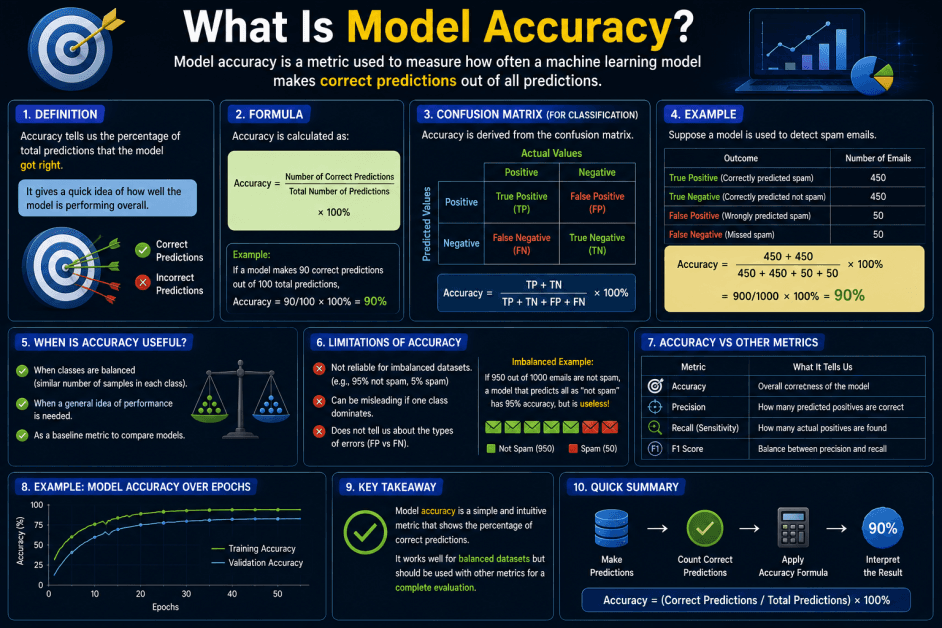
Model accuracy measures how often an AI model makes correct predictions compared with the total number of predictions it makes. It provides a straightforward way to evaluate performance, particularly for classification tasks where each prediction can be clearly identified as correct or incorrect.
Today, model accuracy is widely used in computer vision, natural language processing (NLP), healthcare, finance, fraud detection, recommendation systems, and many other AI applications. Although accuracy is an important metric, it should often be considered alongside other evaluation measures to provide a more complete picture of model performance.
What Is Model Accuracy?
Model accuracy is the percentage of correct predictions made by a machine learning model out of all predictions it makes.
In simple terms, it answers the question:
"How often does the model get the answer right?"
The standard formula is:
Accuracy = (Number of Correct Predictions ÷ Total Number of Predictions) × 100%
For example:
-
Total predictions: 1,000
-
Correct predictions: 950
Accuracy = (950 ÷ 1,000) × 100 = 95%
This means the model correctly predicted the outcome 95% of the time.
How Is Model Accuracy Measured?
Accuracy is typically calculated after training using a validation or test dataset.
1. Train the Model
The AI model learns patterns from the training dataset.
Examples include:
-
Images
-
Text
-
Audio
-
Medical records
-
Financial transactions
2. Make Predictions
The trained model processes previously unseen data from a validation or test dataset.
3. Compare Predictions
Each prediction is compared with the correct (ground truth) label.
Predictions are classified as:
-
Correct
-
Incorrect
4. Calculate Accuracy
The number of correct predictions is divided by the total number of predictions to produce the accuracy score.
Developers often monitor this score throughout model development to evaluate improvements.
Why Is Model Accuracy Important?
1. Measures Overall Performance
Accuracy provides a simple indicator of how well a model performs.
2. Compares Different Models
Developers can compare multiple AI models and select the one that performs best.
3. Supports Model Improvement
Changes to hyperparameters or architectures can be evaluated using accuracy scores.
4. Helps Validate Training
Increasing validation accuracy generally indicates that the model is learning useful patterns.
5. Guides Deployment Decisions
Accuracy is one of several metrics used to determine whether a model is ready for real-world use.
Accuracy vs Other Evaluation Metrics
While accuracy is valuable, it is not always sufficient on its own.
Precision
Measures how many positive predictions are actually correct.
Recall
Measures how many actual positive cases the model successfully identifies.
F1 Score
Balances precision and recall into a single metric.
ROC-AUC
Evaluates how well a classification model distinguishes between classes across different thresholds.
For datasets where one class is much more common than another (known as imbalanced datasets), precision, recall, and F1 score often provide more meaningful insights than accuracy alone.
Common Applications of Model Accuracy
Model accuracy is widely used in:
-
Image classification
-
Computer vision
-
Natural language processing (NLP)
-
Large Language Models (LLMs)
-
Spam detection
-
Fraud detection
-
Medical diagnosis support
-
Speech recognition
-
Recommendation systems
-
Autonomous vehicles
-
Predictive analytics
-
Financial forecasting
Benefits of Model Accuracy
Easy to Understand
Accuracy is simple to calculate and interpret.
Useful for Model Comparison
It provides a consistent benchmark when comparing multiple models.
Supports Training Decisions
Developers can monitor accuracy to evaluate the impact of model improvements.
Works Well for Balanced Datasets
Accuracy is particularly informative when all classes are represented in similar proportions.
Widely Supported
Nearly every machine learning framework reports accuracy during model evaluation.
Limitations of Model Accuracy
Can Be Misleading
A high accuracy score does not always mean a model performs well, especially on imbalanced datasets.
Ignores Error Types
Accuracy treats all errors equally, even when some mistakes are more serious than others.
Not Suitable for Every Problem
Tasks such as medical diagnosis or fraud detection often require additional evaluation metrics.
Depends on Data Quality
Poor-quality or biased datasets can produce misleading accuracy scores.
Requires Human Interpretation
Developers should interpret accuracy alongside business goals, domain knowledge, and other evaluation metrics.
Best Practices for Evaluating Model Accuracy
Use a Separate Test Dataset
Always calculate final accuracy using data the model has never seen before.
Combine Multiple Metrics
Evaluate precision, recall, F1 score, and other metrics in addition to accuracy.
Check for Data Imbalance
Ensure the dataset represents all classes appropriately before relying on accuracy alone.
Monitor Validation Accuracy
Track validation accuracy during training to identify overfitting or underfitting.
Evaluate Real-World Performance
Test the model in realistic conditions to confirm that its accuracy translates to practical applications.
Future of Model Accuracy
As AI systems become more advanced, model evaluation is evolving beyond a single accuracy score. Modern AI development increasingly relies on comprehensive evaluation frameworks that measure fairness, robustness, reliability, explainability, and performance across diverse datasets.
Large language models, multimodal AI systems, and autonomous applications often require specialized benchmarks that combine accuracy with task-specific metrics. Automated evaluation tools are also helping developers monitor model performance continuously after deployment to detect changes in accuracy over time.
Despite these advances, model accuracy will remain one of the most fundamental indicators of AI performance. When combined with other evaluation metrics, high-quality data, and responsible human oversight, it provides valuable insight into how effectively a model performs its intended task.
Conclusion
Model accuracy is one of the most widely used metrics for evaluating machine learning and deep learning models. It measures the percentage of correct predictions made by a model and provides a simple way to assess overall performance.
Although accuracy is easy to understand and highly useful for many classification problems, it should not be the only measure used to evaluate AI systems. Combining accuracy with metrics such as precision, recall, and F1 score leads to a more complete understanding of model quality.
As artificial intelligence continues to evolve, model accuracy will remain a core component of AI evaluation, helping developers build systems that are accurate, reliable, and effective in real-world applications.
 What Is Model Accuracy? AI Model Accuracy Explained FAQs
POST A COMMENT (0)
All Comments (0)
Replies (0)