





What Is Dropout in Neural Networks? A Simple Guide
Deep learning models often contain millions or even billions of parameters, allowing them to recognize complex patterns in data. However, highly complex neural networks can sometimes memorize the training data instead of learning general patterns. This issue, known as overfitting, reduces a model's ability to perform well on new, unseen data.
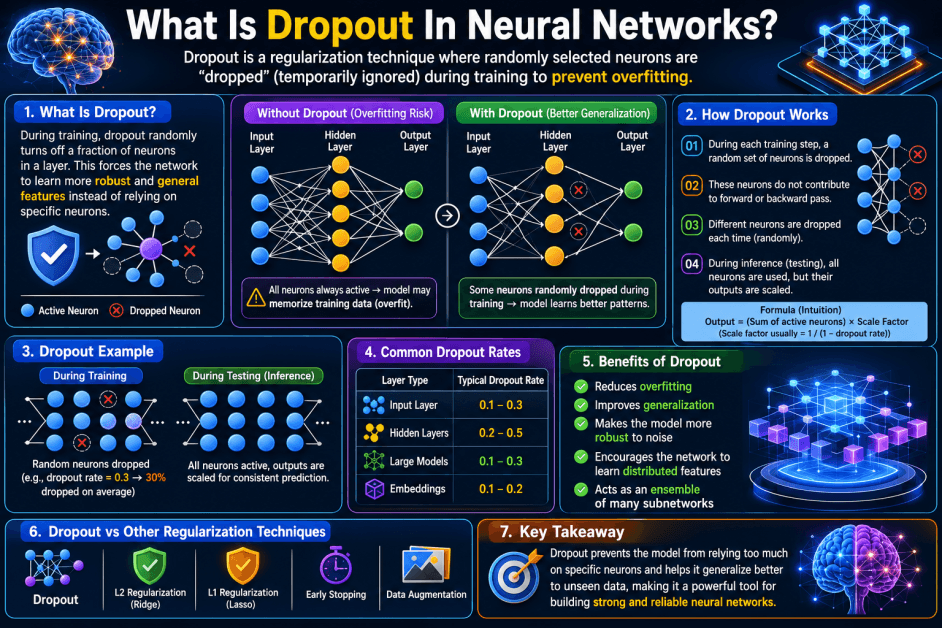
One of the most widely used techniques to address this problem is dropout. Dropout is a regularization method that temporarily disables a random subset of neurons during training, encouraging the neural network to learn more robust and generalized features rather than relying on a few specific neurons.
Today, dropout is widely used in computer vision, natural language processing (NLP), speech recognition, recommendation systems, medical AI, and many other deep learning applications. Although dropout improves model generalization, developers must carefully configure it based on the neural network architecture and training objectives.
What Is Dropout in Neural Networks?
Dropout is a regularization technique used during deep learning training that randomly deactivates a percentage of neurons in a neural network during each training step.
When neurons are temporarily removed, the network cannot depend on the same pathways every time it learns. Instead, it develops multiple ways of recognizing patterns, making it more resilient and less likely to overfit the training data.
Importantly, dropout is only applied during training. During inference (when the trained model makes predictions), all neurons are active so the model can use everything it has learned.
How Does Dropout Work?
Dropout operates throughout the training process.
1. Feed Training Data
The neural network receives a batch of training examples.
Examples include:
-
Images
-
Text
-
Audio
-
Sensor data
-
Medical records
-
Financial transactions
2. Randomly Disable Neurons
Before processing the data, a randomly selected percentage of neurons is temporarily switched off.
For example:
-
Dropout rate = 20%
-
About 20% of eligible neurons are ignored during that training step.
-
The remaining 80% continue processing normally.
A new random set of neurons is selected for the next training step.
3. Learn with Remaining Neurons
The active neurons make predictions and calculate the loss.
Because different neurons are active each time, the network learns multiple independent representations of the data.
4. Update the Model
Optimization algorithms update the network's weights based only on the active neurons.
The process repeats for every batch throughout training.
During inference, dropout is disabled and all neurons contribute to the final prediction.
Why Is Dropout Important?
1. Prevents Overfitting
Dropout reduces the likelihood that the network memorizes the training data.
2. Improves Generalization
Models trained with dropout often perform better on previously unseen data.
3. Reduces Neuron Dependency
Individual neurons become less dependent on one another, creating more robust feature representations.
4. Supports Large Neural Networks
Dropout is especially valuable for deep neural networks with many layers and parameters.
5. Enhances Model Reliability
Dropout helps build models that perform consistently across different datasets and environments.
Common Dropout Rates
Typical dropout rates include:
-
0.1–0.2 (10–20%) – Light regularization
-
0.3–0.5 (30–50%) – Common for hidden layers
-
Above 0.5 – Strong regularization, used selectively depending on the model
The optimal dropout rate varies depending on the dataset, neural network architecture, and training task.
Common Applications of Dropout
Dropout is widely used in deep learning applications, including:
-
Image recognition
-
Computer vision
-
Natural language processing (NLP)
-
Large Language Models (LLMs)
-
Speech recognition
-
Medical image analysis
-
Recommendation systems
-
Fraud detection
-
Autonomous vehicles
-
Robotics
-
Financial forecasting
-
Predictive analytics
Benefits of Dropout
Reduces Overfitting
Dropout encourages the network to learn general patterns instead of memorizing training examples.
Improves Generalization
Models often perform better on new and unseen datasets.
Creates More Robust Networks
The model becomes less reliant on individual neurons, making it more resilient.
Simple to Implement
Most modern deep learning frameworks include dropout as a standard neural network layer.
Works Well with Other Regularization Methods
Dropout is commonly combined with L2 regularization, data augmentation, batch normalization, and early stopping.
Challenges of Dropout
Selecting the Right Dropout Rate
A rate that is too low may not sufficiently reduce overfitting, while a rate that is too high can slow learning or reduce model accuracy.
Longer Training Time
Because fewer neurons are active during each training step, convergence may require more epochs.
Not Suitable Everywhere
Some neural network architectures benefit less from dropout or rely more heavily on alternative regularization techniques.
Hyperparameter Tuning
Developers often need to experiment with different dropout rates for optimal performance.
Human Expertise Required
Choosing where and how much dropout to apply requires understanding of the model architecture and training objectives.
Best Practices for Using Dropout
Apply Dropout to Hidden Layers
Dropout is most commonly used in hidden layers rather than the input or output layers.
Tune the Dropout Rate
Experiment with different dropout percentages to find the best balance between learning and generalization.
Monitor Validation Performance
Track validation loss and accuracy to ensure dropout improves performance rather than reducing it.
Combine with Other Techniques
Use dropout alongside techniques such as L2 regularization, early stopping, and data augmentation.
Evaluate on Unseen Data
Always test the trained model on validation and test datasets to confirm good generalization.
Future of Dropout in Deep Learning
Dropout remains one of the most widely used regularization techniques in deep learning, although its role continues to evolve alongside modern AI architectures. Researchers are developing adaptive dropout methods that automatically adjust dropout rates during training based on the model's learning progress and complexity.
In large foundation models and advanced neural networks, dropout is often combined with techniques such as batch normalization, weight decay, stochastic depth, and data augmentation to improve training efficiency and model robustness. Some newer architectures use dropout selectively or replace it with alternative regularization strategies better suited to their design.
As artificial intelligence continues advancing, dropout will remain an important tool for improving generalization and reducing overfitting. Combined with high-quality data, effective optimization methods, and responsible human oversight, it helps build AI systems that are accurate, reliable, and capable of performing well in real-world environments.
Conclusion
Dropout is a powerful regularization technique that helps neural networks avoid overfitting by randomly disabling a subset of neurons during training. This encourages the model to learn more robust and generalized patterns instead of relying on a limited set of features.
Widely used across computer vision, natural language processing, speech recognition, healthcare, and many other AI applications, dropout plays a key role in improving model reliability and prediction accuracy. Although selecting the appropriate dropout rate requires experimentation, it remains one of the simplest and most effective methods for building better deep learning models.
As AI technology continues to evolve, dropout will continue to be an essential part of training modern neural networks, working alongside other optimization and regularization techniques to create more efficient, trustworthy, and scalable artificial intelligence systems.
 What Is Dropout in Neural Networks? AI Dropout Explained FAQs
POST A COMMENT (0)
All Comments (0)
Replies (0)