





What Is a Pretrained Model? A Simple Guide
Training an artificial intelligence (AI) model from scratch often requires enormous amounts of data, computing power, and time. Modern AI models may take weeks or even months to train using thousands of GPUs and vast datasets. To make AI development faster and more accessible, researchers and developers often use pretrained models.
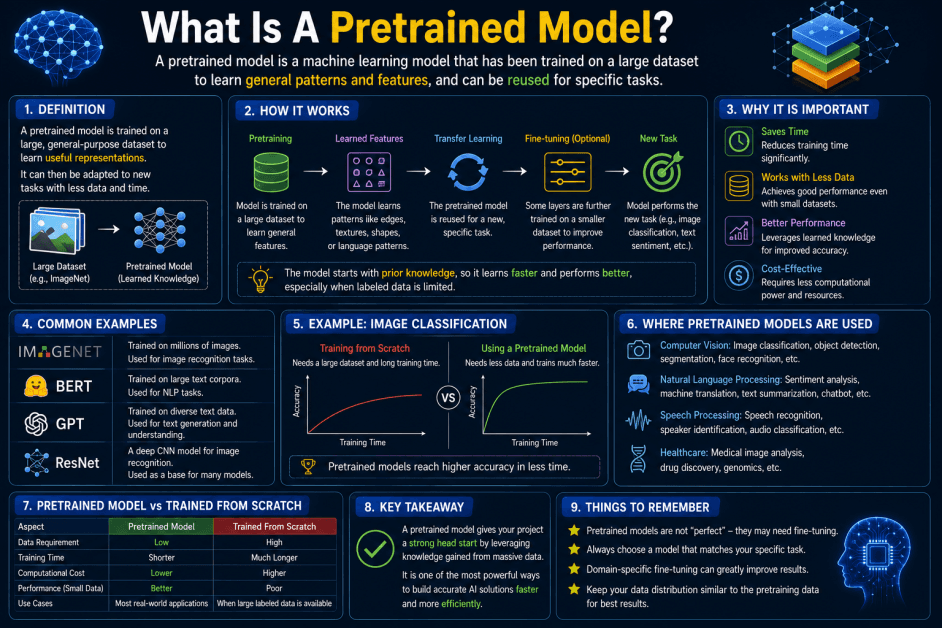
A pretrained model is an AI model that has already been trained on a large dataset to learn general patterns before being adapted for a specific task. Instead of starting from zero, developers can reuse this existing knowledge and fine-tune the model using a smaller, task-specific dataset.
Pretrained models power many of today's AI applications, including chatbots, image recognition, speech assistants, recommendation systems, translation tools, and medical AI. While these models significantly reduce development time, human expertise remains essential for selecting, adapting, evaluating, and deploying them responsibly.
What Is a Pretrained Model?
A pretrained model is a machine learning or deep learning model that has already completed an initial training phase using a large and diverse dataset.
During pretraining, the model learns general features and patterns such as language structure, object shapes, or speech characteristics. Developers can then adapt the pretrained model to solve a specific problem instead of training a completely new model.
This approach is widely used because it saves computational resources while often producing better results than training from scratch.
How Does a Pretrained Model Work?
Pretrained models are developed through multiple stages.
1. Initial Training
The model is trained on a large dataset.
Examples include:
-
Billions of text documents
-
Millions of images
-
Hours of speech recordings
-
Large scientific datasets
-
Video collections
During this phase, the model learns broad knowledge and general patterns.
2. Save the Trained Model
After pretraining is complete, the model's learned parameters are saved.
These learned parameters can be reused for future AI applications.
3. Fine-Tune for a Specific Task
Developers provide a smaller, task-specific dataset.
Examples include:
-
Medical image diagnosis
-
Product recommendations
-
Customer support chatbots
-
Fraud detection
-
Sentiment analysis
The model adjusts its existing knowledge to perform the new task.
4. Deploy the Model
Once fine-tuning and evaluation are complete, the pretrained model is deployed for real-world use.
Types of Pretrained Models
1. Language Models
These models are pretrained on large collections of text.
Applications include:
-
Chatbots
-
Text generation
-
Translation
-
Summarization
-
Question answering
2. Vision Models
Vision models are pretrained using millions of images.
They support tasks such as:
-
Object detection
-
Image classification
-
Facial recognition
-
Medical imaging
3. Speech Models
Speech models learn from large audio datasets.
Common applications include:
-
Speech recognition
-
Voice assistants
-
Speaker identification
-
Speech translation
4. Multimodal Models
These models learn from multiple data types, such as text, images, audio, and video, enabling them to perform tasks that combine different forms of information.
Key Characteristics of Pretrained Models
1. Already Trained
The model has completed an initial learning process before being reused.
2. Reusable
Developers can apply the same model to many related tasks.
3. Supports Transfer Learning
Knowledge learned during pretraining can be transferred to new applications.
4. Reduces Development Time
Using an existing model eliminates the need to train from scratch.
5. Highly Scalable
Pretrained models can often be adapted across industries and domains.
Common Applications of Pretrained Models
Pretrained models are widely used in:
-
Natural language processing (NLP)
-
Large Language Models (LLMs)
-
Computer vision
-
Image recognition
-
Speech recognition
-
Healthcare
-
Financial forecasting
-
Fraud detection
-
Recommendation systems
-
Robotics
-
Autonomous vehicles
-
Predictive analytics
Benefits of Pretrained Models
Faster Development
Developers can build AI applications much more quickly by starting with an existing model.
Lower Training Costs
Pretraining requires significant computing resources, but reusing a pretrained model dramatically reduces the cost for downstream applications.
Improved Performance
Pretrained models often outperform models trained from scratch, especially when only limited task-specific data is available.
Better Data Efficiency
Fine-tuning requires far fewer labeled examples than full model training.
Broad Industry Adoption
Organizations across healthcare, education, finance, retail, manufacturing, and research use pretrained models to accelerate AI development.
Challenges of Pretrained Models
Domain Differences
A pretrained model may require significant fine-tuning if the new task differs greatly from the original training data.
Computational Requirements
Although fine-tuning is less expensive than pretraining, large models can still require powerful hardware.
Bias in Training Data
If the original training data contains biases, those biases may influence the model's behavior unless addressed during development.
Limited Transparency
Very large pretrained models can be difficult to interpret and explain.
Human Expertise Required
Developers must carefully evaluate pretrained models for accuracy, fairness, security, and suitability before deployment.
Best Practices for Using Pretrained Models
Choose the Right Model
Select a pretrained model designed for the intended application, such as language, vision, or speech.
Fine-Tune Carefully
Adapt the model using high-quality, representative data for the target task.
Evaluate Thoroughly
Test performance using independent validation and test datasets before deployment.
Monitor Model Performance
Continue monitoring the model after deployment to ensure reliable performance over time.
Address Bias and Security
Review the model for potential bias, privacy concerns, and security risks before using it in production systems.
Future of Pretrained Models
Pretrained models are becoming the foundation of modern artificial intelligence. Advances in foundation models, self-supervised learning, and multimodal AI are enabling systems to understand and generate text, images, audio, video, and code using shared underlying knowledge.
Future pretrained models are expected to become more efficient, requiring less computing power while delivering higher accuracy. Researchers are also focusing on domain-specific pretrained models for industries such as healthcare, law, finance, engineering, and scientific research, allowing organizations to build specialized AI applications more quickly.
At the same time, responsible AI development remains essential. Improving transparency, reducing bias, protecting privacy, and ensuring human oversight will continue to be key priorities as pretrained models become more widely adopted across industries.
Conclusion
A pretrained model is an AI model that has already learned general knowledge from a large dataset and can be adapted for specific tasks through fine-tuning. This approach significantly reduces training time, lowers development costs, and enables organizations to build high-performing AI systems with fewer resources.
From language models and computer vision systems to speech recognition and recommendation engines, pretrained models have become a cornerstone of modern artificial intelligence. By combining reusable knowledge with task-specific training, they make AI development faster, more scalable, and more accessible.
As artificial intelligence continues to evolve, pretrained models will remain a critical building block for future AI applications, working alongside high-quality data, advanced optimization techniques, and responsible human oversight to deliver reliable and effective solutions.
 What Is a Pretrained Model? AI Pretrained Models Explained FAQs
POST A COMMENT (0)
All Comments (0)
Replies (0)