





What Is a Neural Network Layer? A Simple Guide
Artificial intelligence (AI) models inspired by the human brain are known as neural networks. These systems learn patterns from data by processing information through multiple interconnected stages called layers. Each layer performs a specific function, gradually transforming raw input into meaningful predictions or decisions.
Neural network layers are the building blocks of deep learning models used in applications such as image recognition, natural language processing (NLP), speech recognition, recommendation systems, healthcare, and autonomous vehicles. Together, these layers enable AI systems to solve complex problems that traditional algorithms often struggle to handle.
While modern neural networks can contain dozens or even hundreds of layers, human expertise remains essential for designing the architecture, selecting the right layer types, and evaluating model performance.
What Is a Neural Network Layer?
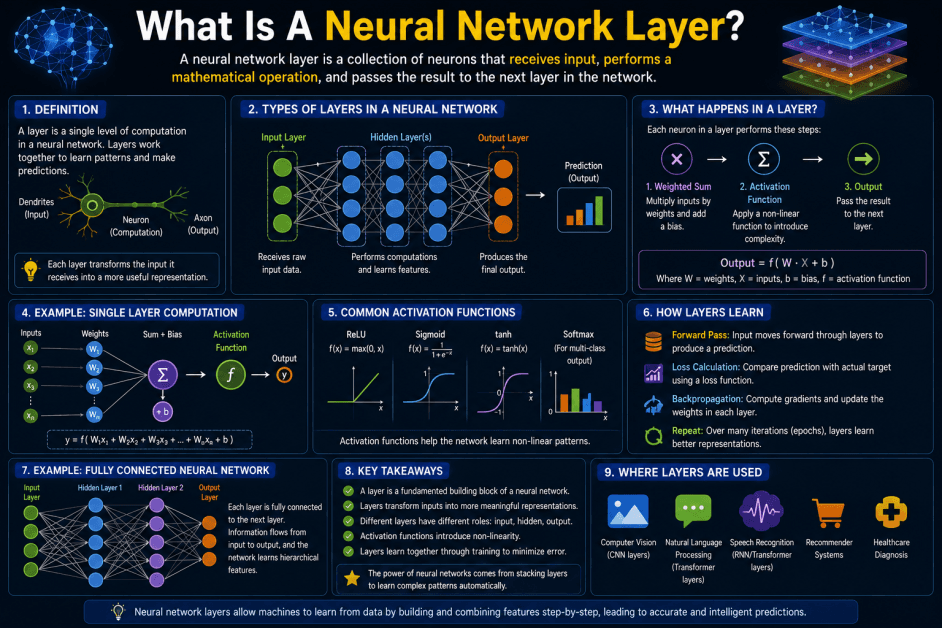
A neural network layer is a group of interconnected artificial neurons that processes data before passing it to the next layer in the network.
Each layer receives information, performs mathematical calculations using weights, biases, and activation functions, and produces an output. As data moves through multiple layers, the model learns increasingly complex features and patterns.
For example, in an image recognition model:
-
Early layers may detect edges and colors.
-
Middle layers identify shapes and textures.
-
Deeper layers recognize complete objects such as cars, animals, or people.
How Does a Neural Network Layer Work?
A neural network processes data one layer at a time.
1. Receive Input
The first layer accepts raw input data.
Examples include:
-
Images
-
Text
-
Audio
-
Sensor readings
-
Financial data
-
Medical records
2. Perform Calculations
Each neuron multiplies the input values by learned weights, adds a bias, and applies an activation function to produce an output.
These calculations allow the network to learn meaningful relationships within the data.
3. Pass Information Forward
The output from one layer becomes the input for the next layer.
As the data moves deeper into the network, the model extracts increasingly sophisticated features.
4. Produce the Final Output
The final layer generates the model's prediction or decision.
Examples include:
-
Identifying an object in an image
-
Predicting the next word in a sentence
-
Classifying an email as spam or not spam
-
Estimating a numerical value
Main Types of Neural Network Layers
1. Input Layer
The input layer is the first layer of a neural network.
Its role is to receive raw data and pass it into the network for processing.
Examples:
-
Image pixels
-
Text tokens
-
Audio signals
-
Numerical features
2. Hidden Layers
Hidden layers are the intermediate layers located between the input and output layers.
They perform most of the learning by identifying patterns, relationships, and features within the data.
Deep learning models typically contain multiple hidden layers.
3. Output Layer
The output layer is the final layer.
It generates the model's prediction.
Examples include:
-
Class labels
-
Probabilities
-
Numerical predictions
-
Generated text
Specialized Neural Network Layers
Modern deep learning models also use specialized layers for specific tasks.
Convolutional Layers
Designed for image and video processing by detecting local visual features.
Recurrent Layers
Process sequential information such as language, speech, and time-series data.
Attention Layers
Allow models to focus on the most relevant parts of the input, making them especially useful for transformers and large language models.
Normalization Layers
Help stabilize and speed up training by adjusting intermediate values.
Dropout Layers
Randomly deactivate some neurons during training to reduce overfitting and improve generalization.
Key Characteristics of Neural Network Layers
1. Process Information Sequentially
Data flows from one layer to the next until a prediction is produced.
2. Learn Features Automatically
Layers discover useful patterns directly from data without requiring manually engineered features.
3. Increase Model Complexity
Additional layers allow models to solve increasingly sophisticated tasks.
4. Work Together
Each layer builds upon the output of previous layers to improve prediction quality.
5. Support Different AI Tasks
Different layer types are optimized for images, language, speech, video, and many other applications.
Common Applications of Neural Network Layers
Neural network layers are fundamental to:
-
Computer vision
-
Image classification
-
Natural language processing (NLP)
-
Large Language Models (LLMs)
-
Speech recognition
-
Recommendation systems
-
Medical imaging
-
Fraud detection
-
Robotics
-
Autonomous vehicles
-
Financial forecasting
-
Predictive analytics
Benefits of Neural Network Layers
Automatic Feature Learning
Layers discover complex patterns without requiring extensive manual feature engineering.
High Accuracy
Deep neural networks with well-designed layers can achieve excellent performance on complex tasks.
Scalability
Layered architectures can be expanded to solve increasingly difficult problems.
Flexibility
Different layer types can be combined to create models tailored to specific applications.
Broad Industry Use
Neural network layers form the foundation of many modern AI systems across numerous industries.
Challenges of Neural Network Layers
Computational Requirements
Deep networks with many layers often require powerful hardware and significant training time.
Risk of Overfitting
Highly complex models may memorize training data if not properly regularized.
Architecture Design
Choosing the number and type of layers requires experimentation and expertise.
Limited Interpretability
Understanding exactly how information is processed across many layers can be difficult.
Human Expertise Required
Developers must carefully design, train, evaluate, and optimize neural network architectures.
Best Practices for Designing Neural Network Layers
Match Layers to the Task
Select layer types appropriate for the problem, such as convolutional layers for images or attention layers for language.
Avoid Unnecessary Complexity
Use enough layers to solve the task effectively without making the model overly large.
Apply Regularization
Techniques such as dropout, weight decay, and early stopping help improve generalization.
Monitor Training Performance
Track validation metrics to identify overfitting or underfitting during training.
Experiment and Optimize
Evaluate different architectures and hyperparameters to achieve the best performance.
Future of Neural Network Layers
Neural network layers continue to evolve as AI research advances. Modern architectures increasingly combine specialized layers, such as attention mechanisms, normalization layers, and efficient convolutional designs, to improve learning speed and performance while reducing computational costs.
Researchers are also developing adaptive and modular neural networks that can dynamically activate only the layers needed for a specific task. These innovations aim to make AI models more efficient, scalable, and energy-conscious without sacrificing accuracy.
As artificial intelligence continues to expand into new industries, neural network layers will remain a core building block of deep learning systems. Combined with high-quality data, advanced optimization techniques, and responsible human oversight, they will continue enabling AI models to solve increasingly complex real-world problems.
Conclusion
A neural network layer is a fundamental component of deep learning that processes information and passes it through a network of artificial neurons. By working together, input, hidden, output, and specialized layers enable AI systems to learn patterns, recognize objects, understand language, and make intelligent predictions.
Neural network layers are used in applications ranging from image recognition and speech processing to large language models and autonomous vehicles. Their flexibility and ability to learn complex representations make them central to modern AI development.
As artificial intelligence continues to advance, neural network layers will remain essential to building powerful, reliable, and scalable machine learning systems capable of addressing increasingly sophisticated challenges.
 What Is a Neural Network Layer? AI Neural Network Layers Explained FAQs
POST A COMMENT (0)
All Comments (0)
Replies (0)