What Is Model Checkpointing? A Simple Guide
Training modern artificial intelligence (AI) models can take hours, days, or even weeks, depending on the size of the dataset and the complexity of the neural network. During this lengthy process, unexpected interruptions such as power outages, hardware failures, or software crashes can cause valuable training progress to be lost. Model checkpointinghelps prevent this problem by periodically saving the model during training.
Model checkpointing allows developers to store snapshots of a model's current state, including its learned parameters and training progress. If training is interrupted, the model can resume from the most recent checkpoint instead of starting over from the beginning.
Today, model checkpointing is a standard practice in machine learning and deep learning projects, including large language models (LLMs), computer vision, speech recognition, healthcare, robotics, and scientific research. While checkpointing improves reliability and efficiency, human oversight remains essential for selecting the best checkpoint and managing the training process.
What Is Model Checkpointing?
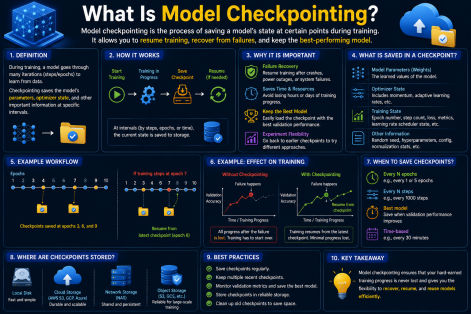
Model checkpointing is the process of periodically saving a machine learning model during training so that its current state can be restored later if needed.
A checkpoint typically includes:
-
Model weights
-
Neural network architecture or configuration (depending on the framework)
-
Optimizer state
-
Current training epoch or step
-
Learning rate information
-
Other training metadata
By saving these components, developers can continue training from the latest checkpoint rather than repeating previously completed work.
How Does Model Checkpointing Work?
Checkpointing occurs automatically or manually during model training.
1. Start Model Training
The AI model begins learning from the training dataset.
Examples include:
-
Image classification
-
Language translation
-
Speech recognition
-
Fraud detection
-
Medical image analysis
2. Save a Checkpoint
At predefined intervals—such as after every epoch or after a certain number of training steps—the training framework saves the model's current state.
3. Continue Training
Training proceeds normally while additional checkpoints are created throughout the process.
Some systems retain only the latest checkpoint, while others save multiple versions.
4. Resume or Restore
If training stops unexpectedly or developers want to continue later, they load the most recent checkpoint and resume training without losing previous progress.
Developers can also restore the checkpoint that achieved the best validation performance for deployment.
Types of Model Checkpointing
1. Epoch-Based Checkpointing
The model is saved after each training epoch.
This is one of the most common checkpointing strategies.
2. Step-Based Checkpointing
The model is saved after a fixed number of training iterations or batches.
This is useful for very large datasets where epochs may take a long time to complete.
3. Best Model Checkpointing
Only the checkpoint that achieves the best validation performance is saved.
This helps developers deploy the highest-performing version of the model.
4. Periodic Checkpointing
Checkpoints are saved at regular time intervals or according to custom training schedules.
Key Characteristics of Model Checkpointing
1. Saves Training Progress
Checkpointing preserves the model's current learning state.
2. Enables Recovery
Training can resume after interruptions without starting over.
3. Supports Long Training Jobs
Checkpointing is especially valuable for models that require days or weeks of training.
4. Stores Training Metadata
In addition to model parameters, checkpoints often include optimizer settings and training progress.
5. Improves Experiment Management
Developers can compare multiple checkpoints and select the version that performs best.
Common Applications of Model Checkpointing
Model checkpointing is widely used in:
-
Large Language Models (LLMs)
-
Computer vision
-
Image recognition
-
Natural language processing (NLP)
-
Speech recognition
-
Recommendation systems
-
Medical AI
-
Autonomous vehicles
-
Robotics
-
Financial forecasting
-
Scientific research
-
Predictive analytics
Benefits of Model Checkpointing
Prevents Loss of Training Progress
Training can continue from the latest saved checkpoint after interruptions.
Saves Time
Developers avoid repeating hours or days of completed training.
Enables Best Model Selection
Validation metrics help identify and preserve the highest-performing checkpoint.
Supports Experiment Reproducibility
Saved checkpoints make it easier to reproduce experiments and compare training results.
Improves Reliability
Checkpointing provides an additional layer of protection for large-scale AI training projects.
Challenges of Model Checkpointing
Storage Requirements
Large AI models may produce checkpoint files that require substantial disk space.
Checkpoint Frequency
Saving checkpoints too frequently may increase storage usage and slightly slow training, while saving too infrequently increases the risk of losing progress.
Version Management
Managing many checkpoint files can become complex in large AI projects.
Framework Compatibility
Checkpoint formats may differ across machine learning frameworks, requiring careful handling when moving models between environments.
Human Expertise Required
Developers must determine when to save checkpoints, which versions to retain, and which checkpoint is appropriate for deployment.
Best Practices for Model Checkpointing
Save the Best Validation Model
Retain the checkpoint with the strongest validation performance instead of relying only on the final training epoch.
Use Automatic Checkpointing
Configure the training framework to save checkpoints at consistent intervals.
Monitor Storage Usage
Delete unnecessary checkpoint files or archive older versions to manage disk space efficiently.
Include Training Metadata
Save optimizer state, epoch number, and other relevant information to enable seamless training resumption.
Test Checkpoint Recovery
Verify that checkpoints can be restored correctly before relying on them in production workflows.
Future of Model Checkpointing
Model checkpointing continues to evolve alongside increasingly large AI systems. As foundation models and large language models grow in size, checkpointing strategies are becoming more efficient through distributed storage, cloud-based infrastructure, and incremental checkpointing techniques that reduce storage requirements.
Modern machine learning platforms increasingly automate checkpoint management by monitoring validation performance, retaining only the best-performing models, and integrating checkpoint recovery into large-scale training pipelines. These capabilities are particularly important for distributed training environments where thousands of GPUs work together.
As artificial intelligence advances, model checkpointing will remain a fundamental part of reliable AI development. Combined with automated monitoring, robust infrastructure, and responsible human oversight, it will continue helping developers build scalable, reproducible, and resilient machine learning systems.
Conclusion
Model checkpointing is an essential practice in machine learning and deep learning that protects training progress by periodically saving a model's current state. It enables developers to recover from interruptions, resume training efficiently, and preserve the best-performing versions of their models.
From computer vision and natural language processing to large language models and scientific research, checkpointing plays a vital role in modern AI workflows. By reducing the risk of lost progress and supporting reproducible experimentation, it makes AI development more efficient and reliable.
As artificial intelligence continues to advance, model checkpointing will remain a key component of successful model training, working alongside optimization techniques, high-quality data, and responsible human oversight to build trustworthy AI systems.