





What Is Batch Size in AI Training? A Simple Guide
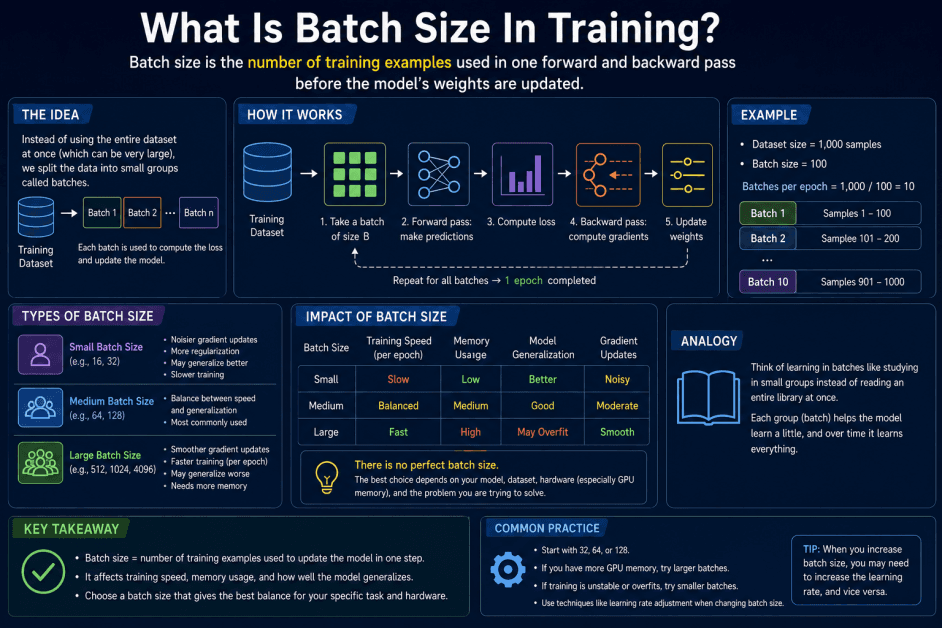
Training an artificial intelligence model requires processing large amounts of data efficiently. Instead of sending an entire dataset through a neural network all at once, AI models usually divide the data into smaller groups known as batches. The number of training examples contained in each group is called the batch size.
Batch size is one of the most important settings in machine learning and deep learning because it directly affects training speed, memory usage, model accuracy, and learning stability. Choosing the right batch size helps AI models train efficiently while making effective use of available computing resources.
Although batch size is an important training parameter, there is no single value that works best for every model. Data scientists and machine learning engineers select batch sizes based on the dataset, hardware capabilities, model architecture, and training objectives.
What Is Batch Size?
Batch size refers to the number of training examples processed by an AI model before it updates its internal parameters, such as weights and biases.
For example, if a dataset contains 10,000 training samples and the batch size is 100, the model processes 100 samples at a time. After each batch, it calculates the prediction error, updates the model's parameters, and then moves to the next batch until the entire dataset has been processed.
The collection of all batches together forms one complete epoch.
How Does Batch Size Work?
Batch size determines how training data flows through a neural network.
1. Divide the Dataset
The complete training dataset is divided into multiple smaller batches.
For example:
-
Dataset size: 12,000 images
-
Batch size: 200
-
Total batches per epoch: 60
2. Process One Batch
The neural network processes every example in the current batch and generates predictions.
Examples include:
-
Image classification
-
Text generation
-
Speech recognition
-
Fraud detection
-
Medical diagnosis
3. Calculate the Loss
After processing the batch, the model calculates the prediction error using a loss function.
This loss measures how accurately the model performed on that batch.
4. Update Model Parameters
Optimization algorithms such as Gradient Descent update the model's weights based on the calculated loss.
The model then processes the next batch until all batches have been completed.
Types of Batch Training
1. Batch Gradient Descent
The model processes the entire training dataset before updating its parameters.
Characteristics:
-
Stable updates
-
High memory requirements
-
Slower training for large datasets
2. Mini-Batch Gradient Descent
The dataset is divided into smaller batches.
This is the most commonly used training method in modern deep learning because it balances speed and stability.
3. Stochastic Gradient Descent (SGD)
The model updates its parameters after processing one training example at a time.
This approach can learn quickly but often produces noisier updates.
Key Characteristics of Batch Size
1. Controls Memory Usage
Smaller batch sizes require less GPU or CPU memory.
2. Influences Training Speed
Larger batches often improve hardware utilization, while smaller batches may require more updates.
3. Affects Model Learning
Different batch sizes can influence how well the model generalizes to new data.
4. Works Together with Epochs
Multiple batches combine to complete one epoch during model training.
5. Depends on Hardware
The maximum practical batch size is often limited by available GPU or system memory.
Common Applications of Batch Size
Batch size is used when training many AI models, including:
-
Image recognition
-
Natural language processing (NLP)
-
Large Language Models (LLMs)
-
Speech recognition
-
Recommendation systems
-
Medical AI
-
Autonomous vehicles
-
Fraud detection
-
Financial forecasting
-
Robotics
-
Computer vision
-
Predictive analytics
Benefits of Choosing an Appropriate Batch Size
Efficient Resource Utilization
Selecting an appropriate batch size helps maximize GPU and CPU performance while reducing unnecessary computation.
Faster Training
Well-chosen batch sizes can reduce total training time without sacrificing model quality.
Better Memory Management
Batch processing allows large datasets to be trained even when system memory is limited.
Stable Learning
Mini-batches often provide a good balance between stable learning and computational efficiency.
Flexible Model Training
Batch size can be adjusted to match different datasets, model architectures, and hardware configurations.
Challenges of Batch Size
Large Batch Sizes
Very large batches require more memory and may reduce the model's ability to generalize well to unseen data.
Small Batch Sizes
Very small batches increase the number of parameter updates, which may slow overall training and produce noisier learning.
Hardware Limitations
Available GPU memory often determines the maximum usable batch size.
Model-Specific Tuning
The optimal batch size varies depending on the neural network architecture, dataset, and optimization algorithm.
Human Expertise Required
Selecting the appropriate batch size requires experimentation, evaluation, and experience.
Best Practices for Choosing Batch Size
Start with Common Values
Many deep learning projects begin with batch sizes such as 16, 32, 64, or 128, then adjust based on performance and available hardware.
Monitor GPU Memory
Choose a batch size that fits comfortably within available memory while leaving room for efficient computation.
Evaluate Model Performance
Test different batch sizes and compare validation accuracy, training speed, and convergence.
Combine with Proper Learning Rates
Batch size and learning rate often influence each other and should be tuned together.
Use Validation Data
Evaluate trained models using validation datasets to ensure the chosen batch size supports good generalization.
Future of Batch Size Optimization
Batch size will continue to be an important part of AI model training as machine learning systems grow in size and complexity. Researchers are developing adaptive training techniques that automatically adjust batch sizes during training to improve efficiency and convergence.
Advances in GPU technology, AI accelerators, distributed computing, and cloud-based infrastructure are allowing larger batch sizes to be used for training increasingly sophisticated foundation models and large language models. At the same time, optimization algorithms are becoming more effective at maintaining model quality across a wide range of batch sizes.
Responsible AI development will continue emphasizing efficient resource utilization, energy consumption, and model performance. Engineers will increasingly combine batch size optimization with automated hyperparameter tuning to create more reliable and scalable AI systems.
Conclusion
Batch size is one of the most important hyperparameters in machine learning and deep learning. It determines how many training examples are processed before an AI model updates its internal parameters, directly affecting training speed, memory usage, and model performance.
Selecting the right batch size helps balance computational efficiency with learning quality. While larger batches can accelerate training, smaller batches may improve generalization depending on the task and dataset.
As artificial intelligence continues advancing, batch size optimization will remain a key part of building efficient and accurate AI models. Combined with appropriate learning rates, optimization algorithms, and high-quality data, it helps create machine learning systems that are both powerful and reliable.
 What Is Batch Size in AI Training? Batch Size Explained FAQs
POST A COMMENT (0)
All Comments (0)
Replies (0)