





What Is a Learning Rate? A Simple Guide
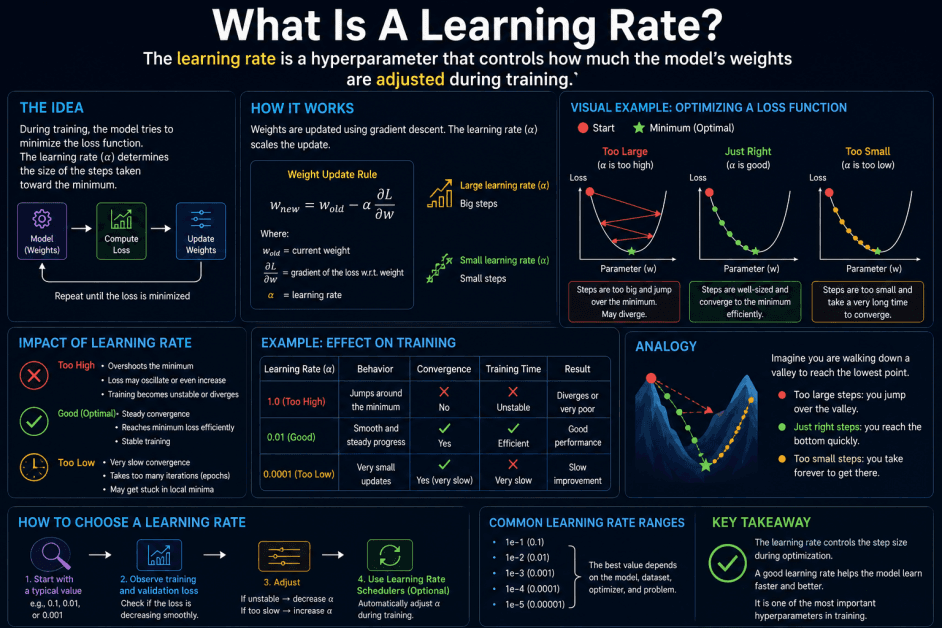
Training an artificial intelligence model involves continuously improving its predictions by adjusting millions—or even billions—of internal parameters. One of the most important settings that controls this learning process is the learning rate. It determines how much the model changes its parameters after each training step based on the errors it makes.
The learning rate has a significant impact on how quickly and effectively an AI model learns. If it is set too high, the model may learn too aggressively and fail to reach the best solution. If it is set too low, learning can become extremely slow and may require much more computing time.
Every modern AI system—including image recognition models, speech recognition software, recommendation systems, and large language models—uses a learning rate during training. Selecting an appropriate learning rate is essential for building accurate, efficient, and reliable machine learning models.
What Is a Learning Rate?
A learning rate is a hyperparameter that controls how much a machine learning model updates its weights and biases after calculating prediction errors during training.
After the model processes a batch of training data and calculates the loss, an optimization algorithm such as Gradient Descent determines how the model's parameters should change. The learning rate controls the size of those updates.
A suitable learning rate allows the model to gradually reduce prediction errors while moving toward an optimal solution.
How Does a Learning Rate Work?
The learning rate influences every step of the model training process.
1. Make Predictions
The AI model processes training data and generates predictions.
Examples include:
-
Classifying images
-
Translating text
-
Detecting spam emails
-
Recognizing speech
-
Predicting stock prices
2. Calculate the Loss
A loss function compares the predicted output with the correct answer and measures the prediction error.
3. Compute the Gradient
Optimization algorithms calculate the direction in which the model's parameters should move to reduce the loss.
4. Update the Parameters
The learning rate determines how large each update should be.
-
A small learning rate makes tiny adjustments.
-
A large learning rate makes bigger adjustments.
This process repeats throughout training until the model reaches satisfactory performance.
Why Is Learning Rate Important?
1. Controls Learning Speed
The learning rate determines how quickly an AI model learns from its mistakes.
2. Affects Model Accuracy
Choosing an appropriate learning rate helps the model reach better solutions and improve prediction accuracy.
3. Influences Training Stability
A balanced learning rate helps training progress smoothly without large fluctuations.
4. Reduces Training Time
A well-chosen learning rate allows models to converge more efficiently.
5. Supports Deep Learning
Modern deep neural networks rely on carefully selected learning rates to train effectively.
Small vs. Large Learning Rate
Small Learning Rate
Advantages:
-
More stable learning
-
Better chance of reaching an optimal solution
-
Lower risk of overshooting
Disadvantages:
-
Slower training
-
May require many more epochs
-
Higher computational cost
Large Learning Rate
Advantages:
-
Faster initial learning
-
Shorter training time
Disadvantages:
-
Can overshoot the optimal solution
-
May cause unstable training
-
Sometimes prevents the model from converging
Common Applications of Learning Rate
Learning rates are used in nearly every machine learning and deep learning application, including:
-
Image recognition
-
Natural language processing (NLP)
-
Large Language Models (LLMs)
-
Speech recognition
-
Recommendation systems
-
Fraud detection
-
Medical diagnosis support
-
Autonomous vehicles
-
Financial forecasting
-
Robotics
-
Computer vision
-
Predictive analytics
Benefits of Choosing the Right Learning Rate
Faster Model Training
Appropriate learning rates help models learn efficiently without unnecessary delays.
Improved Accuracy
Well-tuned learning rates enable models to achieve better predictive performance.
Better Resource Utilization
Efficient learning reduces unnecessary computing time and energy consumption.
Stable Optimization
Balanced parameter updates reduce the risk of unstable training.
Flexible Across Models
Learning rates can be adjusted for different neural network architectures, datasets, and optimization algorithms.
Challenges of Learning Rate
Too High
An excessively high learning rate can cause the model to miss the optimal solution or fail to converge.
Too Low
A very small learning rate may require a long training time and increase computational costs.
Model-Specific Tuning
Different AI models often require different learning rate values.
Interaction with Other Hyperparameters
Learning rate works closely with batch size, optimization algorithms, and regularization techniques.
Human Expertise Required
Selecting the best learning rate usually requires experimentation and careful evaluation.
Best Practices for Choosing a Learning Rate
Start with Proven Defaults
Many optimization algorithms provide effective default learning rates that can serve as a starting point.
Monitor Training Metrics
Track loss and validation accuracy to determine whether learning is progressing effectively.
Use Learning Rate Schedules
Gradually reducing the learning rate during training often improves final model performance.
Experiment with Different Values
Test multiple learning rates to identify the best balance between speed and accuracy.
Combine with Appropriate Optimization Algorithms
Learning rates should be tuned alongside optimizers such as SGD, Adam, or RMSprop for the best results.
Future of Learning Rate Optimization
Learning rate optimization continues to evolve as AI models become larger and more sophisticated. Modern optimization techniques increasingly use adaptive learning rates that automatically adjust parameter updates during training. Optimizers such as Adam, AdamW, AdaGrad, and RMSprop dynamically modify learning rates based on the model's learning progress, improving both speed and stability.
Researchers are also developing advanced learning rate schedules, including cosine annealing, cyclical learning rates, and warm-up strategies. These techniques help train large neural networks and foundation models more efficiently while reducing the risk of unstable convergence.
As artificial intelligence advances, automated hyperparameter tuning and AutoML systems are making it easier to identify effective learning rates with minimal manual effort. Combined with high-quality data, powerful computing resources, and responsible human oversight, learning rate optimization will remain a key factor in building accurate and efficient AI systems.
Conclusion
The learning rate is one of the most important hyperparameters in artificial intelligence and deep learning. It controls how much an AI model adjusts its internal parameters after each training step, directly affecting learning speed, stability, and overall performance.
Choosing the appropriate learning rate helps models learn efficiently, reduce prediction errors, and converge toward better solutions. A learning rate that is too high can cause unstable learning, while one that is too low may significantly slow training.
As AI technology continues to advance, learning rate optimization will remain a fundamental part of machine learning. Combined with effective optimization algorithms, quality data, and responsible human oversight, it helps create AI systems that are increasingly accurate, reliable, and efficient.
 What Is a Learning Rate? AI Learning Rate Explained FAQs
POST A COMMENT (0)
All Comments (0)
Replies (0)