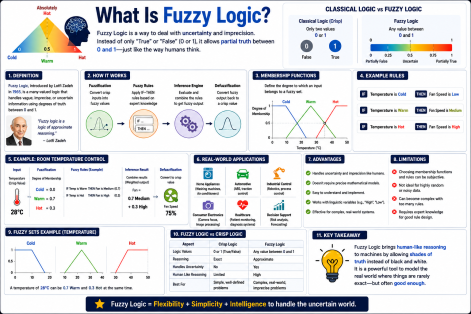
What Is Fuzzy Logic? A Simple Guide
Many real-world decisions are not simply true or false. For example, a room may be slightly warm, very hot, or moderately cool rather than just hot or cold. Humans naturally handle these situations using approximate reasoning, but traditional computer logic often relies on strict yes-or-no decisions.
Fuzzy logic addresses this limitation by allowing computers to work with degrees of truth instead of fixed binary values. Rather than treating information as completely true or completely false, fuzzy logic assigns values between 0 and 1, enabling AI systems to make decisions in uncertain or gradual situations.
Today, fuzzy logic is widely used in consumer electronics, automotive systems, industrial automation, robotics, healthcare, finance, and smart home technologies. Although fuzzy systems automate many decision-making processes, human experts remain responsible for designing the rules, validating outputs, and maintaining reliable performance.
What Is Fuzzy Logic?
Fuzzy logic is a mathematical approach used in artificial intelligence and control systems that allows computers to reason with partial truth instead of only absolute true-or-false values.
Unlike classical Boolean logic, where a statement is either true (1) or false (0), fuzzy logic represents truth as a value anywhere between 0 and 1.
For example:
-
A temperature of 18°C may be 0.2 warm.
-
A temperature of 25°C may be 0.7 warm.
-
A temperature of 32°C may be 1.0 warm.
This enables AI systems to make decisions that more closely resemble human reasoning.
How Does Fuzzy Logic Work?
Fuzzy logic processes information through several stages.
1. Collect Input Data
The system receives input values such as:
-
Temperature
-
Speed
-
Humidity
-
Distance
-
Pressure
-
Risk level
2. Fuzzification
The input values are converted into fuzzy values using membership functions.
Instead of belonging completely to one category, an input may partially belong to multiple categories.
For example:
A temperature of 24°C might be:
-
Cool = 0.3
-
Warm = 0.8
-
Hot = 0.1
3. Apply Fuzzy Rules
The system evaluates predefined rules created by human experts.
Examples include:
-
If temperature is warm, then reduce heating slightly.
-
If speed is high and road is wet, then increase braking assistance.
Multiple rules can be evaluated simultaneously.
4. Defuzzification
The fuzzy output is converted into a single numerical value that controls the final decision or action.
For example:
-
Fan speed
-
Motor power
-
Vehicle braking force
-
Air conditioner temperature
Key Components of a Fuzzy Logic System
1. Fuzzifier
Converts numerical input into fuzzy values.
2. Membership Functions
Define how strongly an input belongs to different categories.
3. Rule Base
Contains expert-defined IF-THEN rules used for reasoning.
4. Inference Engine
Evaluates the fuzzy rules and combines their results.
5. Defuzzifier
Converts fuzzy results into a precise output value.
Key Characteristics of Fuzzy Logic
1. Handles Uncertainty
Works effectively with incomplete or imprecise information.
2. Uses Degrees of Truth
Values are represented on a continuous scale rather than as only true or false.
3. Mimics Human Reasoning
Produces decisions similar to how people evaluate uncertain situations.
4. Rule-Based Decision Making
Uses expert-defined logical rules rather than learning directly from data.
5. Easy to Interpret
Rules are generally transparent and understandable.
Common Applications of Fuzzy Logic
Fuzzy logic is widely used in:
-
Smart home appliances
-
Air conditioners
-
Washing machines
-
Camera autofocus systems
-
Automotive control systems
-
Anti-lock braking systems (ABS)
-
Industrial automation
-
Robotics
-
Medical decision support
-
Financial risk assessment
-
Traffic control systems
-
Consumer electronics
Benefits of Fuzzy Logic
Handles Real-World Uncertainty
Fuzzy logic performs well when information is vague or imprecise.
Produces Smooth Decisions
Outputs change gradually instead of making abrupt yes-or-no transitions.
Easy to Understand
Rule-based reasoning makes the system relatively transparent.
Flexible
Rules can be adapted for many different applications.
Efficient for Control Systems
Fuzzy controllers are widely used in industrial and consumer products.
Challenges of Fuzzy Logic
Requires Expert Knowledge
Developers must create and maintain the rule base manually.
Difficult to Scale
Large systems may require hundreds or thousands of fuzzy rules.
No Automatic Learning
Traditional fuzzy logic systems do not improve automatically from new data.
Rule Conflicts
Complex systems may contain overlapping or conflicting rules that require careful tuning.
Human Expertise Required
Experts are responsible for designing membership functions, validating rules, and ensuring reliable system behavior.
Fuzzy Logic vs Classical Logic
| Feature | Classical Logic | Fuzzy Logic |
|---|---|---|
| Truth Values | True or False | Any value between 0 and 1 |
| Decision Style | Binary | Gradual |
| Handles Uncertainty | Limited | Excellent |
| Human-Like Reasoning | Limited | Strong |
| Best For | Precise conditions | Uncertain or approximate situations |
Best Practices for Fuzzy Logic
Define Clear Membership Functions
Ensure fuzzy categories accurately represent real-world conditions.
Create Consistent Rules
Keep IF-THEN rules logical, simple, and free from contradictions.
Test with Real Data
Validate the system using representative scenarios before deployment.
Update Rules Regularly
Adjust rules and membership functions as conditions or requirements change.
Combine with Modern AI
Integrate fuzzy logic with machine learning or neural networks when adaptive learning is required.
Future of Fuzzy Logic
Fuzzy logic continues to play an important role in artificial intelligence, particularly in applications involving uncertainty, control systems, and decision support. Researchers are increasingly combining fuzzy logic with machine learning, neural networks, evolutionary computing, and neuro-symbolic AI to create systems that can both learn from data and reason under uncertainty.
These hybrid approaches are being applied in autonomous vehicles, smart manufacturing, healthcare, robotics, financial modeling, and Internet of Things (IoT) devices. By combining adaptive learning with explainable rule-based reasoning, they aim to improve both performance and transparency.
As artificial intelligence evolves, fuzzy logic will remain a valuable tool for building intelligent systems that can handle imprecise information and make decisions in complex real-world environments. Together with human expertise and responsible system design, it will continue supporting reliable AI across many industries.
Conclusion
Fuzzy logic is an artificial intelligence technique that allows computers to reason using degrees of truth rather than simple true-or-false decisions. By representing uncertainty mathematically, it enables AI systems to make decisions that more closely resemble human thinking.
From smart appliances and industrial automation to healthcare and automotive systems, fuzzy logic has become an important technology for solving problems involving vague or uncertain information. Its transparent rule-based approach makes it especially useful in applications where explainable decision-making is important.
As AI technology continues to advance, fuzzy logic is expected to remain a key component of intelligent systems, particularly when combined with modern machine learning techniques to create more adaptive and trustworthy AI solutions.