





What Is Evolutionary Computing? A Simple Guide
Many of the world's most difficult problems have countless possible solutions, making it impractical to test every option. Instead of searching exhaustively, artificial intelligence can borrow ideas from nature to discover high-quality solutions efficiently. Evolutionary computing is one such approach, inspired by the principles of biological evolution.
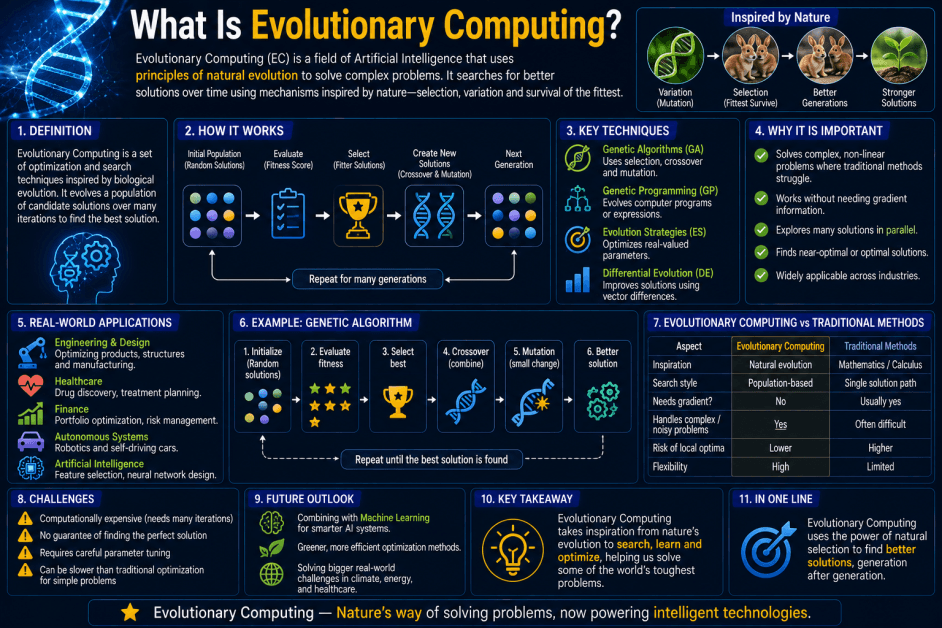
Evolutionary computing uses populations of candidate solutions that evolve over time through processes similar to natural selection, reproduction, mutation, and survival of the fittest. Rather than programming the exact solution, developers define the problem and allow the algorithm to gradually improve solutions across multiple generations.
Today, evolutionary computing is widely used in engineering, robotics, finance, logistics, manufacturing, healthcare, game development, and scientific research. Although these algorithms can automatically discover effective solutions, human expertise remains essential for defining objectives, selecting algorithm parameters, and validating results.
What Is Evolutionary Computing?
Evolutionary computing is a branch of artificial intelligence that uses algorithms inspired by biological evolution to solve optimization, search, and design problems.
Instead of relying on fixed rules, the algorithm creates multiple possible solutions, evaluates how well they perform, and continuously improves them over many generations.
The goal is to discover increasingly effective solutions through an iterative process of selection and adaptation.
How Does Evolutionary Computing Work?
Evolutionary computing follows a cycle that mimics natural evolution.
1. Generate an Initial Population
The algorithm begins with a population of candidate solutions.
These solutions may be created randomly or based on prior knowledge.
2. Evaluate Fitness
Each solution is tested using a fitness function, which measures how well it solves the problem.
Examples include:
-
Accuracy
-
Cost
-
Speed
-
Energy efficiency
-
Resource utilization
3. Select the Best Solutions
Solutions with higher fitness are more likely to be selected for reproduction.
Less effective solutions are gradually removed from the population.
4. Create New Solutions
Selected solutions generate offspring through evolutionary operators such as:
-
Crossover: Combines characteristics from two parent solutions.
-
Mutation: Introduces small random changes to increase diversity.
5. Repeat the Process
The new generation is evaluated, and the cycle continues until the algorithm reaches a stopping condition or finds a satisfactory solution.
Common Types of Evolutionary Computing
1. Genetic Algorithms (GA)
One of the most widely used evolutionary techniques, genetic algorithms evolve solutions using selection, crossover, and mutation.
2. Genetic Programming (GP)
Instead of evolving data values, genetic programming evolves complete computer programs or mathematical expressions.
3. Evolution Strategies (ES)
These algorithms focus on optimizing continuous variables and are widely used in engineering and robotics.
4. Differential Evolution (DE)
An optimization algorithm that efficiently solves complex numerical optimization problems by combining and mutating candidate solutions.
5. Evolutionary Programming (EP)
An evolutionary approach that emphasizes mutation and selection to optimize problem-solving strategies.
Key Characteristics of Evolutionary Computing
1. Population-Based Search
Multiple candidate solutions are explored simultaneously rather than evaluating a single solution at a time.
2. Inspired by Natural Evolution
Algorithms imitate biological processes such as selection, reproduction, and mutation.
3. Iterative Improvement
Solutions improve progressively over many generations.
4. Flexible Problem Solving
Evolutionary computing can solve problems where traditional mathematical methods are difficult to apply.
5. Handles Complex Search Spaces
These algorithms work well in large, nonlinear, and multidimensional optimization problems.
Common Applications of Evolutionary Computing
Evolutionary computing is widely used in:
-
Engineering design optimization
-
Robotics
-
Machine learning model optimization
-
Hyperparameter tuning
-
Financial portfolio optimization
-
Supply chain optimization
-
Manufacturing process optimization
-
Autonomous vehicles
-
Drug discovery
-
Game development
-
Telecommunications
-
Scientific research
Benefits of Evolutionary Computing
Solves Complex Optimization Problems
Evolutionary algorithms can discover effective solutions in very large search spaces.
Does Not Require Exact Mathematical Models
They can optimize problems even when precise equations are unavailable.
Explores Diverse Solutions
Population-based search reduces the chance of relying on only one possible solution.
Adaptable
The same principles can be applied across many industries and problem types.
Supports Hybrid AI
Evolutionary computing is often combined with machine learning, reinforcement learning, and neural networks to improve AI performance.
Challenges of Evolutionary Computing
Computationally Intensive
Evaluating many candidate solutions over multiple generations may require significant computing resources.
Parameter Tuning
Performance depends on settings such as population size, mutation rate, crossover rate, and selection strategy.
No Guaranteed Optimal Solution
Evolutionary algorithms typically find high-quality solutions but cannot guarantee the absolute best solution.
Slow Convergence
Some complex problems require many generations before strong solutions emerge.
Human Expertise Required
Developers must design suitable fitness functions, configure evolutionary operators, and verify the quality of the final results.
Evolutionary Computing vs Traditional Optimization
| Feature | Traditional Optimization | Evolutionary Computing |
|---|---|---|
| Search Method | Mathematical optimization | Population-based evolution |
| Inspiration | Mathematical models | Biological evolution |
| Number of Solutions | Usually one at a time | Multiple simultaneously |
| Handles Complex Problems | Sometimes limited | Excellent |
| Guarantees Global Optimum | Often under specific conditions | No guarantee, but often finds high-quality solutions |
Best Practices for Evolutionary Computing
Design an Effective Fitness Function
A well-defined fitness function is essential for guiding the algorithm toward useful solutions.
Maintain Population Diversity
Diverse candidate solutions help prevent premature convergence.
Tune Algorithm Parameters
Experiment with mutation rates, crossover rates, and population sizes to improve performance.
Combine with Other AI Methods
Integrate evolutionary computing with machine learning or neural networks when appropriate.
Monitor Convergence
Evaluate progress regularly to determine when further evolution provides limited improvement.
Future of Evolutionary Computing
Evolutionary computing continues to gain importance as optimization problems become more complex across industries. Researchers are developing faster and more adaptive evolutionary algorithms capable of solving large-scale problems involving millions of variables while reducing computational costs.
Modern AI systems increasingly combine evolutionary computing with deep learning, reinforcement learning, swarm intelligence, foundation models, and digital twins. These hybrid approaches are improving robot control, neural network architecture search, autonomous systems, smart manufacturing, healthcare optimization, and scientific discovery.
As artificial intelligence advances, evolutionary computing will remain a valuable technique for discovering innovative solutions to complex real-world challenges. Together with human expertise, high-quality data, and responsible system design, it will continue supporting more efficient and adaptable AI systems.
Conclusion
Evolutionary computing is an artificial intelligence approach inspired by the principles of natural evolution. By allowing populations of candidate solutions to evolve through selection, crossover, mutation, and repeated evaluation, it efficiently solves optimization and search problems that are often difficult for traditional methods.
From engineering and robotics to finance, healthcare, and machine learning, evolutionary computing helps organizations identify high-quality solutions without requiring exhaustive searches or precise mathematical models.
As AI technology continues to evolve, evolutionary computing will remain an important optimization technique, enabling intelligent systems to adapt, improve, and solve increasingly complex problems across a wide range of industries.
 What Is Evolutionary Computing? AI Evolutionary Algorithms Explained FAQs
POST A COMMENT (0)
All Comments (0)
Replies (0)