What Is Active Learning? A Simple Guide
Artificial intelligence (AI) models often require large amounts of labeled data to achieve high accuracy. However, labeling data can be expensive, time-consuming, and may require domain experts, especially in fields such as healthcare, finance, and scientific research.
Active learning addresses this challenge by allowing the AI model to identify the most informative data samples and request labels only for those examples. Instead of labeling an entire dataset, developers focus their efforts on the data that is expected to improve the model the most.
Today, active learning is widely used in computer vision, natural language processing (NLP), speech recognition, medical imaging, cybersecurity, and many other AI applications. Although it reduces labeling effort, human expertise remains essential for providing accurate labels, validating results, and ensuring responsible AI development.
What Is Active Learning?
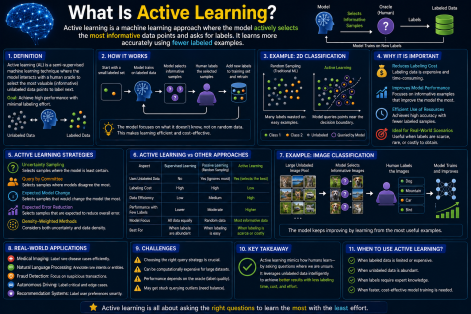
Active learning is a machine learning approach in which an AI model actively selects the most valuable unlabeled data samples for human annotation.
Rather than randomly choosing data to label, the model identifies examples that are uncertain, difficult to classify, or likely to improve learning. Human experts then label these selected samples, and the model is retrained using the newly labeled data.
This iterative process enables AI systems to achieve high performance while requiring significantly fewer labeled examples.
How Does Active Learning Work?
Active learning follows a repeating cycle of learning and improvement.
1. Begin with a Small Labeled Dataset
The process starts with a limited number of labeled examples.
Examples include:
-
Images
-
Text documents
-
Audio recordings
-
Medical scans
-
Sensor data
-
Financial transactions
2. Train the Initial Model
The AI model learns from the available labeled data and begins making predictions on the remaining unlabeled data.
3. Select Informative Samples
The model identifies the data samples that would provide the greatest benefit if labeled.
Selection strategies may focus on:
-
High uncertainty
-
Ambiguous predictions
-
Diverse examples
-
Rare cases
4. Human Annotation
Experts review and label the selected samples.
These new labels are added to the training dataset.
5. Retrain the Model
The updated dataset is used to improve the model.
The cycle repeats until the desired performance is achieved.
Common Active Learning Strategies
1. Uncertainty Sampling
The model selects examples for which it has the lowest prediction confidence.
This is one of the most widely used active learning methods.
2. Query by Committee
Multiple models evaluate the same data, and samples with the greatest disagreement are selected for labeling.
3. Diversity Sampling
The model selects diverse examples to ensure broad coverage of the dataset.
4. Hybrid Strategies
Many modern AI systems combine uncertainty, diversity, and other selection methods to maximize labeling efficiency.
Key Characteristics of Active Learning
1. Human-in-the-Loop
Human experts remain involved by labeling selected data samples.
2. Efficient Data Labeling
Only the most informative examples require manual annotation.
3. Iterative Learning
The model continuously improves through repeated training and labeling cycles.
4. Reduces Labeling Costs
Fewer labeled examples are needed to achieve strong performance.
5. Improves Model Quality
Selecting informative samples often produces better results than random labeling.
Common Applications of Active Learning
Active learning is widely used in:
-
Computer vision
-
Medical image analysis
-
Natural language processing (NLP)
-
Speech recognition
-
Fraud detection
-
Cybersecurity
-
Autonomous vehicles
-
Robotics
-
Recommendation systems
-
Scientific research
-
Predictive analytics
-
Quality inspection in manufacturing
Benefits of Active Learning
Lowers Annotation Costs
Organizations label only the most valuable data instead of the entire dataset.
Improves Model Performance
Targeted labeling often leads to better accuracy using fewer training examples.
Makes Better Use of Human Expertise
Experts spend their time labeling the samples that have the greatest impact on model improvement.
Accelerates AI Development
Reducing labeling requirements speeds up the development of machine learning systems.
Supports Specialized Domains
Active learning is particularly valuable where expert annotations are expensive or difficult to obtain.
Challenges of Active Learning
Requires Human Annotators
The process still depends on knowledgeable people to provide accurate labels.
Selecting the Right Samples
Poor selection strategies may reduce the effectiveness of active learning.
Computational Overhead
Repeated sample selection and model retraining can increase computational costs.
Difficult Implementation
Designing an effective active learning workflow requires careful planning and experimentation.
Human Expertise Required
Developers must evaluate labeling quality, monitor model performance, and adjust selection strategies throughout the training process.
Best Practices for Active Learning
Start with High-Quality Labels
Build the initial training dataset using accurate and representative labeled examples.
Choose an Appropriate Selection Strategy
Select uncertainty sampling, diversity sampling, or hybrid methods based on the application.
Monitor Model Performance
Evaluate validation metrics after each active learning cycle.
Ensure Annotation Quality
Provide clear guidelines and quality checks for human annotators.
Continue Until Performance Stabilizes
Repeat the learning cycle until additional labeled data provides little improvement.
Future of Active Learning
Active learning is becoming increasingly important as organizations seek to build AI systems while minimizing the cost of data annotation. Modern research is combining active learning with self-supervised learning, semi-supervised learning, transfer learning, and foundation models to further reduce the need for manually labeled data.
Advances in automated sample selection and human-AI collaboration are making active learning more efficient for applications such as healthcare, autonomous driving, cybersecurity, manufacturing, and scientific discovery. These systems help experts focus on the most informative cases while allowing AI models to learn more effectively from limited labeled datasets.
As artificial intelligence continues to evolve, active learning will remain a valuable strategy for developing accurate, scalable, and cost-effective AI systems. Together with high-quality data, robust evaluation methods, and responsible human oversight, it will continue improving the efficiency of machine learning across many industries.
Conclusion
Active learning is a machine learning approach that enables AI models to request labels for the most informative data samples instead of relying on fully labeled datasets. By combining machine intelligence with human expertise, it reduces annotation costs while improving model performance and learning efficiency.
From healthcare and computer vision to natural language processing and cybersecurity, active learning is helping organizations develop high-quality AI systems using fewer labeled examples. Its iterative, human-in-the-loop approach makes it particularly valuable when expert annotation is expensive or limited.
As AI technology advances, active learning will continue to play a key role in efficient model development, helping build intelligent systems that make better use of both human expertise and available data.