





What Is Semi-Supervised Learning? A Simple Guide
Artificial intelligence (AI) systems learn by analyzing data and identifying patterns. Traditionally, machine learning models have relied on either supervised learning, which uses fully labeled data, or unsupervised learning, which uses only unlabeled data. In many real-world situations, however, only a small portion of the available data is labeled while the majority remains unlabeled.
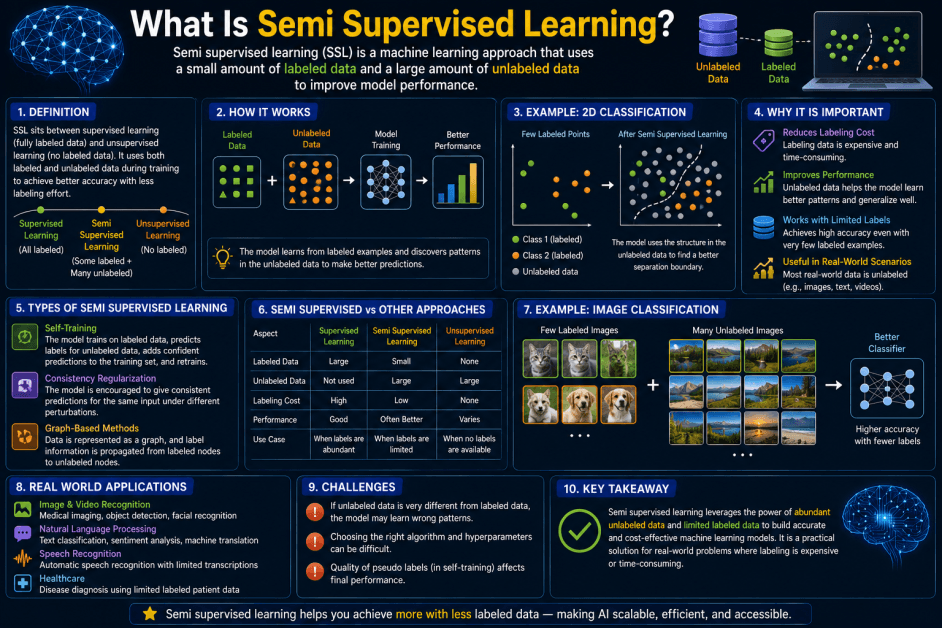
Semi-supervised learning bridges this gap by combining a limited amount of labeled data with a much larger collection of unlabeled data. This approach enables AI models to achieve better performance than using the labeled data alone while significantly reducing the cost and effort required for manual data annotation.
Today, semi-supervised learning is widely used in computer vision, natural language processing (NLP), speech recognition, healthcare, cybersecurity, recommendation systems, and many other AI applications. Although it reduces dependence on labeled datasets, human expertise remains essential for creating high-quality labels, evaluating model performance, and ensuring responsible AI deployment.
What Is Semi-Supervised Learning?
Semi-supervised learning is a machine learning approach that trains an AI model using both labeled and unlabeled data.
Typically, developers begin with a relatively small labeled dataset and a much larger unlabeled dataset. The labeled examples provide guidance, while the unlabeled data helps the model learn additional patterns and improve its ability to generalize.
This method is especially valuable when labeling data is expensive, time-consuming, or requires specialized expertise.
How Does Semi-Supervised Learning Work?
Semi-supervised learning generally follows several stages.
1. Collect Data
The training dataset contains two types of data:
-
A small amount of labeled data
-
A large amount of unlabeled data
Examples include:
-
Images
-
Text documents
-
Audio recordings
-
Medical scans
-
Financial records
-
Sensor data
2. Train with Labeled Data
The model first learns basic relationships from the labeled examples.
These labels provide the initial guidance needed for learning.
3. Learn from Unlabeled Data
The model analyzes the unlabeled data to discover additional structures and patterns.
Depending on the algorithm, it may assign temporary labels, identify similar samples, or learn shared representations.
4. Improve the Model
The combined information from labeled and unlabeled data helps improve prediction accuracy and generalization.
The trained model is then evaluated using separate validation and test datasets.
Common Approaches to Semi-Supervised Learning
1. Pseudo-Labeling
The model generates labels for unlabeled data based on high-confidence predictions, then uses those predictions as additional training examples.
2. Consistency Regularization
The model is trained to produce similar predictions even when the input data is slightly modified, improving robustness.
3. Graph-Based Methods
Relationships between labeled and unlabeled data are represented as a graph, allowing labels to spread across similar data points.
4. Hybrid Deep Learning Methods
Modern deep learning techniques combine multiple semi-supervised strategies to improve performance on large datasets.
Key Characteristics of Semi-Supervised Learning
1. Uses Both Labeled and Unlabeled Data
This approach combines the strengths of supervised and unsupervised learning.
2. Reduces Labeling Costs
Only a relatively small portion of the dataset requires manual annotation.
3. Improves Generalization
Learning from more data helps models perform better on unseen examples.
4. Works Well with Limited Labels
Semi-supervised learning is particularly useful when obtaining labeled data is difficult or expensive.
5. Supports Scalable AI Development
Organizations can take advantage of large collections of unlabeled data without labeling every sample.
Common Applications of Semi-Supervised Learning
Semi-supervised learning is widely used in:
-
Computer vision
-
Image classification
-
Natural language processing (NLP)
-
Speech recognition
-
Medical diagnosis support
-
Recommendation systems
-
Fraud detection
-
Cybersecurity
-
Autonomous vehicles
-
Robotics
-
Scientific research
-
Predictive analytics
Benefits of Semi-Supervised Learning
Reduces Annotation Costs
Organizations can build accurate AI models while labeling only a fraction of the available data.
Improves Model Performance
Using additional unlabeled data often leads to better accuracy than relying solely on small labeled datasets.
Better Generalization
Models learn richer patterns from larger and more diverse datasets.
Efficient Use of Available Data
Large quantities of unlabeled data become valuable training resources.
Broad Industry Adoption
Semi-supervised learning is increasingly used across industries where labeled data is limited.
Challenges of Semi-Supervised Learning
Label Quality Matters
Poor-quality labeled examples can negatively affect the learning process.
Incorrect Pseudo-Labels
If the model generates inaccurate labels for unlabeled data, those errors can propagate during training.
Algorithm Complexity
Semi-supervised methods can be more difficult to design and optimize than traditional supervised learning.
Computational Requirements
Large datasets may require significant computing resources.
Human Expertise Required
Developers must carefully evaluate model performance, monitor data quality, and validate predictions before deployment.
Best Practices for Semi-Supervised Learning
Begin with High-Quality Labels
Ensure the labeled dataset is accurate and representative.
Use Reliable Validation Data
Evaluate performance using separate validation and test datasets.
Monitor Pseudo-Labels
Review automatically generated labels to reduce error propagation.
Combine with Data Augmentation
Augmentation techniques can improve robustness and model generalization.
Continuously Evaluate Performance
Track accuracy, precision, recall, and other evaluation metrics throughout training.
Future of Semi-Supervised Learning
Semi-supervised learning is becoming increasingly important as organizations generate more data than can realistically be labeled by humans. Advances in deep learning are making it possible to extract useful information from large collections of unlabeled data while requiring only a relatively small number of labeled examples.
Researchers are combining semi-supervised learning with self-supervised learning, foundation models, and transfer learning to improve performance across diverse AI tasks. These hybrid approaches are helping reduce labeling costs while enabling more accurate and adaptable models for healthcare, finance, robotics, autonomous systems, and scientific research.
As artificial intelligence continues to advance, semi-supervised learning will remain a valuable approach for developing scalable AI systems. Together with high-quality data, robust evaluation methods, and responsible human oversight, it will continue expanding the practical use of machine learning across industries.
Conclusion
Semi-supervised learning is a machine learning approach that combines a small amount of labeled data with a much larger amount of unlabeled data to build more accurate and efficient AI models. By leveraging both types of data, it reduces the need for expensive manual annotation while improving model performance and generalization.
From computer vision and speech recognition to healthcare and cybersecurity, semi-supervised learning is helping organizations make better use of their available data. Its balance between supervised and unsupervised learning makes it particularly valuable in situations where labeled data is limited but unlabeled data is abundant.
As AI technology continues to evolve, semi-supervised learning will remain an important technique for building reliable, scalable, and cost-effective artificial intelligence systems.
 What Is Semi-Supervised Learning? AI Semi-Supervised Learning Explained FAQs
POST A COMMENT (0)
All Comments (0)
Replies (0)