





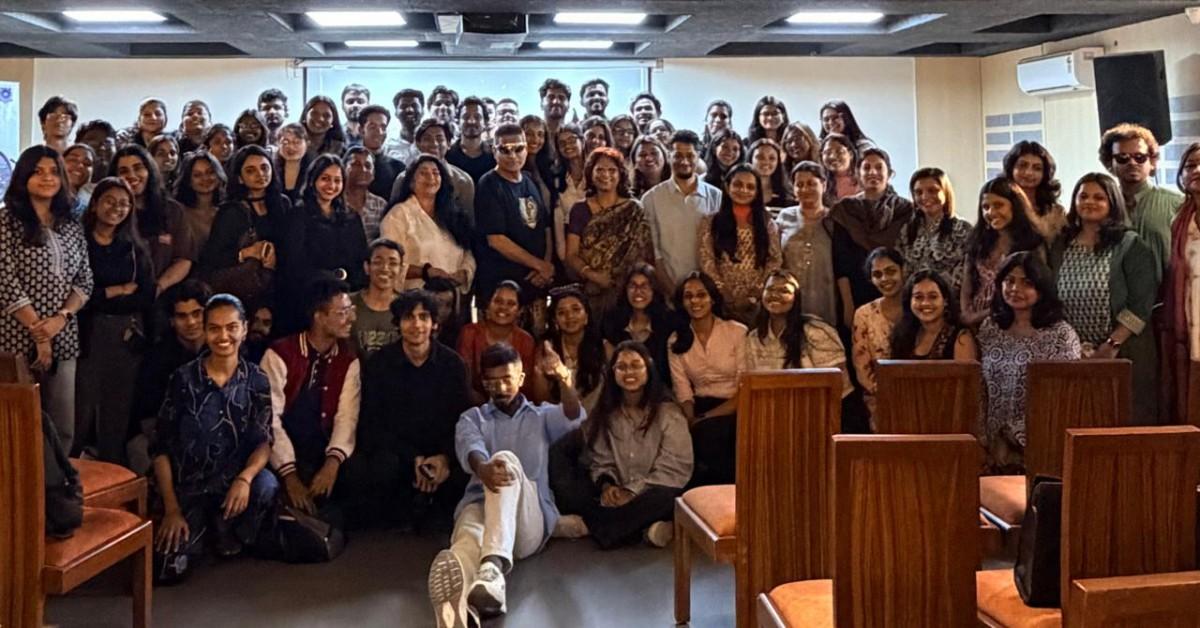
The Department of Mass Media at Kishinchand Chellaram College successfully hosted its XII International Media Summit on February 13 and 14, bringing together leading media professionals, academicians, policymakers, researchers, and students for two days of critical engagement and exchange.
Organised under the theme Strategic Communication for Changing Media Ecologies, the summit served as a dynamic platform to bridge academic thought with industry practice. Through keynote sessions, industry talks, and research presentations, participants explored the challenges posed by misinformation, artificial intelligence, economic pressures, and ethical dilemmas, while also examining the evolving responsibilities of communicators in a fragmented information landscape.
One of the most engaging and impactful sessions was delivered by RJ Jeeturaj from Radio Mirchi 98.3 FM, whose talk titled AI - The Future Dinosaur struck a strong chord with students. Challenging prevailing anxieties around artificial intelligence, he reframed AI not as a threat to creativity but as a powerful tool. Encouraging students to step beyond creative comfort zones, he urged them to experiment, adapt, and trust their creative instincts in an era of constant technological disruption. His session stood out for its blend of humour, real-world relevance, and an optimistic yet grounded vision of the future of media.
Seasoned journalist Dr. Sanjay Singh spoke on the growing influence of narrative drafting and perception-building in news media. He highlighted how chaos is often deliberately manufactured to dilute substantive issues, cautioning that while truth moves slowly, perception travels far more rapidly. Misinformation, he noted, spreads the fastest, frequently eroding credibility that journalists and institutions take years to build. He urged media professionals to remain dispassionate, evidence-driven, and non-judgemental in an increasingly polarised public sphere.
Independent journalist and documentary filmmaker Amitha Balachandra followed with a documentary screening and discussion on 'Tainted Waters'. She spoke about the importance of building credibility before applying for grants and also stressed that informed consent is crucial in media practice, whether obtained on camera or written documentation, especially while working with vulnerable communities.
Adding an important policy and economic dimension to the discussions, Rahul Maheshwari, Economic Affairs Advisor, Netherlands Consulate General, stressed the importance of relevance in media content. He encouraged communicators to understand the economic implications of what they produce, urging them to focus not just on visibility, but on value creation. His session underscored the need for strategic thinking that aligns content, audience needs, and broader economic realities.
Executive coach and leadership communication consultant Dr. Ruta Vyas offered a thought-provoking perspective on communication within organisations, challenging the conventional idea of 'winning' in professional environments. She observed that organisational communication is often driven by short-term objectives, winning deals, influencing opinions, asserting presence, or closing sales while missing the larger strategic picture. Such an approach, she noted, may lead to immediate gains but often weakens long-term relationships. She emphasized that success lies not merely in winning contracts, but in building trust, credibility, and sustainable partnerships. Introducing a practical 'R&R' framework, she redefined successful communication as a balance between results and relationships, reinforcing that in today’s collaborative work environments, a wholesome win-win mindset is essential.
Addressing crisis communication, Heeta Parikh, Founder of Silver Spun Brand Solutions, highlighted that a brand’s reputation is its most fragile asset. She emphasised that during periods of crisis, communication decisions must be timely, transparent, and values-driven, as these moments often define public trust more than periods of success. She referred to Haldiram, Maggi, and Cadbury, illustrating how swift corrective action, clear public messaging, and consistent engagement with stakeholders helped these brands navigate reputational crises.
International perspectives further enriched the summit. Dr. Nancy Snow addressed issues of bias, anonymity, and ethical challenges in global journalism, highlighting how digital platforms complicate accountability. She joined the attendees in a hybrid mode from Syracuse.
Dr. Elizabeth Lubinga spoke about climate change communication using the documentary - The Bliss of Ignorance as a case study. She highlighted the everyday realities of coal-dependent communities in South Africa and pointed out the contradictions between economic survival and health risks. Her session emphasised on climate science with real-life experiences of affected communities. She underscored the role of communication in empowering marginalized communities and advancing environmental awareness.
Industry sessions were further strengthened by cinematographer Swapna Pataskar, who shared her professional journey and reflected on the evolution of camera technologies. She discussed the growing relevance of vertical formats for digital platforms and showcased her projects, including clips from India’s first AI-generated film, slated for public release soon.
Additional key insights were shared by Ameya Karve, Structured Finance Reporter at Bloomberg, who introduced students to the idea of narrativizing economic policy. He highlighted how storytelling, context, and strategic framing can transform complex economic concepts into narratives that are more accessible, persuasive, and meaningful for the public.
Aditi Kamath, Assistant Manager - HDFC, offered practical insights into personal finance, guiding students on how to begin investing through SIPs and build disciplined, long-term investment habits.
The academic segment of the summit featured 13 research paper presentations on media ethics, digital communication, public policy, and allied areas, reinforcing the summit’s emphasis on balancing academic rigour with industry relevance.
The e-waste collection drive organised alongside the summit received an encouraging response, with a significant amount of electronic waste collected for safe disposal and recycling. The initiative helped raise awareness about sustainable consumption and the environmental impact of improper e-waste disposal, reinforcing the summit’s commitment to environmentally responsible practices and actionable change beyond discussion.
The summit received guidance and encouragement from Colonel Dr. Prof. Hemlata Bagla, Vice Chancellor of HSNC University. Strong institutional support was extended by Prof. Tejashree Shanbhag, Principal, KC College, and Prof. Shalini R. Sinha, Vice Principal and Head of the Department of Mass Media. The two day summit was successfully convened under the leadership of Dr. Vidhi Agrawal and Ms. Sneha Subhedar, with the dedicated efforts of the Mass Media faculty.
The XII International Media Summit emerged as a meaningful forum for critical dialogue, global perspectives, and interdisciplinary engagement.
 Related News
POST A COMMENT (0)
All Comments (0)
Replies (0)