





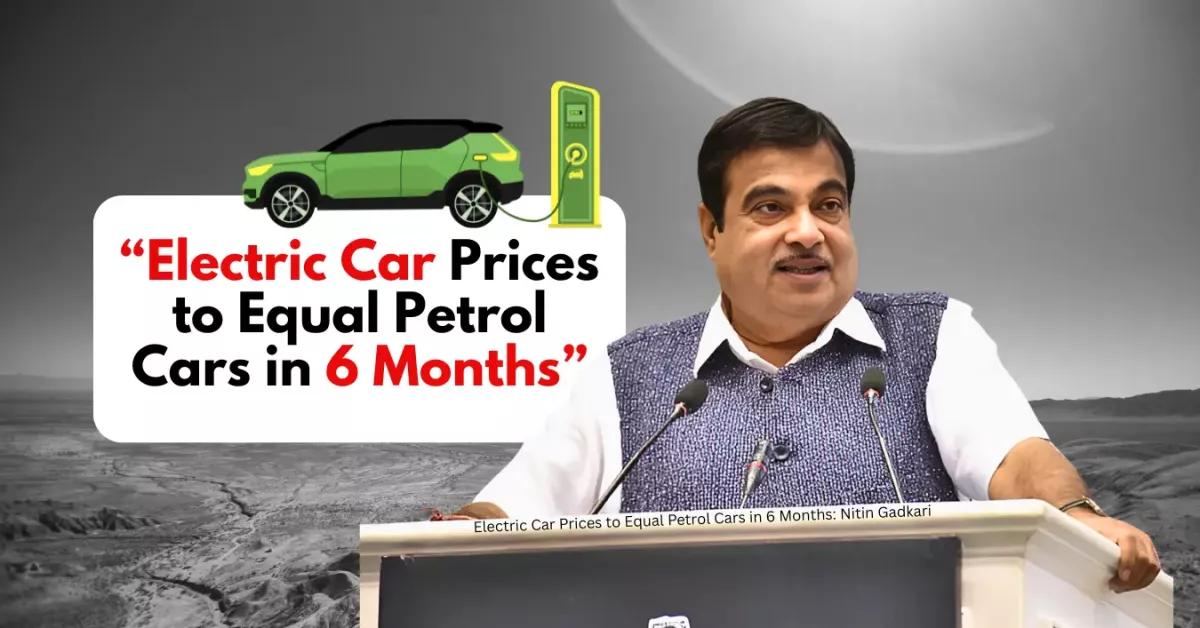
Union Minister for Road Transport and Highways Nitin Gadkari has made a bold prediction — that within the next 4–6 months, the price of electric vehicles (EVs) in India will become equivalent to petrol vehicles.
Speaking at the 32nd Convergence India and 10th Smart Cities India Expo, Gadkari said,
“Within six months, the cost of electric vehicles will be equivalent to the cost of petrol vehicles.”
He added that the government’s vision is based on import substitution, cost-effectiveness, pollution-free mobility, and indigenous production.
Gadkari highlighted that when he took charge of the ministry, the size of India’s automobile industry was ₹14 lakh crore — and today, it has reached ₹22 lakh crore. He further stated that the goal is to make India the world’s No.1 automobile market within the next five years.
The Claim and the Reality: Can It Happen?
While the minister’s statement is highly optimistic, achieving price parity within half a year involves several challenges. Let’s explore the factors behind this claim.
1. Declining Battery Costs
The battery is the most expensive component of an electric vehicle. Over the last few years, the global cost of lithium-ion batteries per kWh has been steadily falling. India’s increasing focus on local battery manufacturing, cell production, and recycling is expected to further reduce prices.
If this decline continues, it could significantly narrow the price gap between EVs and internal combustion engine (ICE) vehicles.
2. Local Manufacturing and Self-Reliance
If India increases local manufacturing of EV components such as motors, controllers, and power electronics, it can reduce import duties and logistics costs. This aligns with the government’s ‘Atmanirbhar Bharat’ (Self-Reliant India) vision.
Domestic production will not only boost employment but also stabilize pricing for future EV models.
3. Tax Policies and Subsidies
The government currently levies only 5% GST on EVs, compared to much higher rates on petrol and diesel vehicles. Additional incentives, such as the FAME-II subsidy, further lower EV costs.
If the government maintains or expands these benefits, price parity could be achieved sooner. However, such policies must balance fiscal implications and long-term sustainability.
4. Competition and Economies of Scale
As more automakers enter the EV space and production scales up, manufacturing costs drop per unit — a principle known as economies of scale.
With major players like Tata, Mahindra, and Hyundai expanding EV lines, consumer options will increase, and prices are expected to fall naturally.
5. Challenges That Remain
Despite the optimism, some ground realities persist:
-
The price gap between popular petrol and EV models is still significant. For instance, the Tata Nexon EV starts at ₹12.49 lakh, while many petrol hatchbacks cost between ₹6–10 lakh.
-
Battery material volatility (especially lithium and cobalt) can affect costs.
-
Charging infrastructure across Tier 2 and Tier 3 cities remains underdeveloped.
-
Consumer skepticism about range, resale value, and battery lifespan is still high.
Hence, complete price parity in just 4–6 months seems ambitious — though it might happen for smaller, entry-level EVs sooner.
India’s Automobile Vision: A Global Push
Gadkari’s statement reflects a larger vision — to transform India’s automobile ecosystem into a global manufacturing powerhouse while reducing pollution and fuel imports.
Key highlights of the strategy include:
-
Expanding the industry from ₹22 lakh crore to make India the world’s No.1 auto market in five years.
-
Reducing dependency on petrol and diesel through ethanol blending and biofuels.
-
Promoting flex-fuel and hybrid vehicles. Gadkari recently urged for only 5% GST on crude ethanol to boost eco-friendly fuel options.
-
Investing in charging infrastructure, EV battery parks, and smart road networks to support green mobility.
This roadmap aims to make India not just an auto giant but also an environmental leader in the global market.
-
Nitin Gadkari’s statement that EV prices will match petrol cars within 4–6 months is visionary but challenging in practice.
-
Rapid battery cost reductions, local production, and continued government incentives could make this possible — at least for select models.
-
Full parity across all segments, however, might take 1–2 years or more, depending on technological and market conditions.
Still, this announcement signals a strong commitment to making electric mobility mainstream in India, marking a new era for the country’s automobile and energy future.
 Related News
POST A COMMENT (0)
All Comments (0)
Replies (0)