What Is Regularization in Machine Learning? A Simple Guide
Machine learning models are designed to learn patterns from data and make accurate predictions. However, if a model learns the training data too closely—including its noise and random variations—it may perform well during training but fail when presented with new, unseen data. This problem is known as overfitting.
Regularization is one of the most effective techniques used to reduce overfitting and improve a model's ability to generalize. By adding constraints during training, regularization encourages AI models to learn the most important patterns instead of memorizing the training dataset.
Today, regularization is widely used in machine learning, deep learning, computer vision, natural language processing, recommendation systems, healthcare, finance, and many other AI applications. Although regularization improves model reliability, human expertise remains essential for selecting the appropriate technique and tuning model performance.
What Is Regularization?
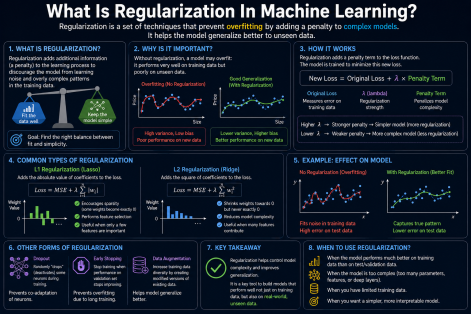
Regularization is a machine learning technique that helps prevent overfitting by limiting the complexity of a model during training.
It works by adding a penalty to the model's learning process, discouraging it from assigning excessively large values to its parameters or relying too heavily on specific features. As a result, the model becomes better at making accurate predictions on new data rather than simply memorizing the training examples.
Regularization is commonly used alongside optimization algorithms, loss functions, and validation techniques to build more robust AI models.
How Does Regularization Work?
Regularization is applied throughout the training process.
1. Train the Model
The AI model processes the training data and generates predictions.
Examples include:
-
Image classification
-
Spam detection
-
Language translation
-
Medical diagnosis
-
Financial forecasting
2. Calculate the Loss
A loss function measures the difference between the model's predictions and the correct answers.
3. Add a Regularization Penalty
The regularization method adds an additional penalty term to the loss function.
This discourages the model from becoming unnecessarily complex.
4. Update Model Parameters
Optimization algorithms adjust the model's parameters while considering both the prediction error and the regularization penalty.
This process helps the model learn meaningful patterns without overfitting.
Common Types of Regularization
1. L1 Regularization (Lasso)
L1 Regularization adds a penalty based on the absolute values of model parameters.
Benefits include:
-
Encourages sparse models
-
Can automatically remove less important features
-
Useful for feature selection
2. L2 Regularization (Ridge)
L2 Regularization adds a penalty based on the squared values of model parameters.
Benefits include:
-
Reduces excessively large weights
-
Produces smoother models
-
Widely used in machine learning and deep learning
3. Elastic Net
Elastic Net combines both L1 and L2 regularization.
It balances feature selection with stable parameter optimization.
4. Dropout
Dropout is commonly used in deep learning.
During training, it temporarily disables a random subset of neurons, encouraging the neural network to learn more robust features rather than relying too heavily on individual neurons.
5. Early Stopping
Early stopping monitors validation performance during training and stops the learning process before the model begins to overfit.
Although technically a training strategy rather than a mathematical penalty, it is widely used as a regularization technique.
Key Characteristics of Regularization
1. Reduces Overfitting
Regularization helps AI models perform better on unseen data by preventing excessive memorization of the training dataset.
2. Improves Generalization
Models become more capable of making accurate predictions on real-world data.
3. Controls Model Complexity
Regularization discourages unnecessarily complex models.
4. Enhances Stability
Models often become more reliable and less sensitive to small variations in the training data.
5. Works Across Many AI Models
Regularization techniques are used in regression models, neural networks, decision trees, and many other machine learning algorithms.
Common Applications of Regularization
Regularization is widely used in:
-
Image recognition
-
Natural language processing (NLP)
-
Large Language Models (LLMs)
-
Speech recognition
-
Recommendation systems
-
Fraud detection
-
Medical diagnosis support
-
Autonomous vehicles
-
Financial forecasting
-
Predictive analytics
-
Robotics
-
Computer vision
Benefits of Regularization
Prevents Overfitting
Regularization helps models learn general patterns instead of memorizing training data.
Improves Prediction Accuracy
Models often perform better when making predictions on new, unseen datasets.
Supports Reliable AI Systems
Regularized models tend to produce more consistent and stable results.
Encourages Simpler Models
Simpler models are often easier to interpret and maintain.
Works with Modern Deep Learning
Regularization techniques remain essential for training large neural networks and foundation models.
Challenges of Regularization
Selecting the Right Technique
Different AI models benefit from different regularization methods.
Choosing the Regularization Strength
Applying too little regularization may not prevent overfitting, while applying too much may reduce model accuracy by oversimplifying the model.
Computational Overhead
Some regularization techniques increase training time or computational complexity.
Model-Specific Behavior
The effectiveness of regularization depends on the dataset, architecture, and learning objective.
Human Expertise Required
Developers must carefully tune regularization settings through experimentation and evaluation.
Best Practices for Using Regularization
Start with Validation Data
Use a validation dataset to measure whether regularization improves model performance.
Tune Regularization Strength
Experiment with different regularization values to find the right balance between bias and variance.
Combine Multiple Techniques
Many modern AI systems combine L2 regularization, dropout, data augmentation, and early stopping.
Monitor Training Metrics
Track both training and validation loss to detect overfitting.
Continue Model Evaluation
Regularly evaluate models using unseen data to ensure they continue to generalize effectively.
Future of Regularization in Machine Learning
Regularization continues to evolve as AI models become larger and more capable. Researchers are developing adaptive regularization methods that automatically adjust penalties during training based on the model's behavior and the complexity of the data.
Modern foundation models and large language models often combine multiple regularization techniques with advanced optimization algorithms to improve accuracy, robustness, and efficiency. Innovations in self-supervised learning, transfer learning, and continual learning are also helping reduce overfitting while enabling models to learn from increasingly diverse datasets.
As artificial intelligence expands into critical fields such as healthcare, finance, scientific research, and autonomous systems, regularization will remain an essential tool for building reliable and trustworthy AI. Combined with high-quality data, rigorous evaluation, and responsible human oversight, it helps ensure machine learning models perform well in real-world environments.
Conclusion
Regularization is a fundamental machine learning technique that helps prevent overfitting by controlling model complexity during training. By encouraging models to focus on meaningful patterns rather than memorizing training data, it improves prediction accuracy and generalization.
Techniques such as L1 Regularization, L2 Regularization, Elastic Net, Dropout, and Early Stopping are widely used across modern AI systems. Selecting the appropriate regularization method depends on the model architecture, dataset, and learning objectives.
As artificial intelligence continues advancing, regularization will remain a critical component of successful machine learning. Together with quality data, effective optimization, and responsible human oversight, it enables AI systems to become more accurate, reliable, and adaptable.