





What Is Backpropagation? A Simple Guide
Backpropagation is one of the most important algorithms in modern artificial intelligence and deep learning. It enables neural networks to learn from their mistakes by adjusting internal parameters during training. Without backpropagation, today's AI systems—including image recognition models, speech recognition software, recommendation systems, and large language models—would not be able to improve their performance effectively.
Whenever an AI model makes a prediction, it compares that prediction with the correct answer. If there is an error, backpropagation helps determine how each connection inside the neural network contributed to that error. The model then updates its parameters to reduce future mistakes. This learning process is repeated thousands or even millions of times until the model becomes more accurate.
Although backpropagation allows AI models to learn from data, it does not make them intelligent on their own. Human experts remain responsible for designing models, preparing training data, selecting algorithms, evaluating results, and ensuring AI systems are developed and used responsibly.
What Is Backpropagation?
Backpropagation is a training algorithm used in artificial neural networks to improve prediction accuracy by reducing errors during the learning process.
After a neural network generates an output, the algorithm calculates the difference between the predicted result and the correct answer. It then works backward through the network to determine how each connection influenced the error and adjusts the model's weights accordingly.
This continuous process enables neural networks to gradually improve their performance as they learn from more training examples.
How Does Backpropagation Work?
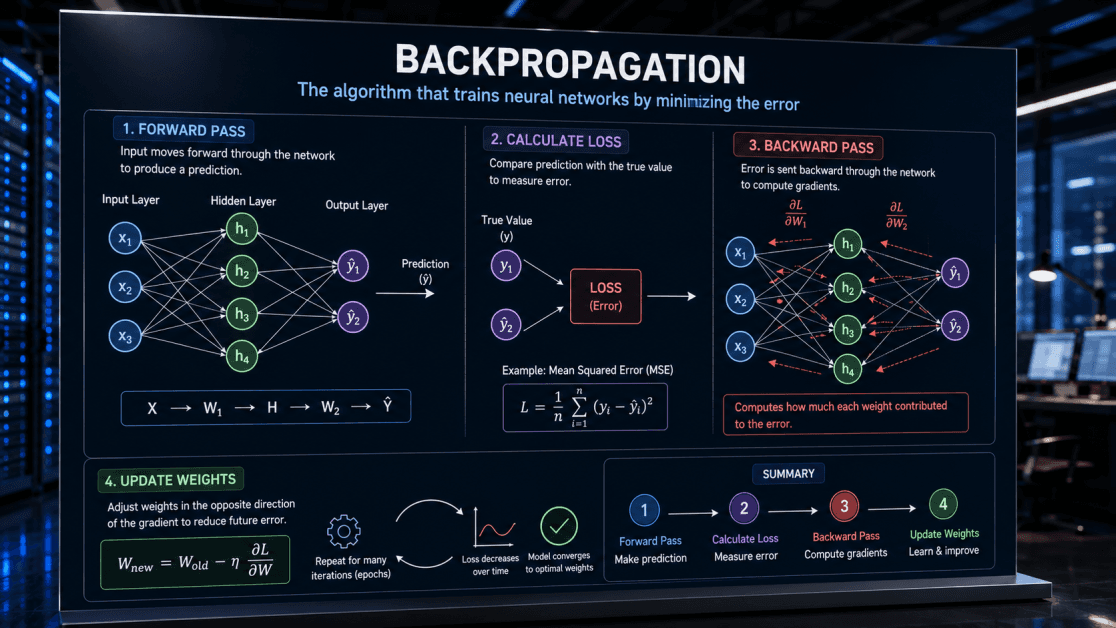
Backpropagation trains a neural network through several repeated steps.
1. Forward Pass
The input data is passed through the neural network.
Each layer processes the information until the model generates a prediction or output.
Examples include:
-
Classifying an image
-
Predicting stock prices
-
Translating text
-
Detecting spam emails
-
Recognizing speech
2. Calculate the Error
The predicted output is compared with the correct answer using a loss function.
The difference between the prediction and the actual result represents the model's error.
3. Backward Pass
The algorithm moves backward through the neural network, calculating how much each weight contributed to the error.
This process uses the chain rule from calculus to distribute the error across the network.
4. Update the Weights
Using optimization methods such as gradient descent, the model adjusts its weights and biases to reduce future errors.
The entire process is repeated many times until the model reaches an acceptable level of accuracy.
Key Characteristics of Backpropagation
1. Error Correction
Backpropagation enables neural networks to identify prediction errors and gradually reduce them during training.
2. Weight Optimization
The algorithm continuously updates neural network weights to improve learning performance.
3. Layer-by-Layer Learning
Backpropagation works through every layer of the neural network, allowing both shallow and deep models to learn complex patterns.
4. Continuous Improvement
Each training iteration helps the model become more accurate as it processes additional examples.
5. Foundation of Deep Learning
Backpropagation is one of the core algorithms used to train modern deep learning models.
Common Applications of Backpropagation
Backpropagation is widely used in AI applications such as:
-
Image recognition
-
Speech recognition
-
Natural language processing
-
Machine translation
-
Recommendation systems
-
Fraud detection
-
Medical diagnosis support
-
Autonomous vehicles
-
Financial forecasting
-
Robotics
-
Predictive analytics
-
Large language models
Benefits of Backpropagation
Enables Neural Network Learning
Backpropagation allows neural networks to improve automatically through repeated training.
Improves Prediction Accuracy
By continuously reducing errors, the algorithm helps AI models generate more accurate results over time.
Supports Deep Learning
Backpropagation makes it possible to train complex deep neural networks containing many hidden layers.
Works Across Many AI Applications
The algorithm supports computer vision, language processing, forecasting, robotics, healthcare, finance, and many other AI fields.
Highly Scalable
Backpropagation can train models ranging from simple neural networks to large-scale deep learning architectures.
Challenges of Backpropagation
High Computing Requirements
Training deep neural networks with backpropagation often requires significant computational power and specialized hardware.
Large Training Datasets
High-performing AI models usually depend on extensive, high-quality datasets.
Vanishing and Exploding Gradients
Very deep neural networks may experience mathematical challenges that make training difficult, although modern architectures include techniques to reduce these issues.
Training Time
Large AI models may require hours, days, or even weeks of training depending on their size and complexity.
Human Oversight
Developers must evaluate model performance, validate outputs, and ensure responsible AI development throughout the training process.
Best Practices for Using Backpropagation
Use High-Quality Training Data
Accurate and representative datasets improve model performance and generalization.
Choose Appropriate Learning Rates
Selecting suitable optimization settings helps models learn efficiently without becoming unstable.
Monitor Training Performance
Track loss, accuracy, and validation metrics throughout training to detect potential issues early.
Prevent Overfitting
Use techniques such as regularization, dropout, and validation datasets to improve model generalization.
Combine AI with Human Expertise
Backpropagation helps AI models learn from data, but human expertise remains essential for designing, evaluating, and deploying reliable systems.
Future of Backpropagation
Backpropagation continues to be the standard algorithm for training most deep learning models, including convolutional neural networks (CNNs), recurrent neural networks (RNNs), transformer models, and many foundation models. Researchers are actively developing more efficient optimization techniques, faster training methods, and hardware accelerators that reduce the computational cost of backpropagation.
Future innovations may improve energy efficiency, distributed training, federated learning, and training on specialized AI processors. Advances in automated machine learning (AutoML) and neural architecture search are also making it easier to design high-performing models that rely on backpropagation during training.
Responsible AI development will remain essential. As neural networks become larger and more capable, organizations will continue focusing on transparency, fairness, privacy, and human oversight to ensure AI systems are trained responsibly and deployed safely.
Conclusion
Backpropagation is one of the fundamental algorithms that makes modern artificial intelligence possible. By enabling neural networks to learn from their mistakes, it allows AI models to improve their accuracy through repeated training and optimization.
From image recognition and language processing to robotics and autonomous systems, backpropagation supports many of today's most advanced AI technologies. Its ability to optimize neural networks has made it a cornerstone of deep learning research and real-world AI applications.
As artificial intelligence continues to evolve, backpropagation will remain a critical part of training intelligent systems. Combined with high-quality data, powerful computing resources, and responsible human oversight, it helps build AI solutions that are more accurate, reliable, and useful across industries.
 What Is Backpropagation? AI Backpropagation Explained FAQs
POST A COMMENT (0)
All Comments (0)
Replies (0)