





What Is an Attention Mechanism? A Simple Guide
The attention mechanism is one of the most important breakthroughs in modern artificial intelligence. It enables AI models to focus on the most relevant parts of the input instead of treating every piece of information equally. This innovation has dramatically improved the performance of AI systems in natural language processing, computer vision, speech recognition, and many other fields.
Before attention mechanisms were introduced, many AI models struggled to process long sequences because they had difficulty remembering information from earlier inputs. The attention mechanism solved this challenge by allowing models to selectively focus on the most important words, images, or data points when making predictions.
Today, attention mechanisms power many of the world's most advanced AI systems, including large language models (LLMs), machine translation systems, AI chatbots, and multimodal AI models. Rather than replacing human intelligence, attention-based AI assists people by improving accuracy, efficiency, and the ability to process complex information.
What Is an Attention Mechanism?
An attention mechanism is a deep learning technique that enables an AI model to determine which parts of the input are most important for completing a specific task.
Instead of relying equally on every input, the model assigns different levels of importance—known as attention weights—to different pieces of information. This allows the AI to concentrate on the most relevant data while reducing the influence of less important information.
Attention mechanisms are widely used in transformer models, which have become the foundation of many modern AI applications.
How Does an Attention Mechanism Work?
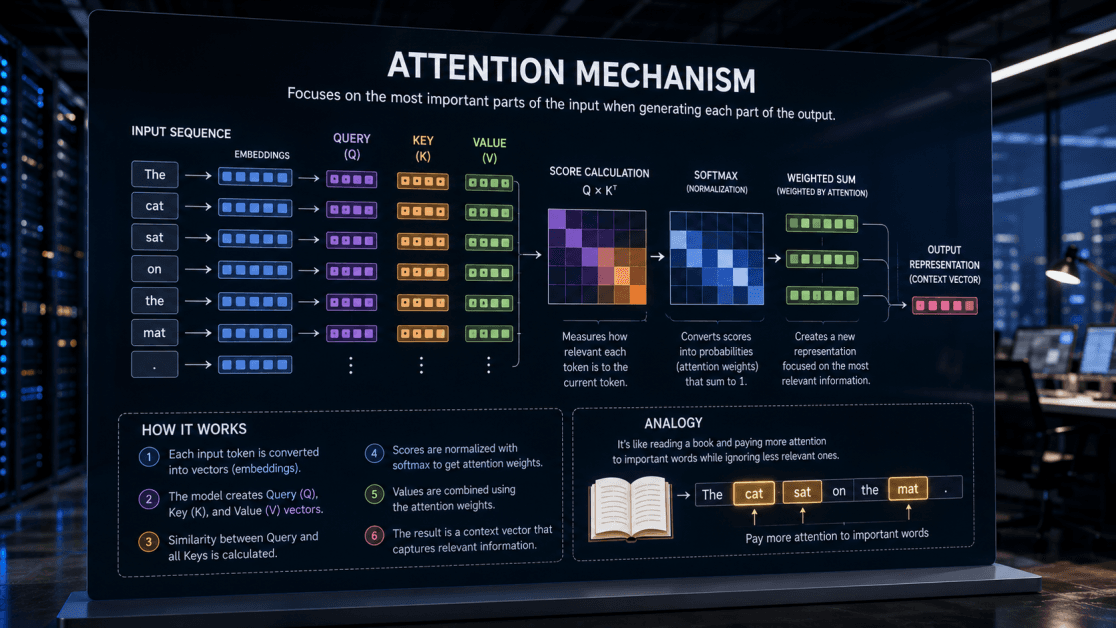
An attention mechanism helps AI identify relationships between different parts of the input through a series of steps.
1. Receive the Input
The AI model receives input such as:
-
A sentence
-
A paragraph
-
An image
-
Audio data
-
A sequence of numbers
-
Video frames
Each element is converted into mathematical representations that the model can process.
2. Calculate Attention Scores
The model compares different parts of the input and calculates how strongly each element relates to the current task.
Words or features that are more relevant receive higher attention scores.
3. Assign Attention Weights
Based on the calculated scores, the model assigns weights that determine how much attention each input should receive.
Important information has greater influence on the final prediction.
4. Generate the Output
The model combines the weighted information to produce a response, prediction, translation, summary, or other output.
Because it focuses on the most relevant context, the result is often more accurate than earlier neural network approaches.
Key Characteristics of Attention Mechanisms
1. Context Awareness
Attention mechanisms help AI understand relationships between different parts of the input, even when they are far apart.
2. Selective Focus
The model automatically emphasizes the most relevant information while reducing the importance of unrelated details.
3. Long-Range Understanding
Unlike many earlier neural networks, attention mechanisms can effectively process long documents and lengthy conversations without losing important context.
4. Parallel Processing
Attention-based models can process multiple parts of the input simultaneously, making training and inference more efficient than many sequential models.
5. Foundation of Transformer Models
Attention mechanisms are the core technology behind transformer architectures that power many modern AI systems.
Common Applications of Attention Mechanisms
Attention mechanisms are widely used across artificial intelligence applications, including:
-
Large Language Models (LLMs)
-
AI chatbots
-
Machine translation
-
Text summarization
-
Question answering
-
Speech recognition
-
Image captioning
-
Computer vision
-
Search engines
-
Recommendation systems
-
Medical AI
-
Autonomous vehicles
Benefits of Attention Mechanisms
Better Understanding of Context
Attention enables AI to understand relationships between words, sentences, or visual features more effectively.
Improved Accuracy
By focusing on the most relevant information, attention mechanisms often improve the quality of predictions and generated content.
Efficient Processing
Attention-based models can process information in parallel, reducing training time compared to many earlier sequential models.
Supports Complex AI Tasks
Attention mechanisms enable AI systems to perform translation, summarization, reasoning, and multimodal understanding with greater effectiveness.
Foundation for Modern AI
Most state-of-the-art language models and many vision models rely on attention mechanisms as a core component of their architecture.
Challenges of Attention Mechanisms
High Computing Requirements
Large attention-based models require significant computational resources, memory, and specialized hardware for training and deployment.
Large Training Data
High-performance attention models generally depend on extensive, high-quality datasets.
Interpretation Challenges
Although attention scores provide some insight into model behavior, understanding exactly why a model reaches a particular decision can still be difficult.
Bias in Training Data
Attention mechanisms may reflect biases present in the data used during training, making ongoing evaluation and mitigation important.
Human Oversight
AI-generated outputs should always be reviewed by qualified users, especially in applications involving healthcare, finance, law, or other high-stakes decisions.
Best Practices for Using Attention Mechanisms
Use High-Quality Data
Training with accurate, diverse, and representative datasets improves model performance and reliability.
Validate AI Outputs
Review predictions and generated content before relying on them in professional or critical applications.
Monitor Model Performance
Continuously evaluate attention-based models to ensure they remain accurate, fair, and aligned with intended objectives.
Protect Sensitive Information
Follow appropriate privacy and cybersecurity practices when processing confidential data.
Combine AI with Human Expertise
Use attention-based AI as a decision-support tool while maintaining human judgment and oversight.
Future of Attention Mechanisms
Attention mechanisms are expected to remain a cornerstone of artificial intelligence as researchers continue improving transformer architectures and developing more efficient attention algorithms. Ongoing innovations aim to reduce computational costs while enabling AI models to process increasingly large amounts of information.
Future AI systems are likely to combine attention mechanisms with multimodal learning, allowing models to understand text, images, audio, video, and structured data within a single architecture. These advances could improve applications in healthcare, education, scientific research, autonomous systems, and enterprise software.
Researchers are also exploring more efficient forms of attention that require less memory and computing power, making advanced AI accessible on a wider range of devices, including smartphones and edge computing platforms.
As attention-based AI continues to evolve, responsible development will remain essential. Transparency, fairness, privacy, and human oversight will continue guiding the deployment of these powerful technologies across industries.
Conclusion
The attention mechanism represents one of the most significant innovations in artificial intelligence. By enabling AI models to focus on the most relevant information, it has dramatically improved the ability of machines to understand language, analyze images, process speech, and solve complex problems.
Today, attention mechanisms form the foundation of transformer models and many of the world's leading AI systems. Their ability to process context efficiently has transformed natural language processing and expanded AI capabilities across numerous industries.
As AI technology continues to advance, attention mechanisms will remain central to building more accurate, efficient, and intelligent systems. When combined with human expertise and responsible AI practices, they help unlock new opportunities while supporting better decision-making and productivity.
 What Is an Attention Mechanism? AI Attention Explained FAQs
POST A COMMENT (0)
All Comments (0)
Replies (0)