What Is One-Shot Learning? A Simple Guide
Most machine learning models require hundreds, thousands, or even millions of labeled examples before they can accurately recognize patterns or make predictions. Humans, however, often learn to recognize something new after seeing it only once. One-shot learning aims to give AI systems a similar ability.
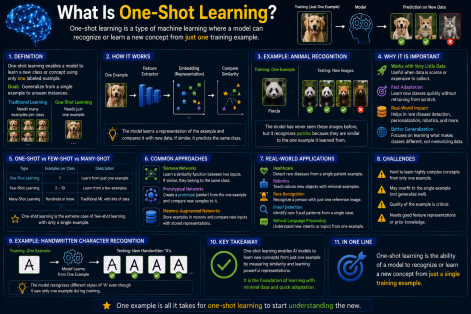
One-shot learning enables an artificial intelligence model to recognize or learn a new concept from just one labeled example. Instead of relying on large training datasets for every new task, the model uses knowledge gained from previous learning to understand and classify new examples with minimal additional data.
Today, one-shot learning is used in facial recognition, medical imaging, product identification, handwriting recognition, robotics, and other applications where collecting large labeled datasets is difficult or expensive. While it greatly reduces data requirements, human expertise remains essential for designing models, evaluating results, and ensuring reliable performance.
What Is One-Shot Learning?
One-shot learning is a machine learning approach in which an AI model learns to recognize or classify a new category using only a single labeled training example.
Rather than memorizing the single example, the model compares it with previously learned representations and identifies similarities that allow it to recognize related data.
This capability is often achieved using techniques such as metric learning, contrastive learning, Siamese neural networks, or meta learning.
How Does One-Shot Learning Work?
One-shot learning typically follows several stages.
1. Pretrain the Model
Before one-shot learning begins, the model is trained on many related tasks or categories.
Examples include:
-
Images
-
Text
-
Audio
-
Medical scans
-
Handwritten characters
This stage helps the model learn general feature representations.
2. Receive One Example
The model is given a single labeled example from a new category.
For example:
-
One image of a new product
-
One handwritten character
-
One person's face
-
One medical image
3. Compare Similarities
Instead of learning from scratch, the model compares the new example with previously learned representations.
It measures how similar new inputs are to the single labeled example.
4. Make Predictions
When new data arrives, the model determines whether it belongs to the new category based on learned similarity patterns.
Common Approaches to One-Shot Learning
1. Siamese Neural Networks
Two identical neural networks compare pairs of inputs and determine how similar they are.
2. Metric Learning
The model learns an embedding space where similar examples are close together and different examples are farther apart.
3. Meta Learning
The model learns strategies that enable rapid adaptation to new tasks using very little data.
4. Prototype-Based Learning
The model creates a representative embedding (prototype) for each category and compares new examples against it.
Key Characteristics of One-Shot Learning
1. Learns from One Example
Only a single labeled sample is required for each new category.
2. Uses Prior Knowledge
The model relies on knowledge learned during earlier training rather than starting from scratch.
3. Focuses on Similarity
Predictions are based on comparing relationships between examples.
4. Reduces Data Requirements
Large labeled datasets are unnecessary for every new task.
5. Supports Rapid Adaptation
Models can quickly recognize new categories without lengthy retraining.
Common Applications of One-Shot Learning
One-shot learning is widely used in:
-
Facial recognition
-
Image classification
-
Handwriting recognition
-
Medical diagnosis support
-
Product identification
-
Document verification
-
Natural language processing (NLP)
-
Robotics
-
Biometric authentication
-
Wildlife identification
-
Industrial quality inspection
-
Scientific research
Benefits of One-Shot Learning
Requires Minimal Labeled Data
Only one example is needed to introduce a new category.
Reduces Annotation Costs
Organizations spend less time collecting and labeling large datasets.
Enables Fast Deployment
New classes can be added quickly without retraining large models from scratch.
Supports Rare Categories
One-shot learning is valuable when only a few examples exist, such as rare diseases or endangered species.
Improves Scalability
AI systems can adapt to new categories more efficiently.
Challenges of One-Shot Learning
Depends on Strong Pretraining
Performance relies heavily on the quality and diversity of the model's prior training.
Limited Information
A single example may not capture all variations within a category.
Similar Categories Can Be Difficult
Closely related classes may be harder to distinguish accurately.
Computational Requirements
Training the underlying representation-learning model may still require significant computing resources.
Human Expertise Required
Developers must carefully design the model, evaluate predictions, and ensure reliable performance before deployment.
Best Practices for One-Shot Learning
Use High-Quality Pretraining
Train the model on diverse and representative datasets before applying one-shot learning.
Choose Robust Similarity Methods
Use well-designed embedding and comparison techniques to improve accuracy.
Evaluate on Unseen Categories
Test the model using categories not encountered during training.
Monitor Real-World Performance
Continuously assess performance after deployment and update the model when needed.
Combine with Other Learning Methods
Integrate one-shot learning with transfer learning, meta learning, or contrastive learning where appropriate.
Future of One-Shot Learning
One-shot learning is expected to play an increasingly important role as AI systems become more adaptable and data-efficient. Researchers are developing models that can recognize entirely new concepts from extremely limited examples while maintaining high accuracy across diverse tasks.
Advances in foundation models, multimodal AI, self-supervised learning, and meta learning are improving one-shot learning capabilities by providing richer feature representations that transfer effectively to new domains. These developments are particularly valuable in healthcare, robotics, cybersecurity, scientific research, and personalized AI applications where labeled data may be scarce.
As artificial intelligence continues to evolve, one-shot learning will remain an important technique for building AI systems that learn quickly from limited information. Combined with high-quality pretraining, careful evaluation, and responsible human oversight, it will help make AI more flexible and practical across a wide range of real-world applications.
Conclusion
One-shot learning is a machine learning approach that enables AI models to recognize or classify new categories using only a single labeled example. By leveraging knowledge gained during earlier training, these models can adapt quickly without requiring large datasets for every new task.
From facial recognition and medical imaging to robotics and document verification, one-shot learning is helping organizations build more efficient AI systems capable of learning from limited data. Its focus on similarity-based learning makes it especially useful when collecting large labeled datasets is impractical.
As AI technology continues to advance, one-shot learning will remain an important approach for developing intelligent systems that can learn rapidly, adapt efficiently, and perform reliably even when only a small amount of data is available.