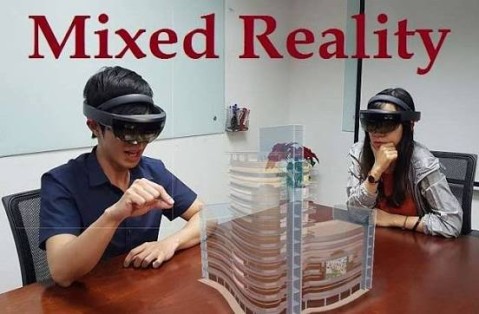
What Is Mixed Reality (MR)? How It Works, Uses and Benefits
Mixed Reality (MR) is an immersive technology that blends the physical and digital worlds, allowing real and virtual objects to coexist and interact in real time. Unlike Augmented Reality (AR), which simply overlays digital content onto the real world, Mixed Reality enables digital objects to understand, respond to, and interact with the surrounding physical environment.
MR combines elements of both Virtual Reality (VR) and Augmented Reality (AR) to create interactive experiences where users can manipulate virtual objects as though they were part of the real world.
Today, Mixed Reality is being used in healthcare, manufacturing, engineering, education, architecture, defense, retail, and enterprise collaboration.
What Is Mixed Reality (MR)?

Mixed Reality is a technology that merges physical and digital environments so users can interact naturally with both real-world objects and computer-generated content.
How Mixed Reality Works
Mixed Reality systems use cameras, depth sensors, spatial mapping, computer vision, Artificial Intelligence (AI), and advanced software to understand the user's surroundings. Specialized headsets or smart glasses continuously map the environment and place digital objects within it. These virtual objects can remain anchored to physical locations, respond to user movements, and even interact with real-world surfaces.
Why Mixed Reality Matters
Mixed Reality enables immersive collaboration, visualization, training, and decision-making by seamlessly integrating digital information into the real world.
Key Components of Mixed Reality
Several technologies work together to create MR experiences.
MR Headset or Smart Glasses
Wearable devices display digital content while allowing users to see their physical surroundings.
Spatial Mapping
The system creates a three-dimensional map of the environment to accurately position virtual objects.
Computer Vision
AI-powered computer vision identifies objects, surfaces, and user movements.
Motion Tracking
Sensors continuously track head, eye, and hand movements to enable natural interaction.
Spatial Audio
Three-dimensional audio enhances immersion by placing sounds within the surrounding environment.
Types of Mixed Reality Experiences
Mixed Reality can support different levels of interaction.
Collaborative Mixed Reality
Multiple users interact with the same digital content in a shared physical or virtual space.
Industrial Mixed Reality
Workers receive real-time visual instructions, equipment data, and maintenance guidance.
Interactive Visualization
Digital models respond to gestures, movement, and environmental changes.
Remote Assistance
Experts guide field technicians through complex procedures using shared mixed reality environments.
Common Applications of Mixed Reality
MR is transforming numerous industries.
Healthcare
Doctors use MR for surgical planning, medical training, anatomy visualization, and remote collaboration.
Manufacturing
Engineers receive interactive assembly instructions and equipment maintenance guidance.
Education
Students explore interactive 3D models, scientific simulations, and virtual laboratories.
Architecture and Construction
Architects visualize buildings within real construction sites before projects begin.
Retail
Customers view and customize products within their own physical environments.
Defense and Aviation
Military personnel and pilots use MR for mission planning and realistic training simulations.
Business Collaboration
Teams collaborate on 3D models, engineering designs, and virtual workspaces regardless of location.
Benefits of Mixed Reality
MR offers numerous advantages.
Better Visualization
Complex designs and data become easier to understand through interactive 3D models.
Improved Productivity
Workers receive contextual information while keeping their hands free.
Enhanced Training
Employees practice procedures in realistic environments without physical risks.
Remote Collaboration
Experts can assist teams anywhere in the world using shared mixed reality experiences.
Better Decision-Making
Organizations can evaluate products, buildings, and workflows before physical implementation.
Challenges of Mixed Reality
Despite its benefits, MR presents several challenges.
High Hardware Costs
Advanced mixed reality headsets remain expensive for many organizations.
Processing Requirements
Real-time environment mapping and graphics rendering require significant computing power.
Content Development
Creating high-quality MR applications requires specialized development skills.
Privacy Concerns
Cameras and sensors continuously collect environmental information, requiring strong privacy protections.
Mixed Reality vs. AR vs. VR
These immersive technologies have different capabilities.
Mixed Reality (MR)
- Digital and physical objects interact with each other.
- Virtual content understands and responds to the environment.
- Provides highly interactive experiences.
Augmented Reality (AR)
- Overlays digital content onto the real world.
- Digital objects generally do not interact extensively with physical surroundings.
Virtual Reality (VR)
- Replaces the real world with a completely virtual environment.
- Users become fully immersed in computer-generated experiences.
Best Practices for Using Mixed Reality
Organizations should follow these recommendations.
Focus on Real-World Value
Develop MR applications that improve productivity, learning, collaboration, or decision-making.
Optimize User Comfort
Design comfortable interfaces with accurate tracking and minimal latency.
Secure Sensitive Data
Protect environmental scans, user interactions, and organizational information.
Test Across Environments
Ensure reliable performance under different lighting and physical conditions.
Train Users
Provide guidance so users can interact naturally with mixed reality systems.
Future of Mixed Reality
Mixed Reality continues to evolve through Artificial Intelligence, spatial computing, 5G, cloud rendering, edge computing, eye tracking, and lightweight wearable devices. AI-powered MR systems are becoming more intelligent by recognizing objects, understanding user intent, and enabling natural voice and gesture interactions. As hardware becomes smaller and more affordable, Mixed Reality is expected to play a major role in enterprise productivity, healthcare, education, engineering, and next-generation digital collaboration.
Conclusion
Mixed Reality represents the next step in immersive computing by combining the strengths of Augmented Reality and Virtual Reality into a single interactive experience. By allowing digital objects to coexist and interact with the physical world, MR is transforming industries through better visualization, collaboration, training, and decision-making. As advances in AI, spatial computing, and wearable technology continue, Mixed Reality is poised to become an increasingly important part of everyday work and life.