What Is Knowledge Representation? A Simple Guide
Artificial intelligence systems need more than data to solve complex problems—they also need a structured way to organize information so they can reason, make decisions, and answer questions. This structured organization of information is known as knowledge representation (KR).
Knowledge representation enables AI systems to describe real-world objects, concepts, relationships, and rules in a format that computers can understand and process. Instead of storing information as isolated facts, AI organizes knowledge so it can infer new information, solve problems, and explain decisions.
Knowledge representation is a foundational concept in artificial intelligence and is widely used in expert systems, knowledge graphs, semantic search, robotics, healthcare, natural language processing (NLP), and enterprise AI. Human experts remain essential for designing knowledge structures, validating information, and ensuring that AI systems reason accurately and responsibly.
What Is Knowledge Representation?
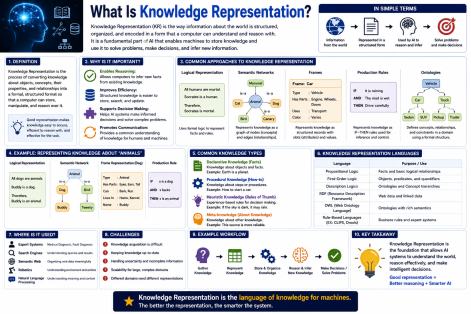
Knowledge representation (KR) is the process of organizing facts, concepts, relationships, and rules in a structured format that allows an AI system to reason, make decisions, and solve problems.
A knowledge representation system not only stores information but also enables the AI to use that information to answer questions, draw conclusions, and support intelligent behavior.
For example, instead of storing only the facts:
-
Paris is the capital of France.
-
France is in Europe.
A knowledge representation system can also infer that:
-
Paris is a city in Europe.
This ability to derive new knowledge makes knowledge representation a key part of intelligent systems.
How Does Knowledge Representation Work?
Knowledge representation follows a structured process.
1. Collect Knowledge
Information is gathered from reliable sources such as:
-
Human experts
-
Documents
-
Databases
-
Scientific research
-
Business rules
-
Public datasets
2. Organize Information
The collected knowledge is structured into meaningful elements such as:
-
Objects
-
Concepts
-
Facts
-
Relationships
-
Rules
-
Categories
3. Store Knowledge
The organized information is stored in a knowledge base using suitable representation techniques.
4. Apply Reasoning
An inference engine or reasoning system uses the stored knowledge to answer questions, solve problems, or generate recommendations.
5. Update Knowledge
Knowledge bases are continuously reviewed and updated as new information becomes available.
Common Types of Knowledge Representation
1. Logical Representation
Uses formal logic and mathematical rules to represent knowledge and perform reasoning.
2. Semantic Networks
Represent knowledge as connected nodes and relationships, similar to a graph.
Example:
-
Dog → is an → Animal
-
Animal → has → Cells
3. Frames
Organize information into structured records containing attributes and values.
For example, a "Car" frame may include:
-
Manufacturer
-
Model
-
Color
-
Engine Type
4. Production Rules
Represent knowledge using IF-THEN rules.
Example:
-
IF a customer is a premium member, THEN apply a discount.
5. Ontologies
Define concepts, categories, properties, and relationships within a domain, helping different AI systems share a common understanding.
Key Characteristics of Knowledge Representation
1. Structured Information
Knowledge is organized in formats that computers can efficiently process.
2. Supports Reasoning
AI systems can infer new facts from existing knowledge.
3. Enables Decision-Making
Knowledge representation provides the foundation for intelligent recommendations and problem-solving.
4. Improves Explainability
Many knowledge-based systems can show how they reached a conclusion.
5. Domain Adaptability
Knowledge representation techniques can be customized for different industries and applications.
Common Applications of Knowledge Representation
Knowledge representation is widely used in:
-
Expert systems
-
Knowledge graphs
-
Search engines
-
Question-answering systems
-
Virtual assistants
-
Healthcare decision support
-
Legal technology
-
Financial services
-
Robotics
-
Semantic web technologies
-
Enterprise knowledge management
-
Scientific research
Benefits of Knowledge Representation
Enables Intelligent Reasoning
AI systems can derive new conclusions from existing information.
Improves Decision Support
Structured knowledge helps AI generate more accurate recommendations.
Supports Explainable AI
Logical reasoning makes many decisions easier to understand and audit.
Organizes Complex Information
Large amounts of knowledge can be stored and managed efficiently.
Promotes Knowledge Reuse
The same knowledge base can support multiple AI applications.
Challenges of Knowledge Representation
Knowledge Acquisition
Collecting and organizing expert knowledge can be difficult and time-consuming.
Keeping Knowledge Updated
Knowledge bases require continuous maintenance as information changes.
Handling Ambiguity
Real-world concepts are often incomplete, uncertain, or context-dependent.
Scalability
Large knowledge bases become increasingly complex to manage.
Human Expertise Required
Experts must design, validate, and maintain knowledge structures to ensure accurate reasoning and reliable decision-making.
Knowledge Representation vs Machine Learning
| Feature | Knowledge Representation | Machine Learning |
|---|---|---|
| Primary Focus | Organizing and reasoning with knowledge | Learning patterns from data |
| Knowledge Source | Human-defined facts and relationships | Training datasets |
| Decision Method | Logical reasoning | Statistical prediction |
| Explainability | Usually high | Often lower, depending on the model |
| Best For | Reasoning and structured knowledge | Pattern recognition and prediction |
Best Practices for Knowledge Representation
Use Accurate Knowledge Sources
Build knowledge bases using reliable and verified information.
Select the Right Representation Method
Choose logical rules, semantic networks, frames, ontologies, or production rules based on the application.
Keep Knowledge Organized
Maintain clear relationships and consistent structures throughout the knowledge base.
Validate Knowledge Regularly
Review information with domain experts to maintain accuracy.
Combine with Modern AI
Integrate knowledge representation with machine learning, knowledge graphs, or neuro-symbolic AI for more capable intelligent systems.
Future of Knowledge Representation
Knowledge representation is becoming increasingly important as AI systems are expected to provide more accurate, explainable, and trustworthy decisions. Researchers are combining traditional knowledge representation techniques with machine learning, large language models (LLMs), knowledge graphs, and neuro-symbolic AI to improve reasoning while preserving the ability to learn from data.
Advances in semantic technologies, automated knowledge extraction, and graph databases are making it easier to build and maintain large-scale knowledge bases. These innovations are supporting applications in healthcare, finance, scientific research, enterprise search, robotics, and intelligent assistants.
As artificial intelligence continues to evolve, knowledge representation will remain a fundamental component of intelligent systems. Together with human expertise, responsible governance, and continuous updates, it will help AI reason more effectively, explain its decisions, and solve increasingly complex real-world problems.
Conclusion
Knowledge representation is the process of organizing facts, concepts, relationships, and rules so that artificial intelligence systems can reason, make decisions, and solve problems. It forms the foundation of many AI technologies by enabling computers to understand and use structured knowledge rather than simply storing raw data.
From expert systems and knowledge graphs to virtual assistants and enterprise AI, knowledge representation plays a central role in building explainable and intelligent applications. Its ability to support logical reasoning makes it especially valuable in domains where transparency and accurate decision-making are essential.
As AI technology advances, knowledge representation will continue working alongside machine learning and other modern techniques to create smarter, more reliable, and more explainable artificial intelligence systems.