What Is Contrastive Learning? A Simple Guide
Artificial intelligence (AI) systems become more effective when they learn meaningful patterns from data rather than simply memorizing examples. One powerful technique for achieving this is contrastive learning, which teaches AI models by comparing similar and different data samples.
Instead of relying entirely on manually labeled datasets, contrastive learning helps models learn rich representations by recognizing which examples should be close together and which should remain far apart in the model's internal representation. This approach has become a cornerstone of modern self-supervised learning and is widely used in computer vision, natural language processing (NLP), speech recognition, recommendation systems, and multimodal AI.
Today, contrastive learning supports many foundation models and advanced AI systems. Although it reduces the need for large labeled datasets, human expertise remains important for designing training strategies, evaluating results, and deploying models responsibly.
What Is Contrastive Learning?
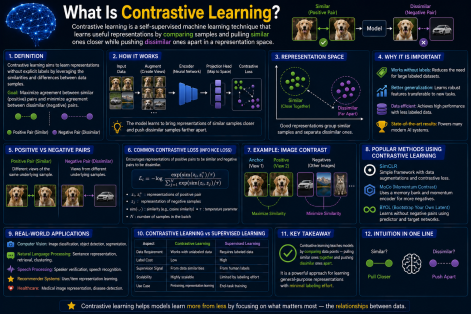
Contrastive learning is a machine learning technique in which an AI model learns by comparing pairs or groups of data samples.
The objective is simple:
-
Similar samples should have similar internal representations.
-
Different samples should have distinct internal representations.
For example, two different photos of the same cat should be recognized as similar, while a photo of a cat and a photo of a bicycle should be represented as different.
By repeatedly learning these relationships, the model develops useful features that can later be adapted to many AI tasks.
How Does Contrastive Learning Work?
Contrastive learning follows a structured training process.
1. Collect Data
The model begins with a dataset that may contain:
-
Images
-
Text
-
Audio
-
Videos
-
Sensor data
-
Multimodal data
Large amounts of labeled data are often unnecessary because many contrastive methods work in a self-supervised manner.
2. Create Sample Pairs
The training process creates relationships between examples.
Examples include:
Positive pairs
-
Two augmented versions of the same image
-
Matching image-text pairs
-
Similar audio recordings
Negative pairs
-
Different objects
-
Unrelated text
-
Different speakers
-
Unrelated images
3. Learn Representations
The model processes each sample and converts it into a mathematical representation known as an embedding.
The training objective encourages:
-
Positive pairs to move closer together.
-
Negative pairs to move farther apart.
4. Fine-Tune for Specific Tasks
Once pretrained, the learned representations can be adapted for applications such as:
-
Image classification
-
Object detection
-
Search and retrieval
-
Recommendation systems
-
Medical diagnosis support
Common Types of Contrastive Learning
1. Self-Supervised Contrastive Learning
Learns from unlabeled data by creating positive pairs through data augmentation.
2. Supervised Contrastive Learning
Uses class labels to identify which samples should be considered similar.
3. Multimodal Contrastive Learning
Learns relationships across different types of data, such as matching images with text descriptions or audio with video.
4. Metric Learning
Focuses on learning an embedding space where similar samples are close together and different samples are separated by meaningful distances.
Key Characteristics of Contrastive Learning
1. Learns from Comparisons
The model improves by comparing relationships between data samples.
2. Builds Strong Representations
Contrastive learning creates feature representations that transfer well to many downstream tasks.
3. Reduces Dependence on Labels
Many contrastive learning methods require little or no manually labeled data.
4. Supports Transfer Learning
Pretrained representations can be fine-tuned for specialized applications.
5. Works Across Multiple Data Types
Contrastive learning can be applied to images, text, audio, video, and multimodal datasets.
Common Applications of Contrastive Learning
Contrastive learning is widely used in:
-
Computer vision
-
Image recognition
-
Natural language processing (NLP)
-
Large Language Models (LLMs)
-
Image search
-
Recommendation systems
-
Facial recognition
-
Speech recognition
-
Medical imaging
-
Robotics
-
Autonomous vehicles
-
Multimodal AI
Benefits of Contrastive Learning
Learns Powerful Feature Representations
Models develop meaningful embeddings that improve performance on many tasks.
Reduces Labeling Costs
Many implementations require little or no manually labeled data.
Improves Transfer Learning
Pretrained representations can be reused across multiple applications.
Supports Large AI Models
Contrastive learning is widely used in modern foundation models and multimodal AI systems.
Broad Industry Adoption
Industries including healthcare, retail, manufacturing, education, and scientific research use contrastive learning to build more capable AI models.
Challenges of Contrastive Learning
Requires Careful Pair Selection
The quality of positive and negative sample pairs significantly influences model performance.
Computational Requirements
Training large contrastive models often requires substantial computing resources.
Hyperparameter Tuning
Factors such as batch size, embedding dimension, and temperature parameters require careful optimization.
Data Quality Matters
Poor-quality or biased datasets can reduce representation quality.
Human Expertise Required
Developers must design training strategies, evaluate learned representations, and ensure responsible AI deployment.
Best Practices for Contrastive Learning
Use Diverse Training Data
High-quality and representative datasets improve learned representations.
Create Meaningful Positive Pairs
Ensure similar samples genuinely represent the same underlying concept.
Balance Positive and Negative Examples
A well-designed training dataset helps the model distinguish meaningful similarities and differences.
Evaluate on Downstream Tasks
Test pretrained representations across real-world applications before deployment.
Monitor Fairness and Robustness
Assess models for bias, reliability, and consistent performance across different datasets.
Future of Contrastive Learning
Contrastive learning is expected to remain a major area of AI research as foundation models and multimodal systems continue to evolve. Researchers are developing more efficient contrastive methods that require fewer computational resources while producing stronger and more transferable representations.
Future AI systems are also expected to combine contrastive learning with self-supervised learning, generative modeling, and reinforcement learning to improve understanding across text, images, audio, video, and other forms of data. These advances will support applications ranging from healthcare and robotics to scientific discovery and autonomous systems.
As artificial intelligence continues to advance, contrastive learning will remain an important technique for building scalable and adaptable AI models. Combined with high-quality data, robust evaluation, and responsible human oversight, it will continue driving progress across many AI applications.
Conclusion
Contrastive learning is a machine learning technique that teaches AI models by comparing similar and different data samples. By learning to group related examples and separate unrelated ones, it creates rich feature representations that can be adapted to a wide variety of downstream tasks.
From computer vision and natural language processing to multimodal AI and recommendation systems, contrastive learning has become a key component of modern artificial intelligence. Its ability to learn from limited labeled data makes it especially valuable in today's data-driven world.
As AI technology continues to evolve, contrastive learning will remain a foundational approach for developing accurate, efficient, and versatile machine learning systems capable of solving increasingly complex real-world problems.