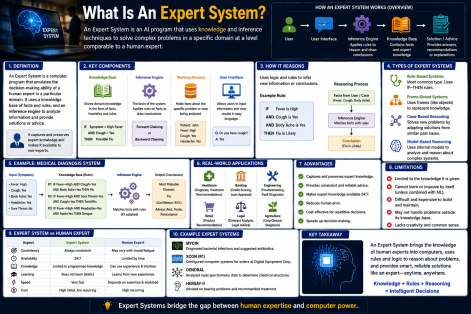
What Is an Expert System? A Simple Guide
One of the earliest practical applications of artificial intelligence was the expert system—a computer program designed to solve problems by applying the knowledge and reasoning techniques of human specialists. Before modern machine learning became widespread, expert systems helped organizations make complex decisions in areas such as medicine, finance, engineering, and manufacturing.
Unlike AI models that learn patterns from large datasets, expert systems rely on a collection of human-defined knowledge and logical rules. They analyze facts, apply reasoning, and recommend solutions much like a human expert would within a specific domain.
Although today's AI landscape is dominated by machine learning and deep learning, expert systems continue to be used in industries where explainability, consistency, and rule-based decision-making are essential. Human experts remain responsible for building, updating, and validating the knowledge that these systems use.
What Is an Expert System?
An expert system is an artificial intelligence program that uses a knowledge base and an inference engine to solve problems or make decisions in a specialized field.
The system stores knowledge provided by human experts and applies logical rules to analyze information and generate recommendations or conclusions.
For example, an expert system may:
-
Suggest possible medical conditions based on symptoms.
-
Recommend financial decisions using predefined rules.
-
Help troubleshoot equipment failures.
-
Assist with legal or regulatory compliance.
Rather than learning automatically from data, an expert system depends on carefully designed knowledge and reasoning.
How Does an Expert System Work?
An expert system follows a structured decision-making process.
1. Receive Input
The user provides information related to a specific problem.
Examples include:
-
Patient symptoms
-
Equipment status
-
Financial data
-
Customer information
-
Technical measurements
2. Search the Knowledge Base
The system compares the input with facts, rules, and expert knowledge stored in its knowledge base.
3. Apply Logical Reasoning
An inference engine evaluates the available rules.
For example:
-
If a machine overheats and vibration is high, recommend maintenance.
-
If income exceeds a threshold, apply a specific tax rule.
4. Generate a Recommendation
The system provides a diagnosis, recommendation, explanation, or decision based on the applicable rules.
Many expert systems can also explain which rules were used to reach their conclusion.
Key Components of an Expert System
1. Knowledge Base
The knowledge base stores domain-specific facts, rules, and relationships provided by experts.
2. Inference Engine
The inference engine applies logical reasoning to determine which rules match the available information.
3. User Interface
The user interface allows people to enter information and receive recommendations.
4. Explanation System
Many expert systems include an explanation component that shows how a decision was reached.
5. Knowledge Acquisition Module
This component helps collect, organize, and update knowledge from domain experts.
Key Characteristics of an Expert System
1. Knowledge-Based
The system depends on expert knowledge rather than learning directly from large datasets.
2. Rule-Based Reasoning
Decisions are made using logical IF-THEN rules.
3. Explainable
Most expert systems can explain the reasoning behind their recommendations.
4. Domain Specific
Expert systems are designed to solve problems within a particular field or industry.
5. Consistent Decision-Making
The same inputs generally produce the same outputs when the knowledge base remains unchanged.
Common Applications of Expert Systems
Expert systems are widely used in:
-
Medical diagnosis support
-
Financial planning
-
Banking and insurance
-
Tax preparation
-
Legal advisory systems
-
Industrial equipment maintenance
-
Manufacturing quality control
-
Customer support
-
Network troubleshooting
-
Cybersecurity
-
Agriculture
-
Educational tutoring systems
Benefits of Expert Systems
Provides Expert-Level Guidance
Organizations can capture and reuse specialized knowledge across teams.
Produces Consistent Decisions
The system applies rules consistently without fatigue or inconsistency.
Highly Explainable
Users can often understand how recommendations were generated.
Improves Productivity
Expert systems help automate repetitive decision-making tasks.
Supports Decision Making
They assist professionals by providing recommendations rather than replacing human judgment.
Challenges of Expert Systems
Knowledge Acquisition Is Difficult
Gathering and organizing expert knowledge can be time-consuming.
Limited Learning Ability
Traditional expert systems do not automatically improve through experience or new data.
Maintenance Requirements
Rules and knowledge bases must be updated as regulations, technologies, and best practices evolve.
Limited Flexibility
Expert systems perform best in structured domains with clearly defined rules.
Human Expertise Required
Experts are needed to create, validate, and maintain the knowledge base to ensure reliable recommendations.
Expert Systems vs Machine Learning
| Feature | Expert Systems | Machine Learning |
|---|---|---|
| Knowledge Source | Human experts | Training data |
| Learning Ability | Manual updates | Learns from data |
| Decision Method | Rule-based reasoning | Statistical prediction |
| Explainability | Usually high | Often lower, depending on the model |
| Best For | Structured rule-based problems | Pattern recognition and prediction |
Best Practices for Expert Systems
Build a High-Quality Knowledge Base
Ensure expert knowledge is accurate, complete, and regularly reviewed.
Keep Rules Simple and Organized
Well-structured rules improve maintainability and reduce conflicts.
Validate Recommendations
Test the system using real-world scenarios before deployment.
Update Knowledge Regularly
Reflect changes in regulations, industry standards, and expert practices.
Combine with Modern AI
Use expert systems alongside machine learning when applications require both reasoning and pattern recognition.
Future of Expert Systems
Expert systems continue to evolve as organizations seek AI solutions that are transparent, reliable, and easy to audit. Researchers are increasingly combining expert systems with machine learning, knowledge graphs, and neuro-symbolic AI to create hybrid systems that can both learn from data and apply logical reasoning.
These modern expert systems are being used in healthcare, finance, manufacturing, cybersecurity, and scientific research to improve decision support while maintaining explainability. Cloud computing, automation, and advanced knowledge management tools are also making expert systems easier to deploy and maintain.
As artificial intelligence advances, expert systems are expected to remain an important technology for applications where consistent reasoning, regulatory compliance, and explainable decisions are essential. Working alongside newer AI techniques, they will continue supporting professionals across many industries.
Conclusion
An expert system is an artificial intelligence program that applies human expert knowledge and logical reasoning to solve specialized problems. By using a knowledge base and an inference engine, it provides recommendations, diagnoses, or decisions based on predefined rules.
Although machine learning now powers many modern AI applications, expert systems remain valuable in industries that require explainable, consistent, and rule-based decision-making. Their ability to capture expert knowledge makes them useful for supporting professionals rather than replacing them.
As AI technology continues to develop, expert systems are increasingly being combined with modern machine learning techniques, creating hybrid AI systems that offer both intelligent learning and transparent reasoning.