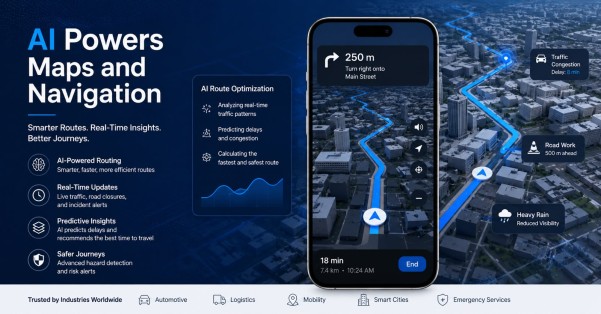
How AI Powers Maps and Navigation: A Complete Guide
Digital maps have evolved far beyond simply showing roads and directions. Today, artificial intelligence helps navigation systems predict traffic, recommend the fastest routes, estimate arrival times, identify road closures, and even suggest alternative paths before congestion develops.
Modern AI-powered navigation combines GPS technology, machine learning, computer vision, cloud computing, and real-time traffic data to provide accurate and dynamic route guidance. Instead of relying only on static maps, AI continuously analyzes changing road conditions to help drivers, cyclists, delivery services, and pedestrians reach their destinations more efficiently.
AI-powered maps are now used in smartphones, connected vehicles, logistics companies, ride-sharing platforms, public transportation systems, autonomous vehicles, and enterprise fleet management.
What Is AI-Powered Maps and Navigation?
AI-powered maps and navigation is the use of artificial intelligence to improve digital mapping, route planning, traffic prediction, and travel recommendations.
Unlike traditional GPS systems that simply calculate the shortest distance, AI evaluates multiple factors to recommend the most efficient route.
These factors may include:
-
Current traffic
-
Road closures
-
Construction zones
-
Accidents
-
Weather conditions
-
Historical traffic patterns
-
Speed limits
-
User preferences
-
Public transportation schedules
How Does AI Power Maps and Navigation?
AI-powered navigation generally follows these steps.
1. Determine the User's Location
The system identifies the user's current position using technologies such as:
-
GPS
-
Mobile network signals
-
Wi-Fi positioning
-
Device sensors
2. Collect Real-Time Data
AI gathers information from multiple sources, including:
-
Live traffic conditions
-
Road sensors
-
Connected vehicles
-
User reports
-
Weather services
-
Construction updates
-
Public transportation data
3. Analyze Traffic and Road Conditions
Machine learning models evaluate:
-
Traffic congestion
-
Vehicle speeds
-
Historical travel times
-
Incident reports
-
Road availability
4. Calculate the Best Route
AI compares multiple possible routes and recommends the one that best matches the user's destination and current travel conditions.
5. Continuously Update Navigation
As conditions change during the journey, AI can:
-
Reroute around accidents
-
Avoid traffic jams
-
Adjust estimated arrival times (ETAs)
-
Recommend faster alternatives
Key Technologies Behind AI Maps and Navigation
1. Global Positioning System (GPS)
Provides accurate location information for navigation.
2. Machine Learning
Learns traffic patterns, travel behavior, and route efficiency from historical and real-time data.
3. Computer Vision
Supports features such as lane detection, traffic sign recognition, and road understanding in advanced navigation and driver assistance systems.
4. Geographic Information Systems (GIS)
Manage, analyze, and organize mapping and geographic data.
5. Cloud Computing
Processes large volumes of mapping and traffic information to deliver real-time navigation updates.
Key Characteristics of AI Maps and Navigation
1. Real-Time Route Optimization
Routes are updated dynamically based on changing road conditions.
2. Accurate ETA Predictions
AI estimates arrival times using live and historical traffic information.
3. Intelligent Traffic Analysis
Traffic patterns are continuously monitored and analyzed.
4. Personalized Navigation
Some systems recommend routes based on user preferences, such as avoiding toll roads or highways.
5. Scalable Global Coverage
AI navigation systems can support millions of users simultaneously across extensive geographic areas.
Common Applications of AI Maps and Navigation
AI-powered maps and navigation are widely used in:
-
Smartphone navigation apps
-
Ride-sharing platforms
-
Delivery and logistics services
-
Fleet management
-
Public transportation
-
Autonomous vehicles
-
Emergency response services
-
Travel and tourism
-
Drone navigation
-
Smart city infrastructure
-
Construction planning
-
Agricultural equipment
-
Maritime navigation
-
Aviation support systems
Benefits of AI Maps and Navigation
Faster Travel
AI identifies efficient routes based on current road conditions.
Improved Traffic Management
Real-time analysis helps reduce congestion and optimize traffic flow.
Better Fuel Efficiency
Shorter travel times and optimized routes can reduce fuel consumption and vehicle operating costs.
Accurate Arrival Estimates
Dynamic ETAs help users and businesses plan more effectively.
Enhanced Business Operations
Delivery companies, logistics providers, and transportation services can improve efficiency through intelligent route planning.
Challenges of AI Maps and Navigation
Data Accuracy
Incorrect or outdated mapping information can affect navigation quality.
Connectivity Requirements
Some advanced navigation features depend on reliable internet access for real-time updates.
Unexpected Road Conditions
Temporary events such as accidents, severe weather, or emergency closures may not be reflected immediately.
Privacy Considerations
Navigation systems should handle location data responsibly and provide users with appropriate privacy controls.
Human Attention Remains Important
Drivers, cyclists, and pedestrians should always remain aware of their surroundings and follow local traffic laws, even when using AI-powered navigation.
Traditional GPS vs AI-Powered Navigation
| Feature | Traditional GPS | AI-Powered Navigation |
|---|---|---|
| Route Planning | Static calculations | Dynamic AI optimization |
| Traffic Awareness | Limited | Real-time traffic analysis |
| ETA Accuracy | Basic estimates | Continuously updated predictions |
| Route Updates | Infrequent | Automatic rerouting |
| Best For | Basic directions | Intelligent travel assistance |
Best Practices for Using AI Maps and Navigation
Keep Maps Updated
Use the latest map data to improve routing accuracy.
Enable Real-Time Traffic Updates
Allow live traffic information when available for better route recommendations.
Verify Critical Routes
For long-distance or business-critical travel, review route options before departure.
Protect Location Privacy
Understand location-sharing settings and use trusted navigation services.
Follow Local Traffic Rules
Use AI navigation as an assistance tool while continuing to observe road signs, speed limits, and driving regulations.
Future of AI Maps and Navigation
AI-powered maps and navigation are expected to become even more advanced as machine learning, computer vision, edge computing, and connected vehicle technologies continue to evolve. Future navigation systems will better predict traffic conditions, road hazards, weather impacts, and travel demand before they occur, enabling more proactive route planning.
Integration with autonomous vehicles, smart city infrastructure, drones, and connected transportation networks will further enhance navigation capabilities. AI is also expected to improve indoor navigation, multimodal travel planning, and energy-efficient routing for electric vehicles by considering charging station availability and battery usage.
As artificial intelligence continues to advance, AI-powered navigation will play an increasingly important role in transportation, logistics, public safety, urban planning, and everyday travel, making journeys safer, faster, and more efficient.
Conclusion
AI-powered maps and navigation combine GPS, machine learning, computer vision, geographic information systems, and real-time traffic analysis to deliver intelligent route guidance. By continuously evaluating road conditions, predicting traffic, and updating routes, AI helps users travel more efficiently and with greater confidence.
From smartphone navigation and delivery services to autonomous vehicles and smart cities, AI is transforming how people and goods move around the world. While AI provides highly effective guidance, users should remain attentive and rely on their own judgment in changing road conditions.
As AI technology continues to evolve, maps and navigation systems will become more predictive, personalized, and deeply integrated into the future of connected transportation.