How AI Detects Objects in Photos: A Complete Guide
Artificial intelligence has dramatically improved the way computers understand images. Instead of simply recognizing that an image exists, modern AI systems can identify multiple objects, determine their locations, classify them into categories, and even understand how they relate to one another.
This technology, known as AI object detection, powers many of the intelligent visual systems used today. From self-driving cars and security cameras to retail analytics, healthcare, manufacturing, and smartphone cameras, object detection enables machines to interpret visual information with remarkable speed and accuracy.
Unlike traditional image recognition, which typically identifies only the main subject of an image, AI object detection can locate and classify many different objects within a single photograph.
What Is AI Object Detection?
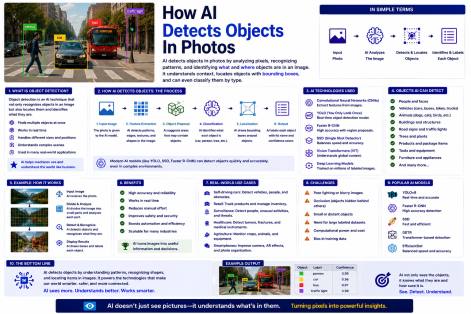
AI object detection is a computer vision technique that identifies, classifies, and locates one or more objects within an image.
Rather than simply recognizing that a photo contains a car, object detection can determine:
-
Where the car is located
-
How many cars are present
-
Whether there are people nearby
-
The position of each detected object
The output usually includes a label (such as "car," "person," or "dog") along with a bounding box that marks each object's location in the image.
How Does AI Detect Objects in Photos?
AI-powered object detection generally follows these steps.
1. Receive the Image
The AI system accepts a photograph, video frame, or digital image for analysis.
2. Analyze Visual Features
Computer vision algorithms examine:
-
Shapes
-
Colors
-
Textures
-
Edges
-
Patterns
-
Spatial relationships
3. Extract Important Features
Deep learning models identify meaningful visual characteristics that distinguish one object from another.
4. Classify Objects
The AI predicts what each detected object represents, such as:
-
Person
-
Car
-
Bicycle
-
Dog
-
Tree
-
Building
-
Traffic light
5. Locate Each Object
The AI places a bounding box around every detected object and records its position within the image.
6. Produce Detection Results
The system returns the detected objects, their locations, and confidence scores that indicate how certain the model is about each prediction.
Key Technologies Behind AI Object Detection
1. Computer Vision
Allows computers to interpret and understand visual information from images and videos.
2. Deep Learning
Neural networks learn to recognize objects by training on millions of labeled images.
3. Convolutional Neural Networks (CNNs)
CNNs extract visual features such as edges, textures, and patterns that help identify objects.
4. Object Detection Models
Specialized AI architectures perform object localization and classification simultaneously.
Examples include:
-
YOLO (You Only Look Once)
-
Faster R-CNN
-
SSD (Single Shot Detector)
-
RetinaNet
-
DETR (Detection Transformer)
5. Vision Transformers (ViTs)
Modern transformer-based models improve object understanding by capturing relationships across an entire image rather than focusing only on local regions.
Key Characteristics of AI Object Detection
1. Multi-Object Detection
AI can identify multiple objects within a single image.
2. Object Localization
Each detected object is assigned a precise location using bounding boxes or other localization techniques.
3. Real-Time Processing
Many object detection systems can analyze live video streams in real time.
4. High Scalability
The technology can process millions of images automatically.
5. Context Awareness
Modern AI models increasingly understand relationships between nearby objects and their surrounding environment.
Common Applications of AI Object Detection
AI object detection is widely used in:
-
Autonomous vehicles
-
Traffic monitoring
-
Security and surveillance
-
Smart cities
-
Retail analytics
-
Manufacturing quality inspection
-
Warehouse automation
-
Robotics
-
Healthcare imaging
-
Agriculture
-
Wildlife monitoring
-
E-commerce
-
Social media platforms
-
Smartphone camera features
-
Drone navigation
Benefits of AI Object Detection
Automates Visual Analysis
Reduces the need for manual image inspection.
Improves Accuracy
Modern AI models can detect objects with high precision across many scenarios.
Supports Real-Time Decision Making
Enables rapid analysis for applications such as autonomous driving and industrial automation.
Enhances Productivity
Processes large image datasets far more efficiently than manual review.
Enables Intelligent Applications
Supports advanced technologies including robotics, smart surveillance, and augmented reality.
Challenges of AI Object Detection
Occluded Objects
Objects that are partially hidden may be difficult to detect accurately.
Poor Image Quality
Blur, low resolution, or poor lighting can reduce detection performance.
Similar-Looking Objects
Objects with similar appearances may occasionally be misclassified.
Environmental Variations
Weather, shadows, reflections, and unusual viewing angles can affect accuracy.
Human Review Remains Important
For healthcare, law enforcement, industrial safety, legal evidence, and other high-stakes applications, AI detections should be reviewed by qualified professionals before decisions are made.
Image Classification vs AI Object Detection
| Feature | Image Classification | AI Object Detection |
|---|---|---|
| Primary Task | Identify the main object or scene | Detect and locate multiple objects |
| Object Location | No | Yes |
| Multiple Objects | Limited | Yes |
| Output | Category label | Labels, bounding boxes, and confidence scores |
| Best For | General image recognition | Detailed scene understanding |
Best Practices for Using AI Object Detection
Use High-Quality Images
Clear, well-lit images generally produce more accurate detections.
Train with Diverse Data
Include different lighting conditions, angles, object sizes, and environments.
Validate Detection Results
Review predictions in applications where errors could have significant consequences.
Monitor Model Performance
Regularly evaluate accuracy and update models as new data becomes available.
Combine AI with Human Oversight
Use AI to automate routine detection while allowing experts to verify critical results.
Future of AI Object Detection
AI object detection is expected to become increasingly accurate as computer vision, transformer architectures, and multimodal AI continue to evolve. Future systems will better understand complex scenes, detect partially hidden objects, recognize fine-grained object categories, and interpret interactions between people, objects, and environments.
Advances in edge AI will also enable faster object detection directly on smartphones, cameras, drones, robots, and Internet of Things (IoT) devices without relying heavily on cloud processing. At the same time, improved efficiency will reduce computing requirements while maintaining high detection accuracy.
As artificial intelligence continues to advance, AI object detection will play an even greater role in autonomous transportation, healthcare, manufacturing, retail, agriculture, security, environmental monitoring, and countless other industries that rely on intelligent visual analysis.
Conclusion
AI object detection combines computer vision, deep learning, and advanced detection models to identify and locate multiple objects within images. By analyzing visual features and understanding scene context, AI can accurately recognize objects and determine their positions, enabling intelligent image analysis across a wide range of applications.
From autonomous vehicles and industrial automation to healthcare, retail, and smartphone photography, AI object detection is transforming how organizations process and interpret visual information. While the technology delivers impressive speed and accuracy, human oversight remains essential in applications where safety, compliance, or precision is critical.
As AI technology continues to evolve, object detection will become faster, more reliable, and more capable of understanding the world through visual data.