





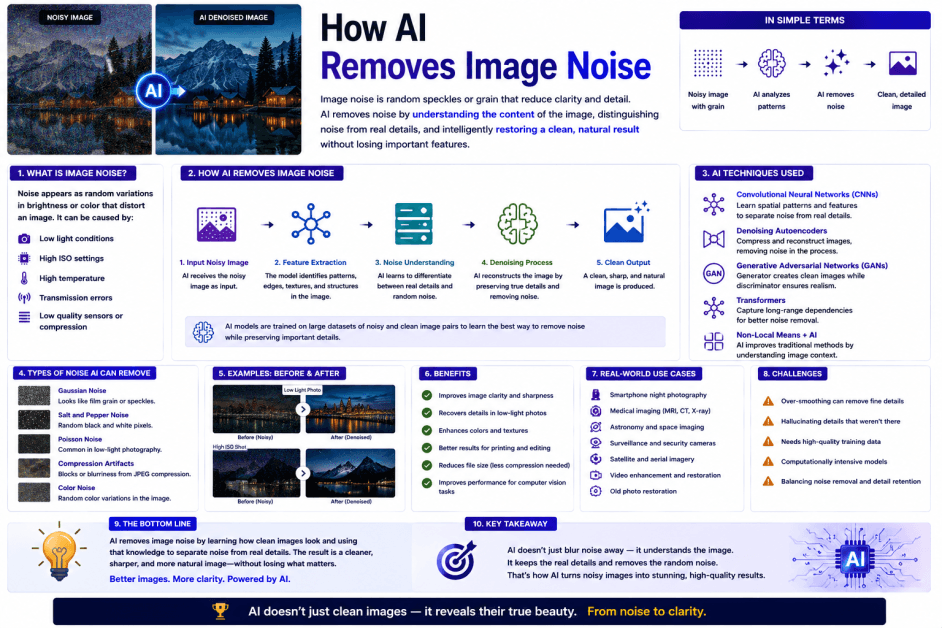
How AI Removes Image Noise: A Complete Guide
Whether you're taking photos at night, using a smartphone indoors, or capturing images with professional cameras, digital noise can reduce image quality. Noise appears as unwanted colored specks, grain, or random brightness variations that make photos look less sharp and less detailed.
Traditional noise reduction techniques often blur fine details while removing unwanted artifacts. Modern AI-powered image denoising takes a more intelligent approach by distinguishing between actual image details and unwanted noise. Using deep learning and computer vision, AI can preserve textures, edges, and important features while significantly reducing noise.
Today, AI image denoising is widely used in smartphone photography, professional cameras, medical imaging, satellite imagery, scientific research, surveillance systems, and image restoration.
What Is AI Image Denoising?
AI image denoising is the process of using artificial intelligence to detect and remove unwanted digital noise from images while preserving important visual details.
Unlike conventional filtering methods that apply the same processing across an entire image, AI analyzes the image content and selectively removes noise based on what it identifies as real objects, textures, and edges.
AI denoising can improve:
-
Low-light photographs
-
Smartphone images
-
High-ISO camera photos
-
Historical photo restorations
-
Medical images
-
Satellite imagery
-
Security camera footage
-
Scientific imaging
What Causes Image Noise?
Image noise can occur for several reasons, including:
-
Low-light photography
-
High ISO camera settings
-
Small camera sensors
-
Electronic sensor interference
-
Long exposure photography
-
Image compression
-
Poor transmission quality
AI helps reduce these artifacts without significantly degrading image quality.
How Does AI Remove Image Noise?
AI-powered image denoising generally follows these steps.
1. Analyze the Image
The AI examines the entire image to understand:
-
Objects
-
Faces
-
Backgrounds
-
Textures
-
Edges
-
Lighting conditions
-
Fine details
2. Detect Noise Patterns
Using deep learning models trained on millions of images, AI distinguishes random digital noise from meaningful image information.
3. Separate Noise from Real Details
Instead of treating every pixel equally, AI estimates which pixels represent genuine image content and which are unwanted noise.
4. Restore Image Quality
The AI reconstructs cleaner image regions while preserving:
-
Sharp edges
-
Skin textures
-
Hair details
-
Product features
-
Landscape elements
-
Fine patterns
5. Generate the Enhanced Image
The system produces a cleaner, more natural-looking image with reduced noise and improved clarity.
Key Technologies Behind AI Image Denoising
1. Computer Vision
Allows AI to recognize image structures, objects, and visual patterns.
2. Deep Learning
Neural networks learn how noisy images relate to clean images by training on large image datasets.
3. Convolutional Neural Networks (CNNs)
CNNs are commonly used to identify spatial patterns and separate noise from genuine image features.
4. Image Restoration Models
Specialized AI models reconstruct damaged or noisy image regions while preserving important details.
5. Generative AI
Some advanced systems generate realistic image details when recovering severely degraded photographs.
Key Characteristics of AI Image Denoising
1. Intelligent Noise Detection
AI distinguishes between random noise and actual image content.
2. Detail Preservation
Fine textures and edges are maintained while unwanted artifacts are removed.
3. Context Awareness
Different parts of an image receive different enhancement treatments based on their content.
4. Fast Processing
Many AI denoising tools process images within seconds.
5. Scalable Automation
Large collections of images can be enhanced automatically with minimal manual effort.
Common Applications of AI Image Denoising
AI image denoising is widely used in:
-
Smartphone photography
-
Professional photography
-
Astrophotography
-
Medical imaging
-
MRI and CT scan enhancement
-
Security and surveillance
-
Satellite imaging
-
Scientific research
-
Historical photo restoration
-
Digital publishing
-
E-commerce product photography
-
Journalism
-
Graphic design
-
Manufacturing quality inspection
Benefits of AI Image Denoising
Improves Image Quality
Removes distracting noise while preserving natural detail.
Enhances Low-Light Photography
Produces clearer images captured in challenging lighting conditions.
Preserves Fine Details
Maintains textures, edges, and important visual information better than many traditional methods.
Saves Editing Time
Automatically performs complex denoising that would otherwise require manual adjustments.
Supports Professional Workflows
Helps photographers, designers, researchers, and businesses process high volumes of images efficiently.
Challenges of AI Image Denoising
Extremely Noisy Images
Very poor-quality images may still lose some detail during restoration.
Artificial Reconstruction
In heavily degraded images, AI may estimate or reconstruct details that are visually plausible but not identical to the original scene.
Computing Requirements
High-resolution denoising often requires significant processing power.
Specialized Use Cases
Medical, scientific, legal, or forensic imaging may require carefully validated denoising methods that meet industry standards.
Human Review Remains Important
Professionals should review AI-denoised images before using them in critical applications where accuracy and authenticity are essential.
Traditional Noise Reduction vs AI Image Denoising
| Feature | Traditional Noise Reduction | AI Image Denoising |
|---|---|---|
| Processing Method | Fixed mathematical filters | Deep learning and computer vision |
| Detail Preservation | Can blur fine details | Preserves textures and edges more effectively |
| Context Awareness | Limited | Understands image content |
| Low-Light Performance | Moderate | Generally stronger performance |
| Best For | Basic image cleanup | Intelligent, high-quality image restoration |
Best Practices for Using AI Image Denoising
Capture the Best Original Image
Good exposure and stable camera settings improve denoising results.
Avoid Excessive Processing
Apply only the level of denoising needed to maintain a natural appearance.
Review Fine Details
Inspect important textures, text, and facial features after enhancement.
Protect Sensitive Images
Use trusted platforms when processing confidential, personal, or regulated images.
Combine AI with Manual Editing
For professional projects, use AI to automate routine noise reduction and apply manual refinements where necessary.
Future of AI Image Denoising
AI image denoising is expected to become increasingly advanced as computer vision, deep learning, and generative AI continue to evolve. Future systems will better understand image content, lighting conditions, camera characteristics, and scene context, allowing them to remove noise with even greater precision while preserving authentic details.
Emerging technologies are also enabling real-time denoising directly on smartphones, digital cameras, drones, medical devices, and video systems. AI models are becoming capable of improving extremely low-light images, restoring heavily degraded photographs, and enhancing video frames without introducing noticeable artifacts.
As artificial intelligence continues to advance, AI-powered image denoising will play an increasingly important role in photography, healthcare, scientific research, security, remote sensing, media production, and enterprise imaging workflows, delivering cleaner and more detailed images with minimal manual effort.
Conclusion
AI image denoising uses computer vision, deep learning, and image restoration techniques to intelligently remove digital noise while preserving important visual details. Unlike traditional filters, AI analyzes the content of an image and distinguishes genuine textures from unwanted artifacts, resulting in cleaner and more natural-looking photographs.
From smartphone cameras and professional photography to medical imaging and satellite analysis, AI-powered denoising improves image quality across a wide range of applications. Although these systems are highly effective, human review remains valuable for ensuring accuracy in professional, scientific, and mission-critical environments.
As AI technology continues to evolve, image denoising will become faster, more precise, and more widely integrated into cameras, creative software, and enterprise imaging solutions.
 How AI Removes Image Noise: The Technology Behind AI Image Denoising FAQs
POST A COMMENT (0)
All Comments (0)
Replies (0)