





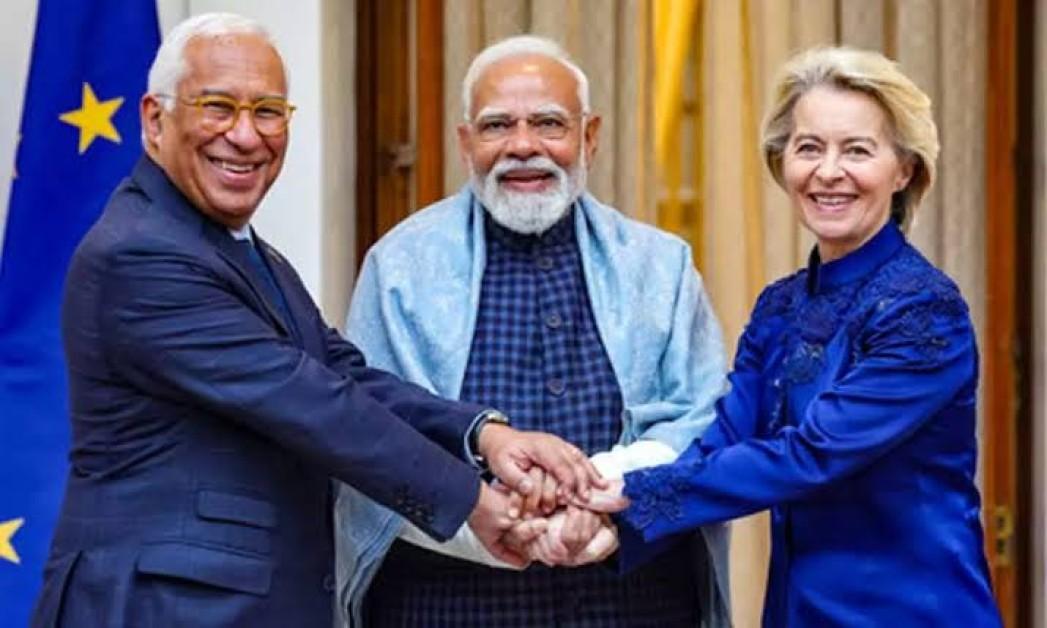
India–EU Free Trade Agreement: Inside the 'Mother of All Deals'
Concluded after nearly two decades, the India–EU FTA creates the world's largest free trade zone — spanning two billion people and a quarter of global GDP — and marks a decisive turn as both sides diversify amid global trade tensions.
By Naina, 7th July 2026
The India–EU Free Trade Agreement, concluded in early 2026 after nearly two decades of negotiations, stands as one of the most significant trade pacts in recent history, and the largest ever concluded by either side. Announced at a summit in New Delhi, the agreement aims to liberalise trade and investment between India and the 27-nation European Union, creating what has been described as the world's largest free trade zone, spanning around two billion people and a quarter of global economic output. Hailed by leaders on both sides as the 'mother of all deals', the pact covers goods, services, investment, and regulatory cooperation. Though negotiations are complete, the agreement is undergoing legal vetting and awaits formal signing and ratification before it enters into force. Here is what the landmark deal involves and why it matters.
The agreement represents a decisive moment for two of the world's largest economies, the European Union being the second-largest and India the fourth. It promises to open vast new opportunities for exporters, businesses, and consumers across both regions, while deepening strategic and political ties at a time of global economic uncertainty. The deal also carries significant geopolitical weight, having been fast-tracked as both India and the EU sought to diversify their trade relationships amid tensions with the United States. From tariff cuts on cars and textiles to contentious issues like carbon border taxes, the agreement is wide-ranging and consequential. Here is a detailed look at the India–EU Free Trade Agreement, its provisions, benefits, challenges, and the road ahead to implementation.
The Landmark Deal
The agreement is historic in scale. Concluded in early 2026 and announced at an India–European Union summit in New Delhi, it is the largest free trade agreement ever concluded by either party. Together, India and the EU represent around two billion people and roughly a quarter of global economic output, making the pact the creation of the world's largest free trade zone. As a deal between the world's second-largest economy, the EU, and its fourth-largest, India, it carries enormous economic significance. Leaders on both sides, including the Indian prime minister and the European Commission president, described it in celebratory terms as a partnership of giants, underscoring the ambition and reach of an agreement long considered one of the most important in global trade.
The Long Road
The path to the deal was extraordinarily long. Negotiations between India and the European Union first began in 2007, but were suspended in 2013 amid disagreements over issues such as intellectual property protection, data security, and the mobility of professionals. Talks were relaunched in 2022, and after intense negotiations spanning several more years, the two sides finally concluded the agreement in early 2026, nearly two decades after discussions first started. The breakthrough followed a target set in 2025 to conclude negotiations, and was aided by shifting geopolitical circumstances. The lengthy journey reflects both the complexity of aligning two large and diverse economies and the eventual political will on both sides to deliver a comprehensive, modern trade agreement after years of stop-and-start efforts.
The Current Status
The agreement is concluded but not yet in force. Following the conclusion of negotiations, the deal is undergoing legal vetting and translation before it can be formally signed, with signing expected around the middle of the year, potentially during a visit by the Indian prime minister to Brussels. Before entering into force, the agreement requires ratification, including approval by the Council of the European Union and the consent of the European Parliament on the trade components, as well as approval on the Indian side, where the Cabinet has already endorsed it. Officials have expressed hope of fast-tracking the process, though the agreement is generally expected to come into effect by 2027. This multi-stage approval process is a standard but significant step before implementation.
The Trade Scale
The existing trade relationship is already substantial. The European Union is one of India's largest trading partners, with bilateral trade in goods and services worth well over a hundred billion euros annually. Thousands of European companies operate in India, and the trading relationship supports hundreds of thousands of jobs in Europe. The agreement is expected to significantly boost these flows, with projections suggesting it could substantially increase European goods exports to India over the coming years, while eliminating or reducing tariffs on the vast majority of goods traded between the two sides. For both economies, the deal represents a major expansion of an already deep commercial relationship, unlocking new market access and opportunities across a wide range of sectors.
What India Gains
India secured significant benefits for its exporters. The agreement grants immediate duty-free access to the European market for many of India's labour-intensive exports, including textiles, apparel, leather, footwear, and gems and jewellery, sectors that employ large numbers of people and stand to gain considerably from tariff-free entry. India also secured preferential market access for its agricultural and food exports, boosting their competitiveness in Europe. Provisions on services and the mobility of professionals, along with mechanisms to ease skilled worker movement, offer further gains. For India, the deal opens up the entire European market alongside its other recent agreements, benefiting exporters, small businesses, farmers, and skilled workers, and supporting its broader economic and development ambitions.
What the EU Gains
The European Union secured valuable access to India's vast market. A headline gain for the EU is a substantial reduction in India's tariffs on cars, which are set to fall from very high levels to far lower rates over several years, alongside quota-based access for a significant number of European vehicles annually, benefiting European carmakers. The agreement gives European companies privileged access to one of the world's most populous countries and its fourth-largest economy, with tariffs eliminated or reduced on the overwhelming majority of EU goods exports. European exporters across sectors including machinery, wines and spirits, and other products stand to benefit. For the EU, the deal offers a significant competitive advantage in a large, fast-growing market and the potential to substantially expand its exports.
The Contentious Issues
Several difficult issues remain. Chief among them is the European Union's carbon border adjustment mechanism, a levy on carbon-intensive imports, which remains in place despite Indian objections, and which could impose new costs on Indian exporters of goods like steel and aluminium; the EU has pledged financial support to help India reduce emissions in response. The accompanying investment protection agreement, including its dispute settlement provisions, involves complex legal matters that have been left for further negotiation. Ratification could also face domestic pressures within some EU member states at differing levels of development. Beyond these, the challenge of implementing the agreement effectively on the ground, ensuring businesses can actually use its provisions, will be crucial to realising its benefits.
The Geopolitical Context
The deal carries major geopolitical significance. Its conclusion was widely seen as having been accelerated by global trade tensions, particularly disputes over tariffs imposed by the United States, which prompted both India and the EU to diversify their export markets and reduce reliance on any single partner. The agreement signalled India's pursuit of a diversified foreign policy and its intent to expand strategic and trade relations worldwide. Notably, the pact was accompanied by broader cooperation, including on security, and fits within India's wider push to sign trade deals with multiple partners. The deal also aligns with ambitions for connectivity initiatives linking India, the Middle East, and Europe, reinforcing its strategic dimension alongside its commercial benefits in a shifting global order.
The Road Ahead
The India–EU Free Trade Agreement marks a transformative step in relations between two of the world's largest economies, but its full impact depends on the road ahead. The immediate priorities are the formal signing and the completion of ratification on both sides, paving the way for the agreement to enter into force, expected by 2027. Beyond that, effective implementation will be key, ensuring that businesses, exporters, and consumers can genuinely benefit from the new market access and reduced tariffs. Resolving outstanding issues, including those around investment protection and carbon border measures, will also shape the relationship. If realised effectively, the agreement could deepen economic and strategic ties for decades, standing as a landmark achievement in global trade and a pillar of the India–EU partnership.
access to India's large market, and the elimination or reduction of tariffs on the vast majority of its goods exports, benefiting exporters across sectors.
 India-EU Free Trade Agreement: The 'Mother of All Deals' FAQs
POST A COMMENT (0)
All Comments (0)
Replies (0)