





India's defence and deep-tech ecosystem is undergoing a quiet but significant shift.
The focus is no longer limited to importing or assembling technologies - it is increasingly moving toward building indigenous, intelligent systems from the ground up.
At the Defence Industry-DIAT Meet 2026, this shift was clearly visible.
The event brought together stakeholders from defence, academia, and emerging technology companies working at the frontier of innovation.
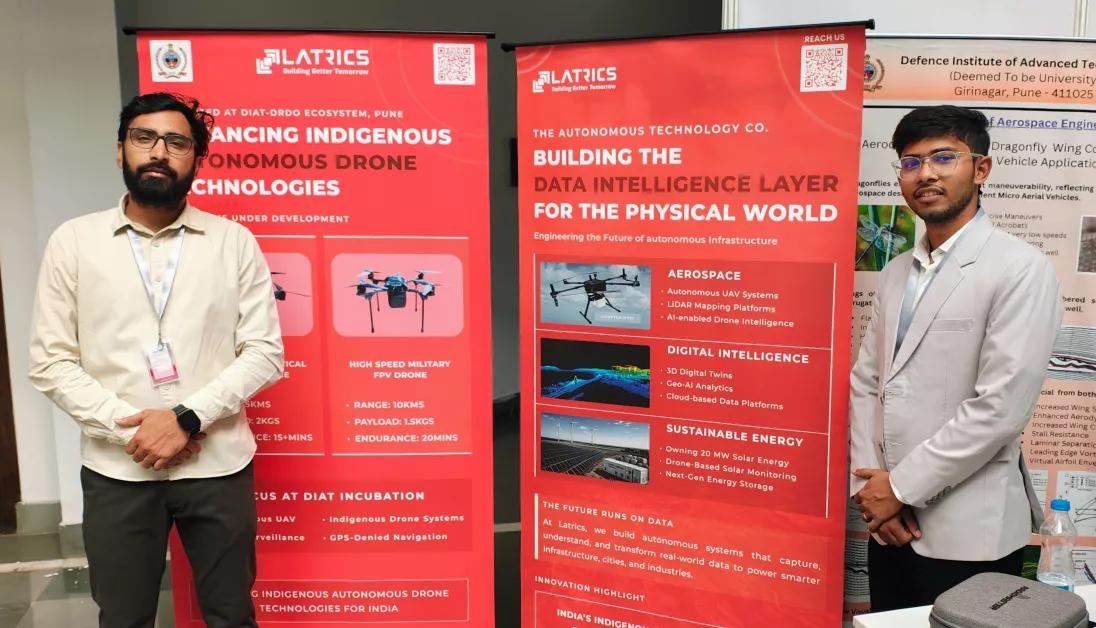
Among the companies present, Latrics stood out for its clear positioning and focused approach toward building autonomous systems.
Incubated within the DIAT-DRDO ecosystem, Latrics is part of a new wave of startups working closely with research institutions to solve real-world, high-stakes problems.
While many companies in the space are often categorized as “drone startups,” Latrics appears to be taking a broader approach.
Its work spans across:
- Autonomous UAV systems
- LiDAR-based mapping platforms
- AI-driven geospatial intelligence
- Digital twin frameworks
Rather than focusing solely on hardware, the company is working toward building what it describes as a data intelligence layer for the physical world - a stack that captures, processes, and translates real-world data into usable intelligence.
A key aspect of Latrics' approach is its emphasis on indigenous development.
Its R&D efforts include work on:
- Autonomous navigation in complex environments
- GPS-denied operational capabilities
- High-speed FPV and tactical drone systems
These are not generic problems - they are highly contextual to defence and infrastructure use cases in India.
This reflects a broader trend where startups are beginning to align more closely with India-specific operational challenges, rather than adapting global solutions.
The significance of such efforts goes beyond individual companies.
The future of defence and infrastructure is likely to be shaped by:
- Real-time data systems
- Autonomous decision-making
- Integrated intelligence platforms
Companies like Latrics indicate a shift from hardware-centric thinking to intelligence-centric ecosystems.
This transition is critical if India aims to build long-term technological sovereignty in strategic sectors.
Latrics' presence at the Defence Industry-DIAT Meet 2026 reflects more than participation - it signals intent.
An intent to move beyond conventional categories,
to build foundational technology layers,
and to contribute to a more self-reliant and innovation-driven defence ecosystem.
If this direction continues, companies like Latrics may not just be part of the ecosystem - they could help define it.
 Related News
POST A COMMENT (0)
All Comments (0)
Replies (0)