





Training vs Inference in AI: Understanding the Key Differences
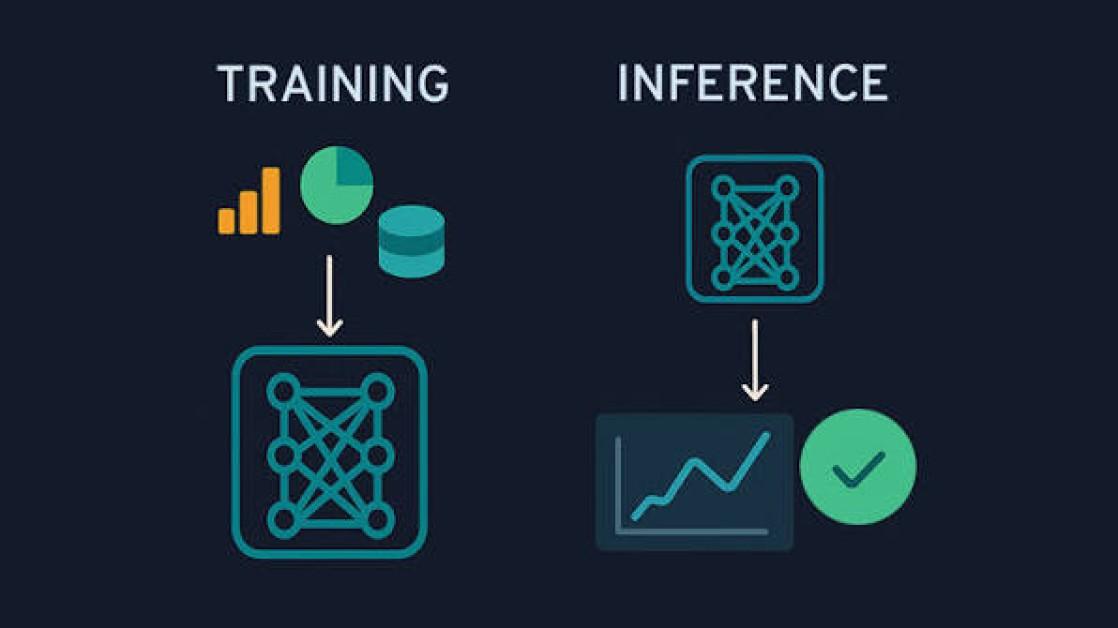
Artificial Intelligence (AI) models go through two critical phases before delivering useful results: training and inference. Training is the process where an AI model learns from large datasets, while inference is the stage where the trained model applies that knowledge to make predictions or generate responses. Although both phases are essential to AI systems, they serve different purposes and require different computing resources. Understanding the distinction between training and inference helps businesses, developers, and technology professionals better evaluate AI performance, deployment strategies, and operational costs.
What Is AI Training?
AI training is the process of teaching a machine learning model by exposing it to large amounts of data. During this phase, the model identifies patterns, adjusts its internal parameters, and improves its ability to perform specific tasks.
How AI Training Works
Training begins by feeding datasets into an AI model. The model compares its predictions with expected outcomes, measures errors, and continuously updates its parameters through optimization techniques until it reaches the desired level of accuracy.
Why AI Training Matters
The quality of training directly affects how well an AI model performs. Well-trained models produce more accurate predictions, better understand complex patterns, and deliver improved performance across real-world applications.
What Is AI Inference?
Inference is the stage where a trained AI model is used to process new data and generate predictions, recommendations, classifications, or responses without further learning.
How AI Inference Works
Once training is complete, the model is deployed into production. During inference, it receives new inputs, applies the knowledge acquired during training, and produces outputs in real time or near real time.
Why AI Inference Matters
Inference enables AI systems to deliver practical value by powering applications such as chatbots, recommendation engines, fraud detection, medical diagnosis, autonomous vehicles, and virtual assistants.
Training vs Inference: Key Differences
Purpose
Training focuses on teaching an AI model by learning from data, while inference focuses on applying that learned knowledge to solve real-world problems.
Data Usage
Training requires massive labeled or unlabeled datasets to improve model accuracy. Inference uses new input data to generate predictions without changing the model's learned parameters.
Computing Requirements
Training is computationally intensive and often requires powerful GPUs or AI accelerators over extended periods. Inference generally requires fewer computing resources and is optimized for speed and efficiency.
Model Updates
During training, the model continuously updates its internal parameters. During inference, those parameters remain fixed while the model generates outputs.
Applications of Training and Inference
Both stages play vital roles in modern Artificial Intelligence systems.
Generative AI
Large Language Models undergo extensive training before being deployed for inference to generate text, summarize documents, answer questions, and assist users.
Healthcare
Medical AI systems are trained on clinical datasets and later perform inference to support disease diagnosis, medical imaging analysis, and treatment recommendations.
Financial Services
Banks train AI models using historical transaction data and then use inference to detect fraud, assess credit risk, and automate customer support.
Autonomous Systems
Self-driving vehicles rely on trained AI models that perform inference continuously to recognize road conditions, detect obstacles, and make driving decisions.
Benefits and Challenges
Benefits of AI Training
Training enables AI models to learn complex patterns, improve prediction accuracy, and adapt to specialized tasks through exposure to large datasets.
Benefits of AI Inference
Inference delivers fast, scalable, and real-time AI capabilities that allow organizations to deploy intelligent applications across industries.
Challenges
Training requires significant computational resources, large datasets, and extended processing time, while inference demands low latency, efficient deployment, and optimized hardware to deliver fast responses.
Future Outlook
As Artificial Intelligence continues to advance, both training and inference are becoming more efficient through improved hardware, optimized algorithms, and specialized AI accelerators. Organizations are increasingly adopting cloud-based infrastructure and edge AI technologies to reduce costs, improve performance, and enable real-time AI applications. Continued innovation in model optimization is expected to make both training and inference faster, more accessible, and more energy efficient.
Conclusion
Training and inference are two fundamental stages of every Artificial Intelligence system. Training enables AI models to learn from data and develop intelligence, while inference applies that knowledge to solve real-world problems. Together, they power modern AI applications across healthcare, finance, manufacturing, education, and enterprise technology. As AI adoption continues to grow, understanding the differences between training and inference will remain essential for businesses seeking to build and deploy intelligent solutions.
 Training vs Inference in AI: Key Differences Explained | NEX NEWS FAQs
POST A COMMENT (0)
All Comments (0)
Replies (0)