





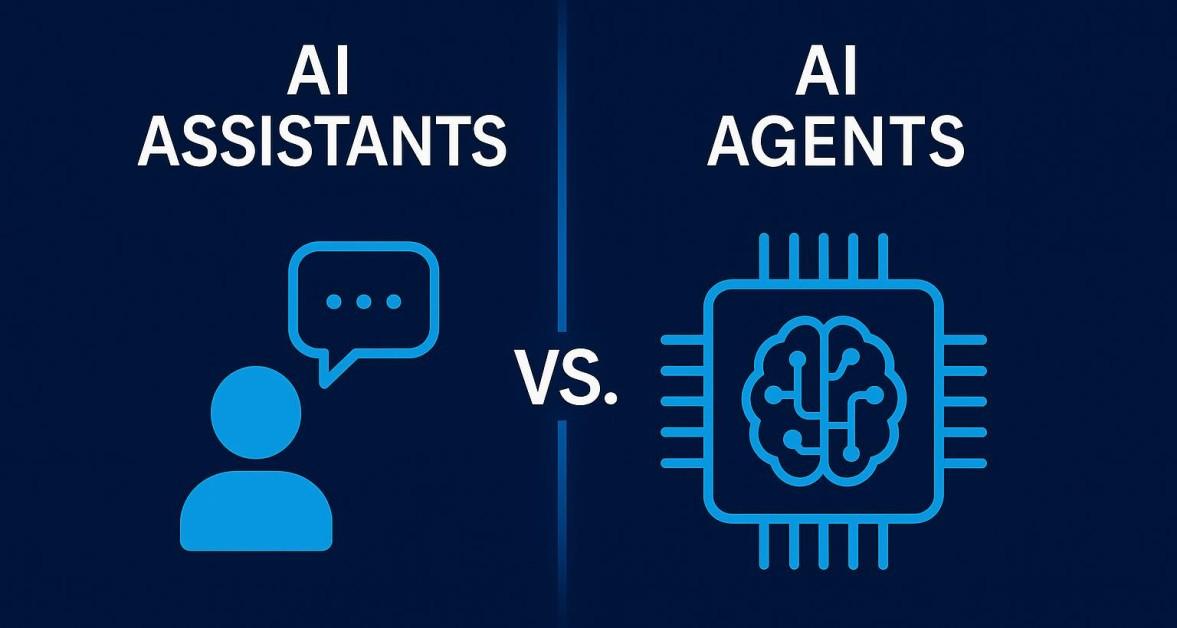
As artificial intelligence evolves rapidly in 2025, two terms are being discussed everywhere: AI assistants and AI agents. While they sound similar, the difference between them is huge and has a major impact on how people work, how businesses operate, and how automation transforms everyday life. Understanding this difference is essential because AI agents are redefining what machines can do without human supervision, while AI assistants continue to support humans in more limited, task-driven ways.
AI assistants are designed to help users with simple, structured tasks. They respond to commands, answer questions, generate content when asked, and perform predefined actions. They function only when the user initiates the task. Most popular AI tools today, such as digital voice assistants, chatbots, and writing generators, fall into this category. They make work easier but depend on human direction at every step.
AI agents, on the other hand, are far more advanced. These systems can think, plan, act, and operate independently within a defined environment. Instead of waiting for instructions, they can take goals from the user and break them into steps, execute tasks, gather information, make decisions, and return with results. AI agents behave like digital employees, capable of handling workflows without constant supervision. They represent the next evolution of artificial intelligence, moving beyond assistance toward true autonomous action.
The core difference lies in autonomy. An AI assistant will write an email when asked, but an AI agent will read your previous emails, analyze the tone, draft a reply automatically, schedule follow-up reminders, and even coordinate with other tools. Assistants follow instructions. Agents follow objectives.
Another major distinction is how they handle complexity. AI assistants are excellent at generating responses and performing tasks within a restricted scope. AI agents, however, can manage multi-step processes across different systems. For example, an AI agent can research market trends, compare competitors, update a spreadsheet, generate a report, and email it to your team without any manual input. This capability allows agents to replicate parts of human reasoning in professional environments.
Businesses in 2025 are increasingly adopting AI agents to automate tasks such as customer onboarding, sales operations, recruitment filtering, financial analysis, supply chain coordination, and workflow optimization. In industries where speed and accuracy matter, agents offer significant advantages by reducing human errors and handling high-volume workloads. This shift is leading to major changes in corporate structures, as companies rely more on autonomous AI processes and fewer manual support teams.
For individuals, the rise of AI agents means a transformation in daily productivity. Professionals can assign goals instead of tasks, letting agents manage scheduling, research, task prioritization, and follow-ups. Students can use agents for personalized learning plans, project execution, and revision management. Creators can generate ideas, scripts, and editing pipelines without handling each step manually. The role of humans shifts from doing the work to supervising and refining the results.
However, this evolution also brings challenges. AI assistants are predictable and limited, making them easy to control. AI agents, with their higher autonomy, raise questions about accuracy, accountability, transparency, and safety. Ensuring that agents behave ethically, respect privacy, and perform tasks faithfully is becoming a major area of concern in 2025. Regulation, monitoring tools, and ethical AI frameworks are becoming essential as these systems gain more operational freedom.
The difference between AI assistants and AI agents matters because it defines the future of work. Assistants improve productivity, but agents fundamentally change workflows. Companies that adopt AI agents early gain a competitive advantage by automating complex operations. Individuals who understand how to use agents can achieve more in less time, reskill more rapidly, and stay ahead in an AI-driven world. The distinction also matters socially, as autonomous AI has direct implications for job roles, training, and digital literacy.
In the rapidly advancing world of 2025, AI assistants remain valuable tools, but AI agents represent a transformative leap toward autonomous digital work. The shift from assistance to agency is creating a new era of intelligent automation. Understanding this difference is the key to navigating the future of technology, work, and innovation.
 Related News
POST A COMMENT (0)
All Comments (0)
Replies (0)