





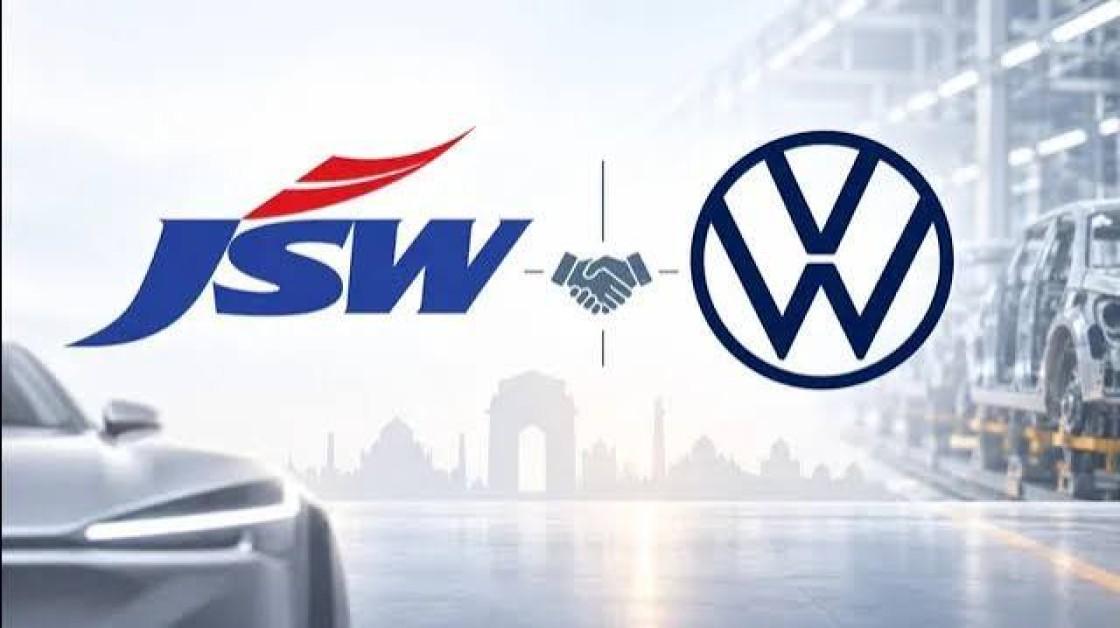
Volkswagen and JSW Sign MoU to Advance Proposed 51:49 India Automotive Joint Venture
Volkswagen Group and Sajjan Jindal-led JSW Group have taken a significant step toward a proposed automotive partnership in India, signing a non-binding memorandum of understanding to explore a joint venture that could combine Volkswagen's engineering and vehicle platforms with JSW's manufacturing scale, execution capabilities and local industrial ecosystem.
The MoU was signed by Škoda Auto a.s. and JSW Green Mobility Limited, with the companies now moving into discussions over the structure, valuation and commercial terms of a potential venture.
A 51:49 ownership structure, with JSW expected to hold the majority stake, is among the structures under discussion. However, the companies have stressed that the MoU remains exploratory and non-binding, and the final shareholding has not yet been formally agreed.
The two sides are targeting a definitive agreement by the end of 2026, subject to negotiations, internal approvals and regulatory clearances.
The proposed partnership would develop, manufacture and sell passenger vehicles for both India and export markets, spanning internal-combustion engines, electric vehicles, hybrids and plug-in hybrids.
For Volkswagen, the partnership could address one of its most persistent challenges in India: achieving sufficient scale and localisation to compete profitably in one of the world's largest passenger-vehicle markets.
For JSW, the alliance would provide access to an established European automotive group, global engineering expertise, vehicle platforms and potentially a larger export opportunity.
Volkswagen and JSW Sign Non-Binding MoU

Škoda Auto and JSW Green Mobility have formally signed a:
non-binding Memorandum of Understanding.
The agreement establishes a framework under which the companies will explore a strategic automotive partnership in India.
Škoda Auto leads Volkswagen Group's operations in the Indian market, while JSW Green Mobility is part of the Sajjan Jindal-led JSW Group's expanding automotive business.
The MoU doesn't create a completed joint venture.
Instead, it moves the negotiations into a more formal stage where the companies can evaluate valuation, ownership, manufacturing, products and governance.
Proposed Venture Could Follow a 51:49 Structure
The proposed alliance is being evaluated around a:
51:49 ownership structure.
Under the plan being discussed, JSW would hold approximately:
51%,
while Volkswagen's side would retain:
49%.
Such a structure would give JSW majority economic ownership while establishing a joint-control governance framework.
The companies have not formally confirmed the final shareholding in their official statements, meaning the 51:49 structure remains subject to negotiations.
Joint Control Is Central to Proposed Governance
Volkswagen has confirmed that the planned partnership is being designed around:
joint control.
The structure would establish clearly defined operational responsibilities and governance mechanisms intended to enable faster decision-making.
This distinction matters because Volkswagen would potentially give up majority ownership while retaining significant influence over:
technology,
products,
manufacturing,
quality,
and strategic decisions.
A carefully structured governance model would therefore be essential to balancing the interests of both partners.
Definitive Agreement Targeted by End of 2026
The companies are expected to spend the coming months completing:
financial due diligence,
valuation discussions,
commercial negotiations,
and structural planning.
A final binding agreement is being targeted by:
the end of 2026.
Any transaction would then remain subject to applicable corporate and regulatory approvals.
The process means the partnership should still be viewed as proposed rather than completed.
Partnership Will Focus on Localisation
One of the most important objectives of the proposed alliance is:
deeper localisation.
Volkswagen has operated in India for more than two decades but has struggled to achieve the scale of domestic leaders.
Greater local sourcing could reduce the cost of:
components,
vehicle platforms,
electronics,
powertrain systems,
and other manufacturing inputs.
This would allow Volkswagen and Škoda to price products more competitively while protecting margins.
Volkswagen Wants to Expand Its India Product Portfolio
The proposed cooperation also aims to support:
a broader product portfolio.
India's passenger-vehicle market has increasingly shifted toward:
SUVs,
compact SUVs,
premium vehicles,
and electric mobility.
Volkswagen and Škoda have strengthened their presence through locally developed models, but their overall portfolio remains smaller than several leading competitors.
A JSW partnership could provide additional capital and local execution capabilities for more frequent product launches.
ICE, Electric and Hybrid Vehicles Are Within Scope
The proposed venture isn't limited to electric vehicles.
The companies have indicated that its potential product portfolio could span:
internal-combustion vehicles,
battery-electric vehicles,
plug-in hybrids,
and:
hybrids.
This multi-powertrain approach reflects uncertainty over the pace at which India's passenger-vehicle market will transition toward full electrification.
Rather than relying on a single technology, the venture could address different customer segments as the market evolves.
Electric Vehicles Could Become a Major Growth Area
Electric vehicles are nevertheless expected to play an important role in the partnership.
Volkswagen Group has extensive global EV technology and platform expertise.
JSW is simultaneously building a larger presence in India's electric-mobility ecosystem.
Combining those capabilities could allow the proposed venture to develop more locally competitive EVs for Indian customers.
Higher localisation would be particularly important for reducing EV costs.
India Main Platform Could Support Future EVs
Volkswagen Group has been evaluating a new electric-vehicle architecture for India commonly referred to as the:
India Main Platform.
The architecture could be adapted from Volkswagen Group technology used elsewhere while being engineered around Indian:
regulations,
supplier capabilities,
cost requirements,
and consumer preferences.
Potential JSW investment could help support development and localisation of vehicles based on this architecture.
Final product decisions have not yet been announced.
Manufacturing Scale Is a Major Part of the Discussions
The partnership also seeks to strengthen:
manufacturing capabilities.
Volkswagen Group already has significant production infrastructure in Maharashtra.
Its facilities include plants at:
Chakan
and:
Chhatrapati Sambhajinagar.
Together, these operations provide manufacturing capacity substantially above Volkswagen Group's current domestic sales volume.
Improving utilisation could materially change the economics of the India business.
Volkswagen Has Around 315,000 Units of Annual Capacity
Volkswagen Group's Indian manufacturing facilities have combined capacity of approximately:
315,000 vehicles annually.
The plants produced around:
160,000 vehicles in 2025.
Approximately 30% of that production was exported.
Domestic sales remain considerably below the available manufacturing capacity.
Increasing production would allow fixed development and manufacturing expenses to be spread across a larger number of vehicles.
India Could Become a Larger Volkswagen Export Hub
Exports are therefore an important part of the proposed partnership.
The companies are exploring how India can become a larger production base for vehicles sold in:
overseas markets.
India offers several potential advantages as an automotive export hub, including:
competitive manufacturing costs,
a large supplier ecosystem,
engineering talent,
and expanding trade relationships.
Higher export volumes could also improve utilisation of Volkswagen's existing Indian factories.
European Exports Could Become Strategically Important
The potential export strategy has become particularly significant as Volkswagen faces intense competition from:
Chinese automakers.
Chinese manufacturers have developed strong cost positions in electric vehicles and are expanding internationally.
Producing vehicles in India could potentially give Volkswagen access to a lower-cost manufacturing base for selected export markets.
This could make the proposed JSW partnership strategically relevant beyond India's domestic car market.
Volkswagen Has Struggled to Build Scale in India
Volkswagen Group has operated in India for more than:
two decades.
Despite its global scale and strong brand recognition, it remains a relatively small participant in India's passenger-vehicle industry.
The group held roughly:
2%–2.5%
of the Indian market recently, depending on the period and measurement used.
That contrasts sharply with Volkswagen's position in several European markets.
The challenge has historically been less about brand awareness and more about:
cost,
product breadth,
localisation,
and scale.
India's Top Automakers Control Most of the Market
India's passenger-vehicle market is highly concentrated.
The four largest manufacturers account for more than:
85% of sales.
That creates a difficult competitive environment for smaller manufacturers.
Successful automakers require:
large dealer networks,
frequent model launches,
deep supplier relationships,
competitive pricing,
and substantial manufacturing scale.
A local partner could help Volkswagen address several of those requirements simultaneously.
Škoda Has Recently Accelerated Growth
Volkswagen Group's recent India performance has nevertheless improved.
Škoda recorded strong growth in 2025, helped by the success of products including the:
Kylaq compact SUV.
Škoda's sales approximately doubled during the year, making India one of the brand's fastest-growing markets.
Skoda Auto Volkswagen India's overall domestic volumes also increased substantially.
The proposed JSW partnership would seek to build on that momentum rather than starting from a weak product base.
SAVWIPL Revenue Reached More Than ₹22,000 Crore
Skoda Auto Volkswagen India reported revenue of approximately:
₹22,338 crore in FY26,
representing an increase of around:
11% year-on-year.
Net profit rose approximately:
48% to ₹139 crore.
The improvement demonstrates that the Indian business has been strengthening operationally even before the proposed partnership.
However, the company's low overall market share means substantial growth potential remains.
JSW Brings Large-Scale Manufacturing Experience
JSW's contribution would extend beyond capital.
The group has large industrial operations across:
steel,
energy,
infrastructure,
cement,
paints,
and automotive businesses.
That gives it experience in:
large-scale manufacturing,
procurement,
project execution,
and domestic supplier relationships.
Those capabilities could help Volkswagen accelerate localisation and reduce costs.
JSW Has Rapidly Expanded Into Automobiles
JSW has been building its automotive strategy aggressively.
Its most established passenger-vehicle investment is:
JSW MG Motor India.
The business operates through a partnership with Chinese automaker:
SAIC Motor.
JSW entered the venture as part of a broader effort to build a significant position in India's passenger-vehicle and electric-mobility sectors.
Proposed Volkswagen Venture Will Be Separate From JSW MG
The proposed Volkswagen partnership is expected to operate:
separately from JSW MG Motor India.
This is strategically important.
JSW isn't proposing to combine Volkswagen and MG within one automotive company.
Instead, it is building multiple automotive platforms involving different international partners.
The Volkswagen venture would therefore have its own:
ownership,
governance,
manufacturing,
and product strategy.
JSW Is Also Building Its Own Automotive Platform
JSW is simultaneously developing another automotive initiative through:
JSW Motors.
That business has been linked with vehicle sourcing and technology cooperation involving Chinese automaker Chery.
The proposed Volkswagen venture would therefore give JSW exposure to another global automotive technology ecosystem.
It would also diversify the group's automotive partnerships beyond Chinese manufacturers.
Volkswagen Partnership Reduces JSW’s China Dependence
This diversification could become strategically valuable.
India's automotive industry has faced restrictions and uncertainty around:
Chinese investment,
technology transfers,
and regulatory approvals.
JSW's existing automotive relationships have significant Chinese exposure.
Volkswagen would give the group a major European partner.
That could reduce concentration risk while providing access to a different technology and export ecosystem.
Volkswagen Brings Global Engineering Capabilities
For JSW, one of the strongest attractions is Volkswagen Group's:
engineering expertise.
Volkswagen has developed vehicle architectures and manufacturing systems used across multiple global brands.
The proposed venture could give JSW access to:
vehicle platforms,
powertrain technology,
electric architectures,
R&D capabilities,
and global product-development experience.
These assets would be difficult and expensive to recreate independently.
Partnership Could Accelerate Product Development
Platform sharing can substantially reduce the cost and time required to develop new vehicles.
One architecture can potentially underpin:
multiple models,
body styles,
and brands.
This allows manufacturers to spread engineering investment across greater volumes.
Volkswagen already uses this strategy globally.
Greater localisation of shared platforms in India could improve both:
cost competitiveness
and:
launch frequency.
Volkswagen and Škoda Brands Are Initial Focus
The proposed partnership is expected initially to focus primarily on:
Volkswagen
and:
Škoda
passenger vehicles.
These brands represent the core volume businesses of Volkswagen Group in India.
Future models, including electric vehicles, could also become part of the venture.
The treatment of Volkswagen Group's luxury brands remains less certain.
Audi, Porsche and Other Luxury Brands Could Be Considered Later
Volkswagen Group also operates premium and luxury marques in India including:
Audi,
Porsche,
Lamborghini,
and Bentley.
These brands aren't currently confirmed as part of the proposed joint venture.
Their inclusion would involve additional structural complexity.
The initial focus is therefore expected to remain on the Volkswagen and Škoda businesses while the partners evaluate the wider portfolio over time.
Tax Dispute Could Influence Final Valuation
One of the most important issues in the negotiations will be Volkswagen Group's ongoing:
customs tax dispute in India.
Indian authorities have alleged that Volkswagen's local operation structured imports of certain vehicle components in a manner that resulted in lower customs duties than would have applied to completely knocked-down vehicle kits.
Volkswagen has contested the allegations and maintains that it complied with Indian law.
The dispute remains unresolved.
Potential Liability Is a Major Due-Diligence Issue
The potential tax exposure has been estimated at approximately:
₹20,000 crore
when considering the wider potential liability associated with the matter.
The figure could materially affect negotiations over:
valuation,
transaction structure,
indemnities,
and allocation of historical liabilities.
Reports indicate JSW isn't expected to assume liabilities arising from the disputed historical transactions.
How the companies ultimately address this issue could therefore become one of the most important elements of a definitive agreement.
Volkswagen Contests Customs Allegations
Volkswagen has challenged the customs authorities' position.
The dispute relates to allegations that certain vehicles were imported in separated component consignments and taxed at lower rates applicable to individual parts rather than the higher duties associated with completely knocked-down units.
Models cited in the dispute have included vehicles from:
Volkswagen,
Škoda,
and Audi.
Volkswagen has maintained that its import practices complied with applicable regulations.
The matter remains subject to legal proceedings.
Due Diligence Will Determine Final Economics
Signing the MoU now allows the parties to undertake detailed:
financial,
legal,
tax,
operational,
and commercial due diligence.
The process will help determine what Volkswagen's Indian operations are worth and how historical liabilities should be allocated.
Only after those questions are resolved can the parties finalise:
equity contributions,
ownership,
governance,
and payment terms.
This is why the current agreement remains non-binding.
JSW Could Use Deferred Consideration Structure
The proposed transaction could involve a combination of:
initial equity payment
and:
deferred consideration.
Such a structure could help manage uncertainty around valuation and outstanding liabilities.
Deferred payments can also align the purchase consideration with future operational milestones or resolution of specific issues.
The precise financing structure remains under negotiation.
Local Partner Could Improve Volkswagen’s Decision-Making
Volkswagen's global scale provides enormous technical capabilities, but large multinational structures can also slow local decision-making.
India's automotive market changes rapidly.
Product pricing, features, variants and sourcing decisions often need to respond quickly to:
consumer preferences,
competitor launches,
regulation,
and commodity costs.
The proposed joint-control structure is specifically being designed to enable faster execution.
Localisation Could Be the Biggest Commercial Benefit
The most important long-term benefit may ultimately be:
cost reduction through localisation.
Indian consumers are highly price-sensitive.
Even premium mass-market brands need to achieve competitive manufacturing economics.
Local sourcing reduces:
import duties,
foreign-exchange exposure,
logistics costs,
and supply-chain complexity.
It can also shorten development cycles by bringing suppliers closer to vehicle production.
JSW’s Steel Ecosystem Could Create Industrial Synergies
JSW's industrial footprint creates potential supply-chain advantages.
The group is one of India's largest steel producers.
Automotive manufacturing requires significant quantities of:
high-strength steel,
specialised sheet products,
and other engineered materials.
While all transactions would need to remain commercially competitive, the broader industrial ecosystem could create procurement and development synergies.
JSW also brings experience in energy and large-scale industrial infrastructure.
Partnership Could Improve Factory Utilisation
Higher manufacturing utilisation would directly improve Volkswagen's India economics.
Factories have substantial fixed costs.
When production volumes remain low, those costs are spread across fewer vehicles.
Increasing domestic sales and exports would allow Volkswagen to distribute:
plant,
engineering,
tooling,
and overhead costs
across a larger production base.
That could improve profitability even before considering other localisation benefits.
India Could Gain Another Large Automotive Investment Platform
A completed JSW-Volkswagen partnership would also be significant for India's manufacturing sector.
The venture could support additional investment in:
vehicle production,
supplier localisation,
engineering,
research and development,
battery systems,
electronics,
and export infrastructure.
A larger Volkswagen manufacturing footprint could also create opportunities for Indian component suppliers to participate in global supply chains.
EV Localisation Could Strengthen Domestic Supply Chain
Electric vehicles require a different supplier ecosystem from conventional cars.
Key components include:
battery packs,
electric motors,
power electronics,
software,
thermal systems,
and advanced semiconductor-based controls.
Localising these systems can reduce EV costs and strengthen domestic manufacturing capabilities.
A large Volkswagen-JSW platform could therefore have effects extending beyond the two companies themselves.
India Remains Strategically Important to Volkswagen
Volkswagen's willingness to explore a substantial local partnership reflects India's growing importance.
India is already one of the world's largest passenger-vehicle markets.
Long-term growth is supported by:
rising incomes,
urbanisation,
infrastructure development,
and relatively low car ownership per capita.
For a global automaker seeking growth outside mature European markets, India is difficult to ignore.
Volkswagen Is Restructuring Globally
The negotiations also come as Volkswagen undertakes a broader global restructuring.
The German group is seeking to:
reduce costs,
improve factory utilisation,
simplify its portfolio,
and respond to increasing competition from Chinese automakers.
Its traditional European business faces pressure from high manufacturing costs and changing EV economics.
A stronger India platform could become part of the group's response.
India Could Support Volkswagen’s Global Cost Strategy
A successful Indian manufacturing operation could serve two purposes.
First, it could compete more effectively in India's domestic market.
Second, it could supply vehicles or components to:
international markets.
That would turn India from primarily a local sales operation into a larger component of Volkswagen's global manufacturing network.
The proposed JSW alliance is designed partly around this opportunity.
Previous Volkswagen India Partnerships Did Not Materialise
Volkswagen has previously explored major partnerships with Indian automakers.
Discussions with:
Tata Motors in 2017
did not result in a long-term alliance.
More recently, Volkswagen explored deeper cooperation with:
Mahindra & Mahindra
around electric vehicle components and platforms.
Those discussions also stopped short of the broad strategic partnership once contemplated.
The JSW MoU therefore represents Volkswagen's latest attempt to find a local partner capable of helping it achieve scale.
Current MoU Is More Advanced but Still Preliminary
The signing of a formal MoU demonstrates meaningful progress.
However, it should not be interpreted as confirmation that the joint venture will definitely proceed.
The companies still need to agree on:
valuation,
ownership,
governance,
liabilities,
product plans,
investment,
and manufacturing responsibilities.
The unresolved customs dispute adds another layer of complexity.
A definitive agreement will represent the point at which the proposed partnership becomes substantially more concrete.
Conclusion
Volkswagen Group and JSW Group have signed a non-binding MoU to explore a strategic automotive joint venture in India, moving forward with a partnership that could reshape the German automaker's strategy in one of the world's largest car markets.
The proposed venture is being discussed around a 51:49 structure with JSW as the majority shareholder, although the companies have not formally confirmed the final ownership split. Their official framework emphasises joint control, clearly defined responsibilities and faster decision-making.
The alliance would potentially develop, manufacture and sell internal-combustion, electric, hybrid and plug-in hybrid vehicles for both Indian and export markets.
For Volkswagen, the strategic logic centres on deeper localisation, better utilisation of its approximately 315,000-unit Indian manufacturing capacity, a wider product portfolio and lower costs. For JSW, the partnership offers access to Volkswagen's global engineering, technology and vehicle platforms while diversifying its rapidly expanding automotive portfolio.
The negotiations still face important issues, particularly valuation and Volkswagen's unresolved customs-tax dispute. The companies are targeting a definitive agreement by the end of 2026.
If completed, the partnership could transform Volkswagen's India business from a relatively small domestic operation into a larger localised manufacturing and export platform, while establishing JSW as an increasingly important participant in India's automotive industry.
 Volkswagen and JSW Sign MoU for Proposed 51:49 India Automotive Joint Venture FAQs
POST A COMMENT (0)
All Comments (0)
Replies (0)