





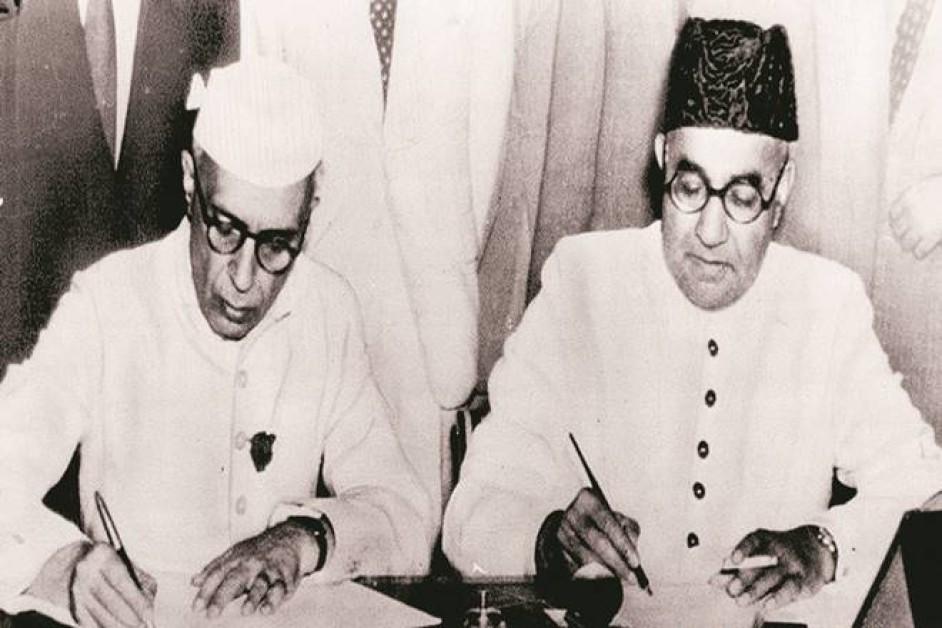
In the aftermath of the brutal Partition of 1947, India and Pakistan grappled with widespread communal violence, mass migrations, and deep-seated mistrust. Against this volatile backdrop, the Liaquat-Nehru Pact — also known as the Delhi Agreement — emerged in April 1950 as a bold diplomatic attempt to protect minority populations in both countries and stabilize rapidly deteriorating relations.
Signed by Jawaharlal Nehru, India's first Prime Minister, and Liaquat Ali Khan, Pakistan's first Prime Minister, this agreement was a critical step toward ensuring civil rights for Hindus, Sikhs, and Muslims caught on the wrong side of newly drawn borders.
The Background: Partition's Humanitarian Crisis
The Partition had unleashed one of the largest forced migrations in human history. Over 15 million people crossed the newly created borders amidst horrific violence that left hundreds of thousands dead. Minorities in both India and Pakistan — primarily Hindus and Sikhs in Pakistan, and Muslims in India — faced persecution, insecurity, and displacement.
By 1950, conditions worsened, particularly in East Pakistan (now Bangladesh), where attacks on Hindu minorities triggered a new wave of fear and migration. India witnessed retaliatory violence against Muslims, pushing the two young nations to the brink of another confrontation.
It was under these urgent and grim circumstances that the Liaquat-Nehru Pact was negotiated.
Key Features of the Liaquat-Nehru Pact
-
Minority Protection:
Both governments pledged to safeguard the lives, property, and cultural rights of their respective minorities. Citizens were granted full freedom to practice their religion and manage religious institutions. -
Non-Discrimination:
Minorities would enjoy equal rights and opportunities without discrimination in employment, civil rights, or political participation. -
Restoration of Property and Citizenship:
Efforts would be made to restore looted property, and individuals displaced by communal violence could reclaim their homes and land. -
Establishment of Minority Commissions:
Both India and Pakistan agreed to set up minority commissions to monitor the treatment of minorities and report directly to their respective governments. -
Right to Return:
Refugees who had fled were given the right to return to their original homes, provided they had not acquired citizenship in the country they had fled to. -
Exchange of Prisoners:
Political prisoners and abducted women would be returned to their respective countries as part of a humanitarian initiative.
The Diplomatic Triumph: An Attempt at Rebuilding Trust
The Liaquat-Nehru Pact was a diplomatic victory under extremely challenging conditions. It reflected a rare moment when both nations, despite intense mutual suspicion, recognized the shared moral and humanitarian imperative of protecting minorities.
Jawaharlal Nehru’s personal commitment to secularism and Liaquat Ali Khan’s desire to stabilize Pakistan’s fragile internal situation made the pact possible. It temporarily averted a full-scale war, reassured minorities, and established a framework for minority rights — at least on paper.
Challenges and Limitations
While the pact was a noble initiative, it faced major hurdles in implementation:
-
Continued Violence: Sporadic communal violence persisted, particularly in rural areas where government enforcement was weak.
-
Mass Migrations Continued: Despite promises of protection, minorities in both countries continued to migrate, driven by fear rather than law.
-
Political Instability: Liaquat Ali Khan’s assassination in 1951 and the rise of hardline elements in Pakistan undermined long-term commitments to minority protection.
In India, Nehru faced opposition from sections of the public who saw the pact as too lenient toward Pakistan.
Legacy and Long-Term Impact
Despite its imperfections, the Liaquat-Nehru Pact laid the foundation for the principle that minorities deserved explicit protection under law — a standard that continues to shape constitutional and legal approaches in both countries.
It also demonstrated that diplomacy and dialogue, even amid profound mistrust, could achieve tangible results. In many ways, it set a precedent for future bilateral efforts, including the Tashkent Agreement (1966) and the Simla Agreement (1972).
However, the pact’s failure to fully stem the tide of migration and violence also highlighted the limitations of political agreements without grassroots social reconciliation.
Conclusion
The Liaquat-Nehru Pact of 1950 was a courageous effort to heal the deep communal wounds left by Partition. It remains a testament to a moment when visionary leadership in India and Pakistan prioritized humanity over hostility.
While the pact could not eliminate the communal tensions that continued to plague South Asia, it laid down an important marker for minority rights and diplomatic engagement between two adversarial nations — a lesson that remains relevant to this day.
 Related News
POST A COMMENT (0)
All Comments (0)
Replies (0)