





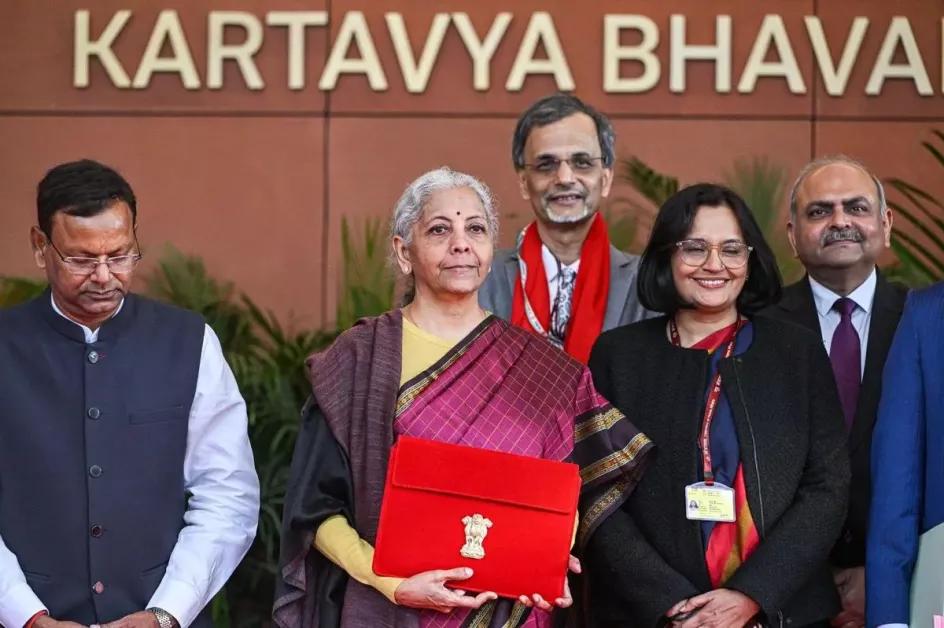
Budget 2026 Analysis | Key Highlights | What Makes This Budget Different
New Delhi:
Union Finance Minister Nirmala Sitharaman on Sunday presented the Union Budget 2026, marking her ninth consecutive budget, and perhaps one of the most policy-driven and ideologically clear financial statements of the Modi government so far.
Contrary to expectations of populist announcements ahead of upcoming state elections, Budget 2026 firmly distanced itself from short-term political appeasement and instead focused on long-term public welfare, economic stability, and systemic reforms. The Finance Minister described the budget as being guided by the principle of “People Over Populism.”
A Budget Without Ornamentation, Heavy on Intent
The 85-minute budget speech was delivered with notable restraint. There were:
-
No poetic references
-
No symbolic quotations
-
No emotional rhetoric
Instead, the speech relied on policy clarity, administrative intent, and governance direction. This was also the first budget prepared in the newly constructed Kartavya Bhavan, replacing the traditional North Block setting—symbolising a transition in India’s governance framework.
“People Over Populism”: The Core Philosophy
The defining feature of Budget 2026 is its conscious shift away from freebie-driven politics toward sustainable economic governance. At a time when electoral considerations often dictate fiscal policy, the government chose to prioritise:
-
Structural reforms over handouts
-
Institutional efficiency over announcements
-
Long-term growth over immediate applause
This approach positions Budget 2026 as a governance-first budget, rather than an election-centric one.
Strong Focus on Youth and Future Leadership
With India’s demographic advantage firmly in focus, Budget 2026 places young citizens at the centre of policy planning. Several proposals draw inspiration from the Viksit Bharat Young Leaders Dialogue 2026, reflecting the government’s intention to harness innovation, entrepreneurship, and skill development.
Key Youth-Oriented Priorities:
-
Encouraging leadership-driven entrepreneurship
-
Supporting innovation-based startups
-
Preparing the workforce for AI, digital, and green economy roles
-
Strengthening skill development ecosystems
The budget reinforces the idea that India’s youth are not merely beneficiaries of policy, but drivers of future economic growth.
Tax Reforms: Relief for Honest Taxpayers
One of the most impactful announcements in Budget 2026 relates to tax compliance and dispute resolution. The government acknowledged that excessive litigation and rigid penalties discourage voluntary compliance.
Major Tax Measures:
-
Simplified rules for “honest taxpayers”
-
Closure of legacy tax disputes through monetary settlement
-
Replacement of imprisonment with financial penalties in select cases
This signals a strategic shift from a punitive tax regime to a trust-based compliance framework, aimed at improving ease of doing business and reducing legal burdens.
Focus on the Poor, Marginalised, and Backward Sections
While the budget avoided overt populism, it remained firmly aligned with social inclusion. The government reiterated its commitment to:
-
Poverty alleviation
-
Welfare of marginalised communities
-
Empowerment of backward sections
Instead of expanding subsidies, the approach focused on capacity building, direct benefit efficiency, and targeted welfare delivery, ensuring that support reaches those who genuinely need it.
Three Strategic Pillars of Budget 2026
Inspired by Kartavya Bhavan’s ethos, the budget is anchored around three core objectives:
-
Accelerating sustainable economic growth
-
Fulfilling aspirations through opportunity creation
-
Capacity building under the principle of “Sabka Saath, Sabka Vikas”
This framework reinforces a balanced model of growth that integrates economic ambition with social responsibility.
Ease of Living: The Final Message
Unlike previous budgets that concluded with literary flourishes, Budget 2026 ended on a distinctly practical note—Ease of Living. The Finance Minister underlined that governance should ultimately translate into:
-
Reduced bureaucratic friction
-
Improved citizen services
-
Greater transparency and efficiency
The speech concluded with a simple yet powerful “Jai Hind”, reinforcing the budget’s grounded and people-centric tone.
Political Subtext Without Policy Compromise
While the budget speech remained policy-focused, subtle political symbolism was observed. The Finance Minister’s choice of a traditional Kanchipuram silk saree was widely interpreted as a cultural nod ahead of upcoming elections, though no state-specific financial announcements were made.
Expert Opinions and Political Reactions
Economists and Policy Analysts:
-
“A structurally mature and reform-oriented budget”
-
“Signals confidence in India’s long-term growth story”
-
“Prioritises systems over slogans”
Opposition Response:
-
Criticism over absence of immediate relief measures
-
Concerns on inflation and consumer spending
Despite criticism, there is broad consensus that Budget 2026 reflects administrative confidence and fiscal discipline.
Reflection of Modi Government’s Economic Vision
Budget 2026 aligns closely with the governance philosophy of Narendra Modi, emphasising:
-
Institutional reforms over temporary incentives
-
Long-term nation building over short-term politics
-
Policy continuity and execution
This budget may well be remembered as a transition budget—marking India’s evolution into a more mature, systems-driven economy.
A Budget That Chooses Stability Over Spectacle
Union Budget 2026 stands out not for dramatic announcements, but for its clarity of purpose. It reflects a government willing to resist populist pressures in favour of sustainable governance.
By prioritising people over populism, systems over symbolism, and future growth over immediate gains, Budget 2026 sets a clear roadmap for India’s economic journey in the years ahead.
 Related News
POST A COMMENT (0)
All Comments (0)
Replies (0)