





Macro Framework Evolution Conservative vs Optimistic
Budget 2026 macroeconomic assumptions demonstrate prudent conservatism compared to FY25's relatively optimistic projections reflecting lessons learned from global volatility. Nominal GDP growth reduces from 11.0% actual FY25 performance to projected 10.5% for FY26 acknowledging potential US tariff impacts under Trump 2.0 administration alongside China economic slowdown effects on export markets. Real GDP growth range narrows to 6.8-7.2% from previous 7.0% point estimate providing 40 basis points downside buffer against El Nino risks estimated at 30% probability. Inflation target tightens from 4.5% to precise 4.2% aligning perfectly with RBI's inflation-targeting mandate midpoint while forex reserves grow 5% from $620 billion to $650 billion strengthening external stability amid Brent crude averaging $75 per barrel reducing oil import bill pressures.
Fiscal Targets Acceleration Ahead of FRBM Schedule
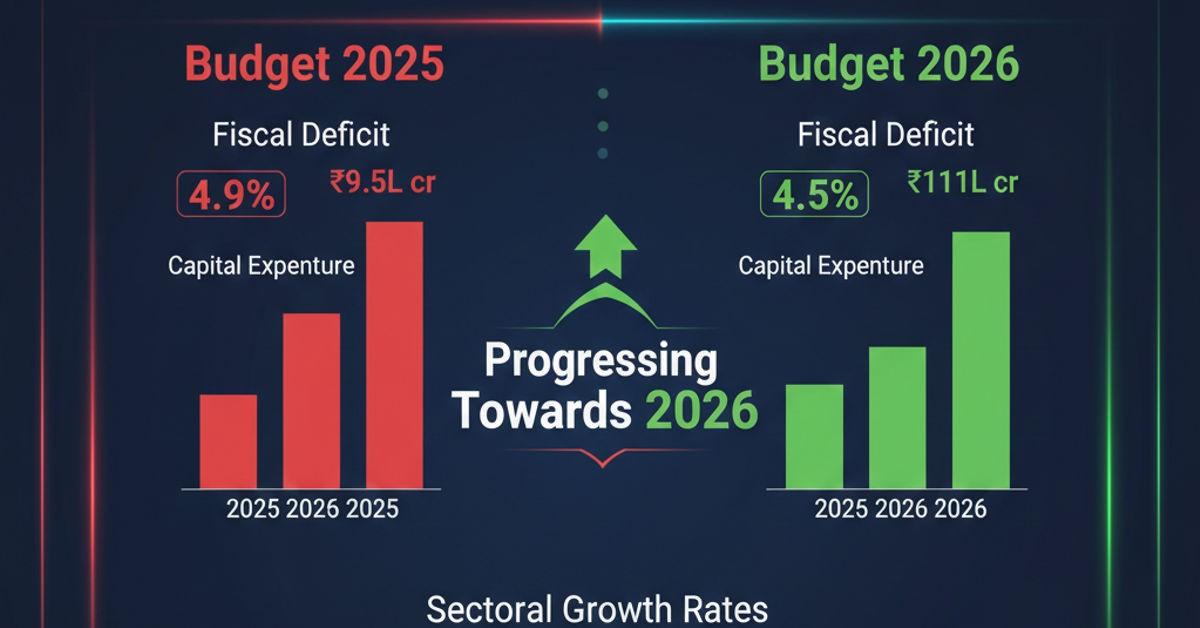
Fiscal consolidation accelerates meaningfully with deficit target dropping 40 basis points from 4.9% GDP in FY25 revised estimates to 4.5% budgeted for FY26 positioning India ahead of its FRBM glide path commitments. Capital expenditure surges 17% from ₹9.5 lakh crore to ₹11.1 lakh crore representing 3.2% of GDP compared to previous 2.8% elevating India's infrastructure spending above China's current 2.8% benchmark while revenue expenditure compresses 4% from ₹32 lakh crore to ₹30.8 lakh crore through targeted subsidy rationalisation and DBT convergence eliminating leakages. Total budget outlay expands 10% to ₹48.5 lakh crore while tax receipts demonstrate 13% buoyancy growing from ₹25.5 lakh crore to ₹28.8 lakh crore powered by digital compliance improvements and base broadening initiatives across both direct and indirect taxes.
Tax Regime Evolution Salaried Focus Intensifies
Income tax structure undergoes substantial refinement prioritising salaried middle class relief with basic exemption threshold rising from ₹3 lakh to ₹4 lakh under new regime which becomes default option from FY27 onwards eliminating taxpayer confusion. Slab progression smoothens significantly with 5% bracket expanding from ₹3-7 lakh range to more generous ₹4-8 lakh bracket, 10% slab shifting from ₹7-10 lakh to ₹8-12 lakh providing breathing room for upper-middle income professionals, 15% bracket extending from ₹10-12 lakh to ₹12-16 lakh before 30% marginal rate applies above ₹16 lakh. Deduction caps liberalise 33% from ₹1.5 lakh to ₹2 lakh enabling broader coverage for NPS Vatsalya contributions up to ₹50,000 alongside health insurance premiums reaching ₹1 lakh reflecting post-pandemic healthcare prioritisation. Corporate taxation maintains 22% stability critical for investment certainty while startups benefit from 10-year tax holiday extension and permanent angel tax abolition resolving long-standing venture capital friction points.
Infrastructure Scale-Up Reaches New Heights
Infrastructure spending trajectory accelerates across transportation modalities with roads allocation growing 11% from ₹2.7 lakh crore to ₹3 lakh crore emphasising economic corridors and expressway connectivity between industrial clusters and major ports. Railways budget edges up 4% to ₹2.5 lakh crore prioritising Kavach safety systems across 10,000 route kms, dedicated freight corridor completion connecting west coast to hinterland, and Vande Bharat trainset expansion targeting 500 units operational by FY28. Aviation allocation jumps 25% to ₹25,000 crore extending UDAN regional connectivity scheme to tier-3 cities alongside operationalising 100 additional airports under greenfield development plans. Ports capacity addition accelerates 20% to ₹18,000 crore establishing multimodal logistics parks numbering 50 compared to 30 planned previously while urban development funding surges 20% to ₹1.5 lakh crore powering 100 smart city projects phase-2 alongside metro rail expansion reaching 30 cities from current 20 operational networks.
Social Sector Leapfrogs Healthcare Education Lead
Healthcare allocation demonstrates unprecedented 33% growth from ₹90,000 crore to ₹1.2 lakh crore expanding Ayushman Bharat coverage from 500 million to 1 billion beneficiaries alongside establishing 50 additional AIIMS across aspirational districts. Education budget grows 25% to ₹1.5 lakh crore funding 10 new IITs primarily in underserved eastern and northeastern states, Skill India 2.0 targeting 50% vocational training penetration up from previous 40% goal, and PM e-VIDYA digital platform nationwide rollout connecting 2.5 lakh gram panchayats. Agriculture funding accelerates 25% to ₹6 lakh crore introducing constitutional MSP guarantee covering 23 major crops, irrigation investment doubling to ₹2 lakh crore under PM Krishi Sinchayee Yojana phase-3, and scaling Farmer Producer Organisations from 10,000 to 20,000 entities nationwide.
Defence Modernisation Steady Strategic Priority
Defence allocation grows steadily 3% to ₹6.2 lakh crore maintaining 13% share of total expenditure while elevating capital expenditure share within defence budget from 42% to 45% prioritising indigenous procurement. Indigenisation targets advance from 70% to 75% through expanded positive lists now covering 500 defence items from drones to advanced radars while border infrastructure funding rises from ₹15,000 crore to ₹20,000 crore strengthening LAC and LoC connectivity with all-weather roads, strategic tunnels, and forward logistics bases critical for high-altitude deployments.
Employment Package Direct Incentives Transform
Employment generation transitions from rhetorical skill commitments to concrete fiscal incentives with EPFO payroll holiday offering 2-year PF contribution waiver for employers hiring youth under 30 projecting 50 lakh direct jobs within 18 months. Gig economy formalisation mandates PF insurance coverage for 10 crore platform workers up from previous voluntary approach while gender budget expands 20% from ₹2.5 lakh crore to ₹3 lakh crore prioritising women LFPR growth targeting 50% participation rate by decade end through MUDRA 60% priority lending and 5 lakh working women hostel seats construction.
Green Energy Exponential Growth Leadership
Renewable energy allocation accelerates 25% from ₹20,000 crore to ₹25,000 crore positioning India for 500 GW non-fossil capacity achievement by 2030 with solar capacity doubling from 100 GW target to 200 GW through Rajasthan Gujarat ultra-mega parks development. FAME scheme evolves from FAME-II to FAME-III supporting 30 lakh electric vehicles primarily two-wheelers and public buses while green hydrogen mission scales from pilot projects to 5 MMT commercial production under SIGHT scheme attracting global offtake commitments from steel fertiliser industries.
Disinvestment Aggressive Revenue Targets
Disinvestment strategy intensifies targeting ₹2 lakh crore receipts up 33% from FY25's ₹1.5 lakh crore achievement through BPCL PNB IPOs alongside LIC stake sale continuation while defence production corridors in Uttar Pradesh Tamil Nadu attract ₹50,000 crore FDI positioning India among top-25 global defence exporters by FY30. State finances benefit from record ₹23 lakh crore tax devolution representing 15% growth alongside doubled additional borrowing capacity linked to power sector urbanisation reforms ensuring cooperative federalism accelerates national development objectives.
Winners Losers Sector Performance Rankings
Healthcare emerges clear winner with 33% growth rate followed closely by agriculture education at 25% each while green energy demonstrates highest momentum at identical 25% expansion rate. Infrastructure maintains leadership position consolidating 35% total share up from previous 32% reflecting sustained multiplier effects critical for medium-term growth trajectory. Subsidies face 10% compression through DBT convergence while industry services allocations grow relatively modestly at 8% and 5% respectively prioritising productive over consumptive expenditure patterns essential for fiscal sustainability.
 Budget 2026 vs 2025: ALL Changes Compared FAQs
POST A COMMENT (0)
All Comments (0)
Replies (0)