





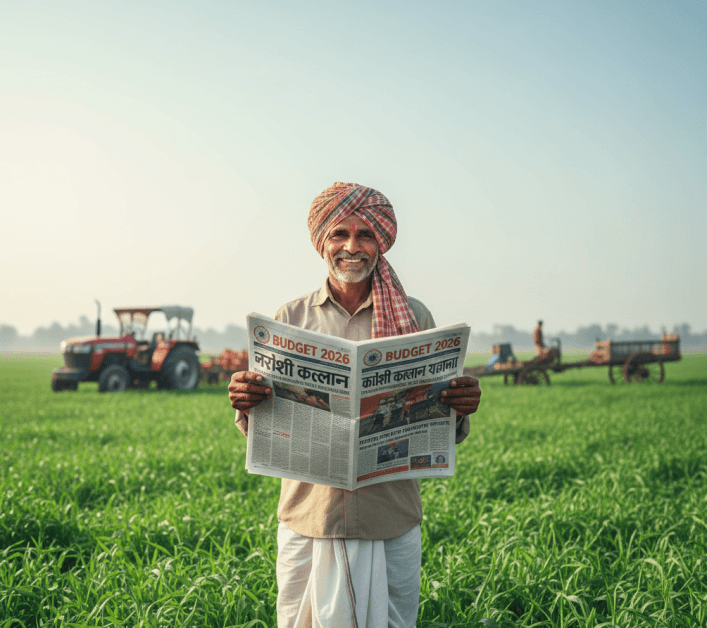
Agriculture and rural livelihoods occupy a central place in Budget 2026, reflecting the sector’s importance for growth, employment and social stability. The government has combined measures aimed at price support, irrigation, rural infrastructure and credit access in an effort to make farm incomes more stable and resilient.
At one level, the Budget continues to rely on minimum support price operations and procurement to provide a safety net for farmers in key crops. The stated objective remains to ensure remunerative prices and protect producers from sharp market fluctuations. However, policymakers are increasingly aware that MSP alone cannot be the sole instrument for income security, particularly as cropping patterns diversify and climatic risks intensify.
Consequently, Budget 2026 places renewed emphasis on irrigation and water management. Expanding irrigation coverage through canals, micro-irrigation systems and water conservation works is seen as a vital step in reducing the dependence of farmers on erratic monsoons. The Budget supports projects in water-stressed regions, including groundwater recharge, watershed development and efficient water use technologies, to improve yields and sustainability.
Rural infrastructure is another focus area aligned closely with agricultural outcomes. Investments in rural roads, storage, cold chains and market yards are intended to reduce post-harvest losses and improve access to markets. When farmers can reach buyers more easily and store produce under better conditions, they are in a stronger position to negotiate prices and avoid distress sales.
Budget 2026 also underscores the role of institutional credit in modernising agriculture. Enhanced limits and streamlined procedures under rural and Kisan-focused credit schemes aim to draw farmers away from informal, high-cost lending. The government is pushing for wider penetration of banking and digital finance in rural areas, enabling farmers to access working capital and investment loans more conveniently.
In parallel, the Budget encourages diversification into high-value segments such as horticulture, pulses, oilseeds, dairy, poultry and fisheries. Support for these allied sectors reflects a recognition that multiple income streams can shield households from the risks associated with relying on a single crop or season. Targeted schemes for livestock health, feed, breeding and processing infrastructure are part of this broader strategy.
Another important dimension is the promotion of agri-tech and digital solutions. Budget 2026 backs initiatives that use data, sensors and digital platforms to provide farmers with timely information on weather, prices and best practices. The government is also looking to build platforms that link producers directly with buyers, including agri-startups and e-commerce entities, potentially improving price realisation and transparency.
On the risk management front, crop insurance and disaster relief mechanisms remain crucial. The Budget aims to improve coverage, reduce claim settlement times and enhance awareness so that farmers are more willing to participate in formal risk-sharing arrangements. Effective insurance is seen as an essential complement to irrigation, price support and diversification.
From a structural perspective, collective models such as farmer-producer organisations (FPOs) receive continued support. By aggregating smallholders into larger groups, FPOs can gain better access to credit, inputs, technology and markets. Budget 2026 reinforces existing schemes that help such organisations with capacity building, governance and initial working capital.
The government is also conscious of the need to align agriculture with environmental and climate goals. Budget announcements encourage climate-resilient seeds, sustainable farming practices and soil health management. Organic and natural farming initiatives get a mention as niche areas with potential for higher-value markets, both domestically and internationally.
A recurring theme across the Budget’s rural and agricultural initiatives is the integration of physical and digital infrastructure. Rural roads, warehouses and markets are being linked with digital identities, land records and payment systems. This integration is intended to make service delivery more efficient, reduce leakages and create a more transparent ecosystem for subsidies, credit and benefits.
For farmers on the ground, the impact of Budget 2026 will depend on how quickly and effectively these schemes are executed. Building irrigation systems and rural infrastructure is inherently time-consuming, but interim gains often appear in the form of improved road access, better storage options and easier credit processes. Over time, these inputs can translate into higher productivity, reduced wastage and a stronger bargaining position in the marketplace.
The Budget also carries an implicit expectation from states, cooperatives and the private sector. Many of the announced initiatives require coordination and co-financing at multiple levels. For example, strengthening cold chains or promoting value-added processing often involves partnerships between government agencies, private firms and farmer groups.
Overall, Budget 2026 treats agriculture not just as a welfare concern but as an economic sector that can contribute meaningfully to growth if productivity, value addition and market access improve. By combining MSP, irrigation, credit, infrastructure and digital tools, the government is attempting to address both short-term vulnerabilities and long-term structural challenges.
 Budget 2026 for Farmers: MSP, Irrigation & Credit FAQs
POST A COMMENT (0)
All Comments (0)
Replies (0)