





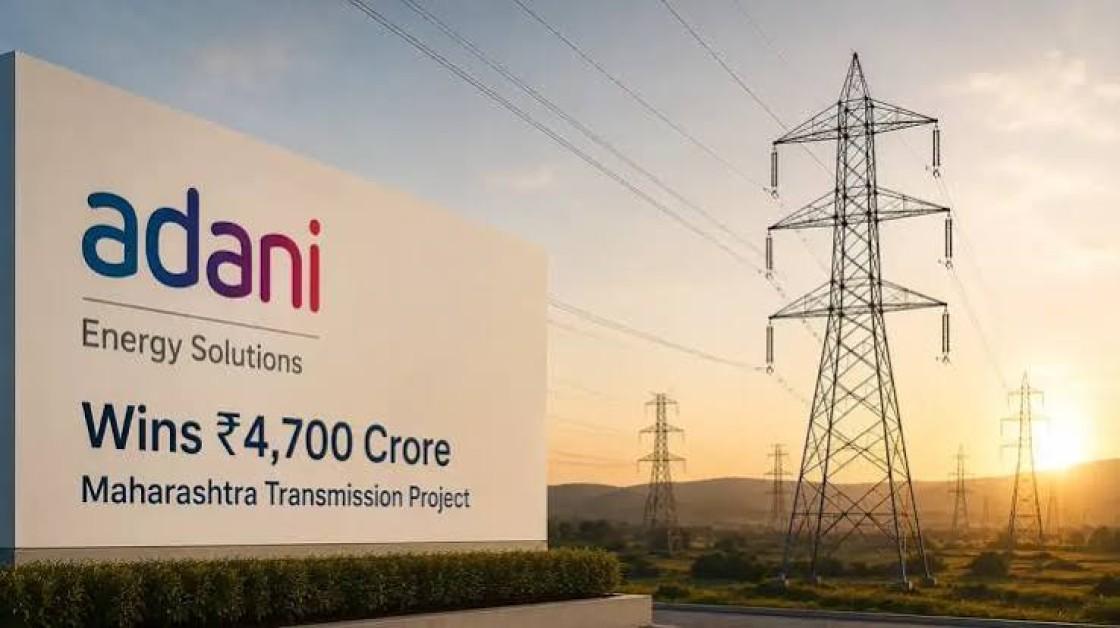
Adani Energy Solutions Wins ₹4,700 Crore Maharashtra Power-Transmission Project
Adani Energy Solutions Ltd has secured a ₹4,700 crore power-transmission project in Maharashtra that will strengthen the network used to move renewable and pumped-storage electricity between southern and western India.
The project, titled Network Expansion Scheme in Western Region to Cater to Pumped Storage Potential near Satara (up to 4,500 MW) – Part A, was awarded through the tariff-based competitive bidding route after Adani Energy Solutions emerged as the lowest bidder.
The development is designed to support the evacuation of renewable electricity generated in Karnataka to major consumption centres in Maharashtra while also connecting pumped-storage projects with combined potential of up to 4,500 MW across the Satara region.
Adani Energy Solutions plans to complete the project within 36 months.
For the company, the win expands an already large transmission-development pipeline and takes its transmission order book to approximately ₹85,000 crore.
Project Has Estimated Capex of ₹4,700 Crore

The new transmission project has an estimated capital expenditure of approximately:
₹4,700 crore.
It will be developed through the project special-purpose vehicle:
Satara Power Transmission Ltd.
The project expands Adani Energy Solutions' presence in Maharashtra while creating infrastructure designed specifically around the state's growing renewable-energy and energy-storage requirements.
Project Will Handle Up to 4,500 MW
The transmission system is designed to support:
up to 4,500 MW
of renewable and pumped-storage capacity.
That scale is significant.
A transmission project of this size is not simply connecting an individual power plant.
It is creating regional infrastructure capable of carrying very large quantities of electricity across multiple generation and consumption centres.
562 Circuit Kilometres of Transmission Lines Will Be Added
Once completed, the project will add approximately:
562 circuit kilometres
of transmission lines to Adani Energy Solutions' portfolio.
Circuit kilometres measure the length of individual electrical circuits carried over transmission infrastructure.
The project therefore represents a substantial physical expansion of the high-voltage network.
Transformation Capacity Will Increase by 9,000 MVA
The project will also add approximately:
9,000 MVA
of transformation capacity.
Transformation capacity determines how much electrical power substations can process between different voltage levels.
Large additions are required when new renewable and storage projects begin injecting substantial electricity into the grid.
A New Substation Will Be Built in Satara
One of the project's major components is a new transmission substation in:
Satara.
Substations act as critical junctions within the electricity network.
They help:
change voltage levels,
manage power flows,
and connect different transmission corridors.
The Satara facility will become an important part of the infrastructure serving pumped-storage and renewable projects in the region.
Kolhapur and Satara Will Be Connected
The project also includes construction of a transmission line connecting:
Kolhapur and Satara.
This corridor will strengthen the movement of electricity within western India while improving connections between generation sources and major demand centres.
The Kolhapur pooling station will also be upgraded as part of the scheme.
Karnataka Renewable Power Will Move Toward Maharashtra
One of the project's strategic functions is to transmit renewable electricity generated in:
Karnataka
toward consumption centres in:
Maharashtra.
This demonstrates why interstate transmission infrastructure is becoming increasingly important.
Renewable power is not always generated where electricity demand is highest.
High-voltage networks must move that electricity across state boundaries.
Maharashtra Has Large Electricity Demand
Maharashtra is one of India's largest industrial and electricity-consuming states.
Major demand centres include:
Mumbai,
Pune,
industrial corridors,
manufacturing clusters,
commercial centres,
and growing data infrastructure.
Reliable transmission capacity is therefore essential to connect new sources of power with these high-demand regions.
Pune and Mumbai Metropolitan Region Will Benefit
The project is intended to support power flows toward major load centres including:
Pune
and the:
Mumbai Metropolitan Region.
These regions contain substantial industrial, commercial and residential electricity demand.
Their consumption requirements are also expected to increase as economic activity expands.
Pumped Storage Is Becoming Important to India’s Grid
The project has a particularly strong connection with:
pumped-storage hydropower.
Pumped-storage facilities function as large-scale energy-storage systems.
When electricity supply exceeds demand, power can be used to pump water from a lower reservoir to a higher one.
When electricity demand rises, the water is released through turbines to generate power.
Pumped Storage Can Store Renewable Energy Indirectly
Solar and wind generation are variable.
Solar plants produce electricity primarily during daylight hours.
Wind output changes according to weather.
Pumped storage allows the electricity system to shift some energy across time.
Excess renewable electricity can help pump water uphill.
That stored potential energy can later generate electricity when demand is higher.
Storage Becomes More Important as Renewable Capacity Expands
India is adding enormous amounts of:
solar
and
wind
capacity.
The more variable generation enters the grid, the more flexibility the electricity system needs.
Flexible resources include:
battery storage,
pumped storage,
gas generation,
and demand management.
Transmission infrastructure must connect those resources to the wider network.
The Satara Region Has Significant Pumped-Storage Potential
The transmission scheme was specifically developed to cater to pumped-storage potential near Satara of up to:
4,500 MW.
This makes the project part of a broader energy-storage ecosystem rather than merely conventional transmission expansion.
Pumped-storage development could become increasingly important to Maharashtra as renewable penetration rises.
Transmission Is the Hidden Infrastructure Behind Renewable Growth
Building renewable generation capacity alone is not sufficient.
A solar or wind project produces economic value only if electricity can reach consumers.
That requires:
transmission lines,
substations,
and grid-management infrastructure.
Without adequate transmission, renewable projects can face curtailment or delayed commissioning.
India Needs Massive Grid Expansion
India is targeting:
500 GW of non-fossil-fuel electricity capacity by 2030.
Achieving that target requires substantial expansion of transmission infrastructure alongside generation.
Renewable capacity is often concentrated in resource-rich states while demand is distributed across the country.
That makes interstate transmission corridors strategically important.
Renewable Energy Is Changing Grid Geography
Traditional power plants were often developed relatively close to:
coal supplies,
cities,
or industrial regions.
Renewables follow different geography.
Solar projects concentrate where sunlight and land availability are favourable.
Wind projects concentrate where wind resources are strong.
The grid therefore needs to connect new generation geographies with existing consumption centres.
Transmission Projects Can Become Bottlenecks
A renewable project can be constructed relatively quickly.
Large high-voltage transmission corridors can take longer because they require:
land,
right-of-way,
equipment,
and regulatory approvals.
If transmission development falls behind generation, new power capacity may not be fully usable.
Coordinated planning is therefore essential.
Adani Energy Solutions Is One of India’s Major Transmission Companies
Adani Energy Solutions has developed a large portfolio of electricity-transmission assets across India.
Its business includes:
high-voltage transmission lines,
substations,
and electricity-distribution operations.
The company has expanded rapidly through both organic development and competitive-bidding projects.
Order Book Reaches Around ₹85,000 Crore
Following the Maharashtra project win, Adani Energy Solutions' transmission order book has reached approximately:
₹85,000 crore.
That provides the company with a substantial multi-year development pipeline.
Large order books can offer future revenue visibility, although execution timelines and project financing remain important.
FY27 Order Wins Have Accelerated
The Maharashtra project also increases Adani Energy Solutions' order inflows during FY27.
The company's latest wins have strengthened expectations for continued growth across India's transmission investment cycle.
Transmission spending is increasingly being driven by:
renewable integration,
storage,
interstate corridors,
and rising electricity demand.
Tariff-Based Competitive Bidding Determines Projects
The Satara scheme was awarded through:
Tariff-Based Competitive Bidding, or TBCB.
Under this model, qualified transmission developers compete to build and operate specified projects.
The bidder offering the most competitive tariff while meeting technical requirements can win the project.
This introduces private-sector competition into transmission development.
Competition Can Reduce Transmission Costs
Transmission charges ultimately become part of the electricity system's overall cost.
Competitive bidding encourages developers to optimise:
capital costs,
financing,
construction,
and operations.
The objective is to build required infrastructure at efficient tariffs.
However, aggressive bidding must still leave enough financial room for reliable long-term operation.
Transmission Assets Have Long Operating Lives
High-voltage transmission infrastructure can operate for decades.
Developers therefore evaluate projects over long time horizons.
Initial construction requires substantial capital.
Once operational, transmission assets can produce relatively predictable regulated or contracted cash flows.
This makes the sector attractive to infrastructure investors.
Financing Is Critical
A ₹4,700 crore project requires substantial financing.
Transmission developers typically use a combination of:
equity,
and debt.
The economics depend on:
construction cost,
borrowing rates,
and the tariff awarded.
Strong access to capital can therefore become a competitive advantage.
Execution Within 36 Months Will Be Important
Adani Energy Solutions plans to commission the project within:
36 months.
That timeline will require coordinated execution across:
engineering,
procurement,
construction,
and land access.
Delays can increase financing costs and postpone project revenues.
Right-of-Way Is a Major Transmission Challenge
Transmission lines often cross:
farmland,
villages,
forests,
and other properties.
Developers need rights to construct and maintain towers and conductors across these areas.
Obtaining right-of-way can sometimes become one of the most difficult parts of project execution.
Early coordination with local authorities and landowners is therefore important.
Transmission Equipment Supply Chains Matter
Large transmission projects require significant quantities of equipment.
These include:
towers,
conductors,
transformers,
switchgear,
and protection systems.
Strong order growth across the sector can therefore benefit manufacturers supplying transmission infrastructure.
Transformer Demand Is Rising
India's power-system expansion is creating substantial demand for transformers.
New:
renewable plants,
substations,
data centres,
and industrial loads
all require electrical transformation equipment.
The project's 9,000 MVA capacity addition demonstrates the scale of equipment required.
Grid Stability Is Becoming More Complex
Renewable energy changes how power systems operate.
Traditional thermal plants typically provide relatively predictable generation.
Solar and wind output can change more rapidly.
Grid operators therefore need:
strong transmission,
storage,
and advanced control systems
to maintain reliability.
Pumped Storage Can Support Peak Demand
Electricity demand changes throughout the day.
Demand may rise sharply during evening hours even as solar generation falls.
Pumped-storage plants can release stored energy during those periods.
This makes them particularly useful for managing peak demand.
Storage Can Reduce Renewable Curtailment
Sometimes renewable plants could produce electricity but the grid cannot use all of it immediately.
The generation may therefore be curtailed.
Storage allows part of that excess electricity to be saved for later.
This increases the useful output of renewable assets.
Transmission and Storage Must Be Planned Together
A storage project is valuable only if it can connect efficiently with the grid.
Likewise, a transmission system designed for high renewable penetration benefits from access to storage.
The Satara project illustrates increasingly integrated planning between:
generation,
storage,
and transmission.
Southern and Western India Will Gain Stronger Linkage
Adani Energy Solutions has said the project will strengthen power flows between:
Southern India
and:
Western India.
Interregional transmission helps balance electricity supply across the country.
If one region has excess renewable generation while another has high demand, stronger interconnections allow power to move where it is needed.
A Strong National Grid Improves Reliability
Regional electricity systems become more resilient when they are well connected.
A local generation shortage can be compensated through imports from another region.
Similarly, excess renewable output can be exported.
This reduces dependence on any single regional generation mix.
Maharashtra Is Expanding Clean-Energy Infrastructure
Maharashtra is pursuing substantial investment in:
renewables,
storage,
transmission,
and electricity distribution.
Its large industrial economy requires significant new power supply.
At the same time, decarbonisation goals are encouraging greater reliance on renewable generation.
Transmission infrastructure must support both objectives.
Mumbai’s Energy Demand Is Particularly Significant
The Mumbai Metropolitan Region contains:
financial services,
commercial real estate,
transport systems,
and large residential demand.
Electricity reliability is economically critical.
As electrification and digitalisation increase, power demand could rise further.
Data Centres Add New Electricity Loads
Maharashtra, particularly Mumbai and surrounding areas, is an important data-centre market.
Data centres consume large quantities of continuous electricity.
The expansion of:
AI,
cloud computing,
and digital services
is expected to increase power requirements.
This creates additional demand for dependable transmission infrastructure.
Electric Vehicles Will Also Increase Demand
Transport electrification gradually shifts energy consumption from petroleum toward electricity.
More:
electric cars,
buses,
and commercial vehicles
will increase power demand.
Grid infrastructure therefore needs to expand ahead of widespread EV adoption.
Industrial Expansion Creates Additional Pressure
Maharashtra remains a major manufacturing centre.
New investments across:
automobiles,
electronics,
chemicals,
and industrial facilities
can significantly increase electricity consumption.
Transmission capacity therefore becomes part of the state's competitiveness as an investment destination.
Large Projects Can Support Local Construction Activity
A ₹4,700 crore transmission project creates demand for:
civil contractors,
engineering services,
equipment suppliers,
and skilled labour.
The economic effect therefore extends beyond Adani Energy Solutions itself.
Power infrastructure supports a broader domestic industrial supply chain.
Grid Investment Enables Future Private Investment
Reliable power is a prerequisite for nearly every major industrial project.
Manufacturers consider:
electricity availability,
quality,
and cost
before investing.
Transmission infrastructure can therefore indirectly support industrial development by improving access to dependable power.
AESL Shares Responded to the Project Win
Adani Energy Solutions shares initially gained after the project announcement.
Investor attention focused on the contribution the order makes to the company's expanding transmission pipeline.
Market reaction, however, should be separated from long-term project economics.
The ultimate value will depend on:
execution,
capital discipline,
and operational performance.
Brokerage Attention Has Increased
Following the order win, Morgan Stanley reiterated its positive view on Adani Energy Solutions and highlighted the company's growing transmission order book.
Brokerage estimates are opinions rather than guaranteed outcomes.
But the attention reflects how transmission order inflows have become a major component of the company's investment narrative.
Growth Requires Balance-Sheet Discipline
A large project pipeline creates opportunities but also requires substantial capital.
Transmission developers need to fund multiple projects simultaneously.
Management therefore needs to balance:
growth,
leverage,
and cash flow.
The quality of execution becomes increasingly important as the order book expands.
Asset Monetisation Could Eventually Support Growth
Infrastructure companies can also recycle capital by monetising mature assets through structures such as:
InvITs,
or strategic asset sales.
This can release equity from operating projects and redeploy it toward new construction.
Capital recycling can therefore help support faster expansion without permanently increasing parent-level leverage.
India’s Transmission Opportunity Is Long Term
The current wave of grid investment is unlikely to end with the 2030 renewable target.
India's electricity consumption per person remains below many developed economies.
As incomes rise and economic activity expands, total electricity demand is expected to increase substantially.
The transmission system therefore needs continuous investment.
Renewable Targets Make the Opportunity Larger
The composition of that electricity growth matters.
India is simultaneously trying to expand supply and reduce carbon intensity.
This means much of the new capacity will come from:
renewables,
nuclear,
and storage-supported systems.
Those resources often require more sophisticated transmission planning than conventional local generation.
Conclusion
Adani Energy Solutions' ₹4,700 crore Maharashtra transmission project represents a significant addition to both the company's order book and India's rapidly expanding clean-energy infrastructure.
The project will create 562 circuit kilometres of transmission lines and 9,000 MVA of transformation capacity, while supporting the movement of up to 4,500 MW of renewable and pumped-storage power.
Its strategic importance comes from the connection it creates between renewable generation in Karnataka, pumped-storage resources around Satara and major electricity-demand centres across Pune and the Mumbai Metropolitan Region.
The project is scheduled for completion within 36 months and will be implemented through Satara Power Transmission Ltd.
For Adani Energy Solutions, the win pushes its transmission order book to approximately ₹85,000 crore, providing substantial visibility into future project execution.
For India's power system, the development highlights an increasingly important reality.
The transition to renewable electricity cannot be achieved by building solar and wind projects alone.
India also needs transmission corridors, substations and large-scale storage capable of moving clean electricity from where it is produced to where consumers need it — and doing so reliably at every hour of the day.
The Maharashtra project is therefore not merely another transmission contract.
It is part of the physical grid infrastructure required to turn India's rapidly expanding renewable capacity into dependable electricity for one of the country's largest industrial and urban economies.
 Adani Energy Solutions Wins ₹4,700 Crore Maharashtra Transmission Project FAQs
POST A COMMENT (0)
All Comments (0)
Replies (0)