





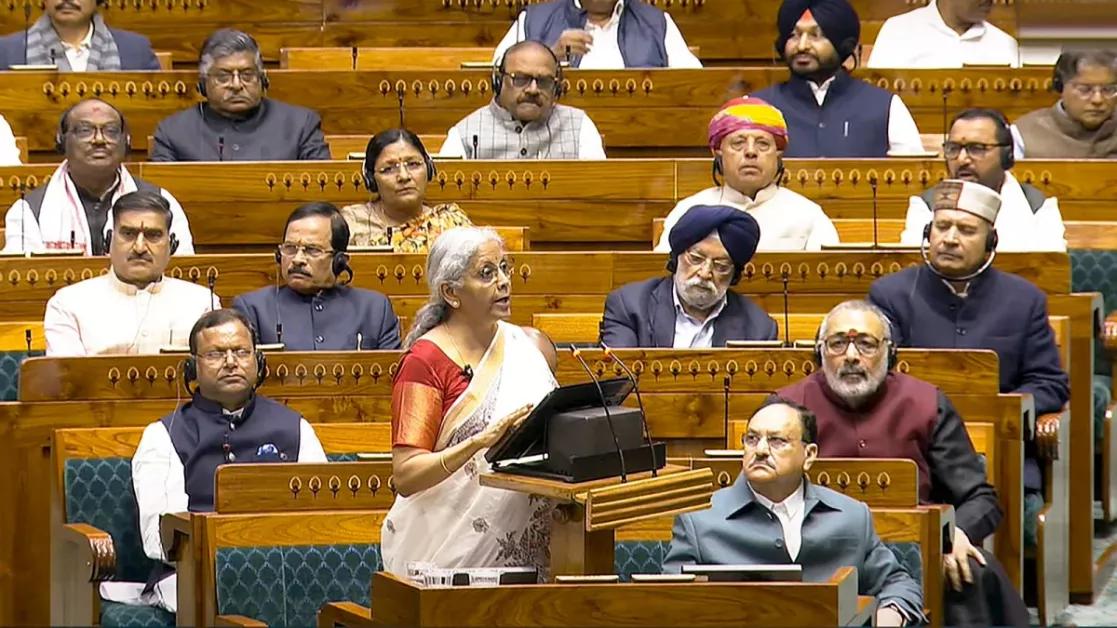
A Growth-Focused Budget with Strategic Intent
The Union Budget 2026 sector-wise impact reflects a decisive shift in India’s economic strategy—moving from short-term stimulus to long-term structural growth. Presented at a time of global uncertainty, the budget positions India as a resilient, investment-driven economy with a clear emphasis on manufacturing, infrastructure, and financial sector deepening.
With a record capital expenditure of ₹12.2 lakh crore and a fiscal deficit target of 4.3% of GDP, the government has chosen to balance growth with fiscal discipline.
For businesses and markets, the implications are significant. Sector-specific incentives, policy reforms, and investment allocations are shaping capital flows, influencing stock performance, and redefining growth trajectories across industries.
Infrastructure: The Core Growth Engine
Infrastructure continues to be the backbone of the Union Budget 2026.
The government has maintained aggressive capital spending, with allocations reaching ₹12.2 lakh crore—one of the highest in India’s history.
Key developments include:
- Expansion of highways, rail corridors, and logistics infrastructure
- Development of Tier 2 and Tier 3 cities as growth hubs
- Focus on multi-modal connectivity and industrial corridors
The impact on business is immediate and far-reaching.
- Construction, cement, and engineering companies are seeing strong order inflows
- Infrastructure firms have witnessed stock price gains post-budget announcements
- Private sector investment is being crowd-in through public spending
Markets view infrastructure as a multi-year growth story, with strong earnings visibility.
Manufacturing: Strategic Push Toward Self-Reliance
Manufacturing is at the center of the budget’s growth narrative.
The government has announced initiatives to scale up production across seven strategic sectors, including semiconductors, biopharma, and electronics.
Major initiatives include:
- India Semiconductor Mission 2.0
- Biopharma SHAKTI program with ₹10,000 crore allocation
- Development of rare earth and advanced manufacturing corridors
This push is aimed at reducing import dependence and strengthening India’s global competitiveness.
For businesses:
- Increased incentives for domestic production
- Improved supply chain ecosystems
- Enhanced export potential
Market analysts suggest that manufacturing stocks are likely to remain key beneficiaries as India positions itself as a global production hub.
MSMEs: Strengthening the Economic Backbone
Micro, Small, and Medium Enterprises (MSMEs) receive significant attention in the budget.
Key announcements include:
- ₹10,000 crore SME Growth Fund
- Revival of 200 legacy industrial clusters
- Enhanced access to credit and digital platforms
These measures are designed to:
- Improve competitiveness
- Increase productivity
- Support employment generation
For the broader economy, MSME growth is critical as it drives both manufacturing output and rural income levels.
Financial Sector: Deepening Capital Markets
The financial sector emerges as a key pillar in the budget’s strategy.
Reforms focus on:
- Strengthening corporate and municipal bond markets
- Enhancing liquidity and investor participation
- Introducing new risk management tools
The shift toward bond markets is particularly important as it:
- Reduces reliance on bank financing
- Provides long-term funding for infrastructure projects
- Encourages institutional investment
For markets, this signals a transition toward a more mature and diversified financial ecosystem.
Technology & Digital Economy: Building Future Capabilities
The budget reinforces India’s ambition to become a global technology leader.
Key areas of focus include:
- Semiconductor manufacturing
- AI and digital infrastructure
- Incentives for Global Capability Centers (GCCs)
These initiatives are expected to:
- Attract global tech investments
- Strengthen innovation ecosystems
- Enhance high-value job creation
The technology sector, while facing short-term global challenges, is positioned for long-term structural growth.
Agriculture & Rural Economy: Productivity Over Subsidy
A notable shift in the budget is the move toward productivity-driven agricultural growth.
Instead of expanding subsidies, the focus is on:
- Improving supply chains
- Enhancing agricultural productivity
- Supporting rural industries such as textiles and handicrafts
Initiatives like khadi and handloom support, along with textile expansion programs, aim to boost rural income and employment.
This approach signals a transition toward sustainable rural development.
Real Estate & Urban Development: Mixed Signals
The real estate sector receives indirect support through infrastructure development and urbanization initiatives.
However, industry stakeholders have expressed mixed reactions.
- Positive sentiment due to improved connectivity and demand drivers
- Concerns around lack of direct policy incentives
The sector is expected to benefit over the long term, but short-term growth may remain uneven.
Stock Market Reaction: Sectoral Divergence
The stock market response to the Union Budget 2026 has been selective.
Positive Market Reactions
- Infrastructure and capital goods stocks rallied
- Manufacturing and defense-related companies gained momentum
- Financial sector stocks responded positively to reforms
Negative or Mixed Reactions
- Increased Securities Transaction Tax (STT) impacted trading sentiment
- Concerns around government borrowing influenced bond yields
- Some sectors saw profit booking after initial rallies
Markets are increasingly reacting not just to announcements, but to execution potential and long-term impact.
Data, Trends & Fiscal Signals
The numbers behind the budget provide deeper insights:
- Total expenditure: ₹53.5 lakh crore
- Capital expenditure: ₹12.2 lakh crore
- Fiscal deficit target: 4.3% of GDP
- GDP growth projection: around 7%
These figures indicate:
- Continued fiscal discipline
- Strong focus on investment-led growth
- Balanced approach between growth and stability
Expert Insights: Interpreting the Budget Strategy
According to market analysts:
- The budget prioritizes long-term capacity building over short-term consumption boosts
- Infrastructure and manufacturing will remain key growth drivers
- Policy continuity is strengthening investor confidence
Experts highlight that India is entering a phase where public investment is catalyzing private capital, creating a virtuous cycle of growth.
Global Comparison: India’s Strategic Positioning
Compared to global economies, India’s budget stands out for its growth orientation.
While developed economies are focusing on inflation control and fiscal tightening, India is:
- Expanding capital expenditure
- Investing in manufacturing and technology
- Strengthening domestic demand
This positions India as one of the fastest-growing major economies globally.
Risks and Challenges
Despite its strengths, the budget also presents certain risks:
- High government borrowing could impact interest rates
- Execution challenges in large infrastructure projects
- Global economic slowdown affecting exports
- Inflationary pressures due to commodity prices
These factors will influence how effectively the budget translates into economic outcomes.
Future Outlook: A Structural Growth Framework
The Union Budget 2026 sets the stage for a multi-year growth cycle.
Key expectations include:
- Continued momentum in infrastructure and manufacturing
- Expansion of financial markets
- Growth in technology-driven sectors
- Strengthening of rural and MSME ecosystems
Market analysts suggest that India is transitioning from a cyclical recovery phase to a structural growth trajectory.
A Budget Focused on Long-Term Transformation
The Union Budget 2026 sector-wise impact underscores a clear strategic direction—India is building a future-ready economy driven by investment, innovation, and resilience.
Rather than relying on short-term stimulus, the budget focuses on strengthening economic fundamentals, enhancing competitiveness, and creating sustainable growth engines.
For businesses, the message is clear: sectors aligned with infrastructure, manufacturing, and technology are poised to lead. For markets, the takeaway is equally important—this is a policy framework designed for long-term value creation, not immediate gains.
As implementation unfolds, the real impact of this budget will be measured not just in numbers, but in how effectively it reshapes India’s economic landscape.
 Related News
POST A COMMENT (0)
All Comments (0)
Replies (0)