





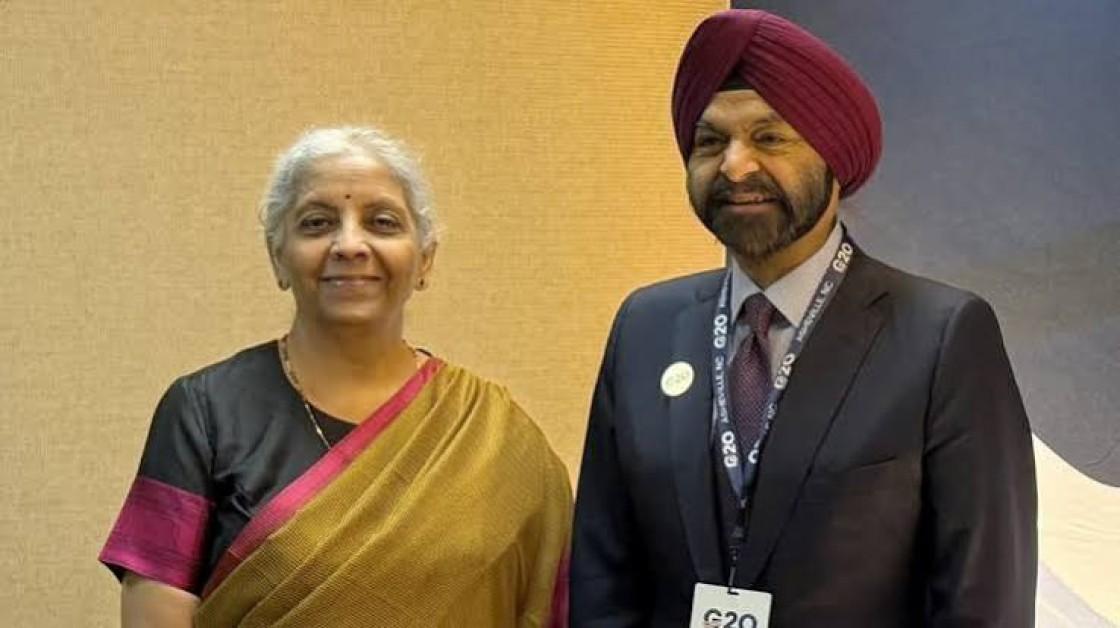
Finance Minister Nirmala Sitharaman Meets World Bank President Ajay Banga to Discuss Private-Capital Mobilisation and Deeper Partnership
Union Finance and Corporate Affairs Minister Nirmala Sitharaman met World Bank Group President Ajay Banga on the sidelines of the G20 Finance Ministers and Central Bank Governors Meeting in Asheville, with discussions focused on expanding the India-World Bank relationship beyond conventional development lending.
The two leaders explored ways to mobilise greater volumes of private capital for India's development priorities, deepen corporate, infrastructure and municipal bond markets and expand the use of guarantees and credit-enhancement mechanisms.
A potentially larger role for the Multilateral Investment Guarantee Agency, or MIGA, emerged as an important part of the discussions.
The meeting also covered infrastructure financing, support for micro, small and medium enterprises, political-risk insurance for Indian companies investing overseas, digital public infrastructure and the development of globally competitive tourism destinations.
The broader objective is to transform the India-World Bank Group relationship from a traditional lender-borrower arrangement into a strategic platform combining capital, knowledge, innovation, risk mitigation and private investment mobilisation.
Sitharaman and Banga Discuss Deeper India-World Bank Partnership

The meeting took place during the G20 Finance Ministers and Central Bank Governors gathering in Asheville.
Sitharaman acknowledged the World Bank Group's continued engagement with India and highlighted the institution's recent financial and developmental support.
The discussions reflected India's growing interest in using multilateral institutions not simply as direct sources of development finance but as mechanisms for attracting much larger pools of private investment.
That shift is increasingly important as India continues investing heavily across infrastructure, urban development, technology and other capital-intensive sectors.
Rather than relying entirely on public expenditure or conventional multilateral loans, policymakers are exploring structures that can reduce risks for institutional and private investors.
$1.5 Billion Development Policy Financing Highlighted
Sitharaman acknowledged the World Bank Group's speedy processing of $1.5 billion in Development Policy Financing.
Development Policy Financing differs from conventional project-specific lending because it can support broader policy and institutional reforms.
The Finance Minister's recognition of the rapid processing of the financing illustrates the continuing role of the World Bank in supporting India's development priorities even as the relationship evolves toward a wider strategic partnership.
The meeting suggested that future engagement could increasingly combine direct financing with mechanisms capable of mobilising additional capital from other investors.
IFC Support for Indian MSMEs Also Discussed
Another important component of the meeting was support for India's micro, small and medium enterprises.
Sitharaman appreciated the International Finance Corporation's support for MSMEs through the Small Industries Development Bank of India, or SIDBI.
The support was processed rapidly and was highlighted for its positive impact on the MSME sector.
MSMEs remain central to India's employment, manufacturing, services and entrepreneurship ecosystem.
However, smaller businesses frequently face financing constraints because lenders and investors may perceive them as carrying greater credit risk than established corporations.
Development institutions can help address this challenge by working through domestic financial institutions capable of reaching large numbers of smaller enterprises.
India Explores Larger Role for MIGA
One of the most significant elements of the meeting was the discussion around expanding MIGA's role in India.
MIGA is part of the World Bank Group and specialises in guarantees and political-risk insurance designed to encourage investment.
The proposed approach would use guarantees more systematically to help deepen India's:
corporate bond market,
infrastructure bond market,
and municipal bond market.
The underlying objective is to reduce some of the risks that prevent private investors from allocating capital to projects requiring large amounts of long-term financing.
Guarantees Could Help Mobilise More Private Capital
India's infrastructure ambitions require enormous pools of capital.
Government budgets and bank lending alone cannot finance every project.
Private capital therefore plays an increasingly important role.
But institutional investors often evaluate infrastructure projects according to risks involving:
project execution,
creditworthiness,
regulation,
long investment periods,
policy uncertainty,
and revenue predictability.
Guarantees can potentially reduce certain risks and improve the attractiveness of projects to investors.
This is where institutions such as MIGA can become strategically important.
Rather than financing an entire project directly, a multilateral institution can provide risk mitigation that helps unlock substantially larger amounts of private investment.
Corporate and Infrastructure Bond Markets Could Gain Depth
India has developed one of the world's largest capital markets, but bank lending continues to play a major role in financing businesses and infrastructure.
A deeper corporate bond market could provide companies with more diversified sources of long-term funding.
Infrastructure projects could similarly benefit from stronger access to bond investors.
The challenge is particularly significant because infrastructure assets often require capital for decades.
Banks, by contrast, generally operate with shorter-duration liabilities.
Bond markets can help connect long-term investors such as:
insurance companies,
pension funds,
asset managers,
and sovereign investors
with long-duration infrastructure assets.
Greater use of guarantees and credit enhancement could potentially make more infrastructure securities suitable for these investors.
Municipal Bond Market Is Another Priority
The discussion also extended to India's municipal bond market.
Indian cities require substantial investment in:
urban transport,
water systems,
waste management,
sanitation,
housing infrastructure,
roads,
and climate resilience.
Municipal bonds can provide cities with an additional mechanism for financing these investments.
However, the market remains relatively small compared with India's overall urban financing requirements.
Strengthening municipal finances, improving creditworthiness and using appropriate guarantees could potentially encourage more investors to participate.
A larger MIGA role could therefore support not only national infrastructure projects but also financing at the city level.
Sector-Based Credit Enhancement Considered for Infrastructure
Sitharaman and Banga also discussed a sector-based, programmatic approach to credit enhancement for infrastructure.
This could represent an important evolution from financing individual projects one at a time.
A programmatic model could potentially create common financing and risk-management structures across groups of projects or entire infrastructure categories.
Such an approach may make investments easier to evaluate and could help build larger pools of investable assets.
Scale matters because major institutional investors frequently prefer sizeable, standardised investment opportunities rather than numerous small projects requiring individual assessment.
Ajay Banga Highlights India's Infrastructure Transformation
Banga acknowledged the significant transformation taking place across India's infrastructure sector.
India has invested heavily across:
highways,
railways,
airports,
urban infrastructure,
digital connectivity,
logistics,
renewable energy,
and other major systems.
The World Bank president identified opportunities to use the institution's financing and risk-management instruments more extensively to support India's development ambitions.
This includes expanding MIGA engagement and examining how World Bank Group capabilities can complement domestic investment.
Political-Risk Insurance Could Support Indian Companies Overseas
The discussions were not limited to investment flowing into India.
The two leaders also considered the use of political-risk insurance for Indian companies investing overseas.
Indian businesses are increasingly expanding internationally across manufacturing, infrastructure, energy, technology and services.
Investment in foreign markets can expose companies to risks that may not arise in their domestic operations.
These can include:
political instability,
restrictions on currency transfers,
government actions,
contractual uncertainty,
or other sovereign-related risks.
Political-risk insurance can help mitigate some of these exposures and potentially encourage companies to undertake investments that might otherwise appear too risky.
Global Digital Public Infrastructure Knowledge Hub Discussed
Digital public infrastructure was another major area of discussion.
Sitharaman highlighted India's engagement with the World Bank Group on establishing a Global Digital Public Infrastructure Knowledge Hub in India.
India has developed large-scale digital systems supporting areas including:
digital identity,
payments,
government services,
and digital transactions.
The proposed knowledge hub could provide a mechanism for sharing experience and implementation expertise with other countries.
This would represent another example of the India-World Bank relationship moving beyond conventional financing.
India would not simply receive capital.
Its development experience could also become part of the knowledge exchanged through the World Bank's international network.
Technology Could Be Extended to Agriculture
The discussions around digital public infrastructure included opportunities to use technology in sectors such as agriculture.
Digital systems can potentially support farmers and agricultural markets through:
identity verification,
payments,
credit access,
insurance,
market information,
benefit transfers,
and supply-chain visibility.
India's scale provides an important testing environment for digital systems designed to serve large populations.
Successful approaches could potentially provide lessons for other developing economies facing similar challenges.
Sitharaman indicated that India is looking forward to early progress toward launching the proposed knowledge hub.
Tourism Development Included in New Partnership Framework
Tourism also featured in the discussions.
India and the World Bank Group are exploring the development of globally competitive tourism destinations under the new India-World Bank Group Country Partnership Framework.
The proposed model could combine capabilities from several parts of the World Bank Group.
The International Bank for Reconstruction and Development could provide policy and infrastructure support.
The International Finance Corporation could support private-sector investment.
MIGA could provide guarantees and risk-mitigation instruments.
This coordinated approach demonstrates how the World Bank Group's different institutions can potentially work together around a single development objective.
Tourism Requires More Than Building Attractions
Creating globally competitive tourism destinations requires investment across a wide range of supporting infrastructure.
This can include:
transport connectivity,
airports,
roads,
hotels,
urban services,
heritage conservation,
digital infrastructure,
water and sanitation,
and destination management.
Government investment alone may not be sufficient.
Private-sector participation can provide hotels, hospitality services, transport, entertainment and other commercial infrastructure.
A combination of public policy support, private investment and multilateral guarantees could therefore help create integrated tourism destinations.
India-World Bank Relationship Could Move Beyond Lending
Perhaps the most strategically important outcome of the meeting was the discussion about redefining the broader relationship between India and the World Bank Group.
Historically, multilateral development institutions were often viewed primarily as lenders providing governments with financing for development projects.
India and the World Bank are now considering a wider model.
The partnership could increasingly operate as a platform for:
global knowledge,
innovation,
private-capital mobilisation,
risk mitigation,
and development financing.
The objective would be to combine India's scale and implementation capacity with the World Bank Group's international expertise and financial instruments.
Private Capital Is Becoming Central to Development Finance
The emphasis on private capital reflects a broader change in global development finance.
The investment required for infrastructure, climate transition, urbanisation and economic development across emerging economies is far larger than governments and multilateral institutions can finance independently.
Development institutions are therefore increasingly focused on using their capital to mobilise additional investment.
This can involve:
guarantees,
blended finance,
credit enhancement,
political-risk insurance,
co-investment,
and improved project structures.
The goal is to make projects sufficiently investable for private-sector institutions to participate at scale.
Why Private Capital Mobilisation Matters for India
India's economic expansion creates enormous financing requirements.
Rapid urbanisation requires new infrastructure.
Manufacturing expansion requires industrial capacity.
Growing electricity consumption requires additional generation and grid investment.
Cities need transport and public services.
Businesses require capital.
The digital economy requires continuous investment in technology infrastructure.
Public spending will remain important, but sustainable long-term development increasingly requires complementary private investment.
A deeper partnership with the World Bank Group could help India develop financial structures capable of attracting this capital.
Multilateral Guarantees Can Multiply Development Capital
The concept of private-capital mobilisation changes the role of multilateral institutions.
Instead of asking only:
How much can the World Bank lend?
the more important question becomes:
How much additional investment can World Bank participation unlock?
If a guarantee reduces project risk sufficiently for pension funds, insurers or other institutional investors to participate, a relatively limited amount of multilateral support can potentially facilitate a much larger financing pool.
This multiplier effect is particularly important for countries undertaking infrastructure investment at India's scale.
Meeting Reflects India's Broader G20 Economic Engagement
Sitharaman's meeting with Banga formed part of a wider series of bilateral engagements around the G20 Finance Ministers and Central Bank Governors meeting.
The Finance Minister also held discussions with senior international economic and financial officials during the gathering.
The engagements covered areas including:
global economic conditions,
investment,
financial cooperation,
infrastructure,
technology,
trade,
and resilient supply chains.
India's discussions with the World Bank nevertheless stand out because they point toward a structural evolution in the country's relationship with one of the world's most important multilateral development institutions.
Conclusion
Finance Minister Nirmala Sitharaman's meeting with World Bank Group President Ajay Banga signals an effort to broaden the India-World Bank partnership from conventional development lending toward a more comprehensive platform for investment, knowledge and private-capital mobilisation.
The discussions covered a potentially larger role for MIGA, deeper corporate and municipal bond markets, infrastructure credit enhancement, political-risk insurance, MSME financing, digital public infrastructure and tourism development.
Sitharaman also acknowledged the rapid processing of $1.5 billion in Development Policy Financing and IFC's support for Indian MSMEs through SIDBI.
The larger strategic shift, however, lies in how the two sides are thinking about development finance.
Rather than relying solely on direct public or multilateral financing, India and the World Bank Group are exploring ways to use guarantees, risk mitigation, private investment and institutional capital to expand the pool of money available for development.
If implemented effectively, the approach could deepen India's capital markets while creating new financing channels for infrastructure, cities, businesses and other long-term development priorities.
 Nirmala Sitharaman and Ajay Banga Discuss Private Capital and Deeper India-World Bank Partnership FAQs
POST A COMMENT (0)
All Comments (0)
Replies (0)