





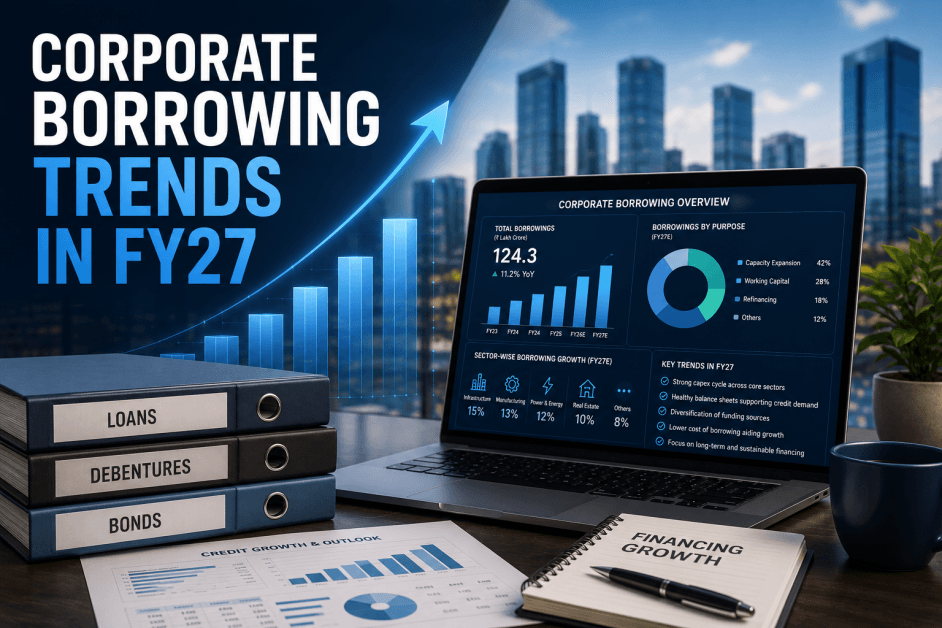
Corporate Borrowing Trends in FY27: Credit Demand, Bond Issuance, and Interest Rate Outlook
Corporate borrowing in FY27 is expected to remain closely linked to India's investment cycle, infrastructure spending, manufacturing expansion, and overall economic growth. Businesses are increasingly evaluating a mix of bank loans, corporate bonds, and other financing options to support capital expenditure, refinancing, working capital requirements, and expansion plans.
Borrowing trends during the financial year are likely to be influenced by interest rates, liquidity conditions, inflation, government investment, and corporate confidence.
Why Corporate Borrowing Matters

Corporate borrowing plays an important role in business expansion and economic development.
Companies raise capital to:
- Expand production capacity
- Finance infrastructure projects
- Build new manufacturing facilities
- Refinance existing debt
- Support mergers and acquisitions
- Meet working capital requirements
- Invest in technology and innovation
Healthy credit growth generally reflects stronger business confidence and investment activity.
Key Drivers of Borrowing in FY27
Several macroeconomic and business factors are expected to shape borrowing decisions.
Major drivers include:
- Economic growth
- Infrastructure investment
- Manufacturing expansion
- Interest rate trends
- Corporate earnings
- Government capital expenditure
- Domestic demand
- Global financing conditions
Companies are expected to remain selective, focusing on projects that offer sustainable long-term returns.
Bank Credit Remains a Major Funding Source
Commercial banks continue to be the primary source of financing for many Indian businesses.
Corporate borrowing from banks is commonly used for:
- Capital expenditure
- Working capital
- Equipment purchases
- Project financing
- Business expansion
- Inventory financing
Credit availability and lending costs will remain important considerations throughout FY27.
Corporate Bond Market Activity
Many large companies continue to access the corporate bond market as part of their funding strategy.
Bond issuance offers several potential advantages:
- Diversified funding sources
- Longer repayment periods
- Flexible financing structures
- Access to institutional investors
- Reduced dependence on bank lending
The level of bond issuance will depend on interest rates, investor demand, and market liquidity.
Interest Rate Outlook
Interest rates remain one of the most important factors affecting corporate borrowing decisions.
Higher borrowing costs may:
- Delay expansion projects
- Increase financing expenses
- Reduce profit margins
- Slow capital expenditure
- Encourage refinancing at more favorable terms when available
Conversely, a stable or easing interest-rate environment may improve borrowing appetite among businesses.
Sector-Wise Borrowing Trends
Different industries are expected to display varying borrowing patterns during FY27.
Infrastructure
Large infrastructure projects are likely to continue driving long-term borrowing requirements.
Manufacturing
Manufacturers may seek financing for capacity expansion, automation, and technology upgrades.
Renewable Energy
Investment in solar, wind, battery storage, and transmission infrastructure may support continued financing activity.
Real Estate
Developers may access both bank financing and bond markets for residential and commercial projects.
Financial Services
Banks and non-banking financial companies may continue raising capital to support lending growth.
Technology
Technology companies may focus on funding digital transformation, artificial intelligence, cloud infrastructure, and research initiatives.
Refinancing Activity
Many companies are expected to refinance existing debt during FY27 to improve their financial structure.
Refinancing objectives may include:
- Lower borrowing costs
- Longer loan maturities
- Improved cash flow management
- Better debt diversification
- Stronger balance sheets
The attractiveness of refinancing will depend largely on prevailing interest rates and credit market conditions.
Impact on Investors
Corporate borrowing trends can influence multiple asset classes.
Potential effects include:
- Corporate bond yields
- Equity valuations
- Banking sector performance
- Credit quality
- Capital expenditure expectations
- Earnings growth
Investors often evaluate borrowing alongside leverage, profitability, and cash flow generation.
Risks to Monitor
Several challenges could affect corporate borrowing activity during FY27.
These include:
- Higher interest rates
- Inflation pressures
- Global economic uncertainty
- Currency volatility
- Rising input costs
- Weak external demand
- Geopolitical developments
Businesses may remain cautious if financing costs or economic uncertainty increase significantly.
Opportunities
Despite near-term challenges, several structural factors continue to support borrowing demand.
Potential growth drivers include:
- Government infrastructure spending
- Manufacturing expansion
- Industrial corridors
- Digital infrastructure
- Renewable energy investment
- Urban development
- Private capital expenditure
- Supply chain diversification
These sectors are expected to generate sustained financing requirements over the medium to long term.
Outlook
Corporate borrowing in FY27 is expected to remain supported by India's ongoing investment cycle, infrastructure development, and manufacturing growth. While higher interest rates and global uncertainties may influence borrowing decisions, companies with strong balance sheets and well-defined expansion plans are likely to continue accessing both bank credit and bond markets.
The pace of borrowing will depend on domestic demand, financing costs, policy developments, and overall business confidence during the financial year.
Conclusion
Corporate borrowing trends in FY27 are expected to reflect India's broader economic and investment outlook. Demand for credit is likely to remain supported by infrastructure projects, manufacturing expansion, and business investment, while interest rates and market conditions will shape financing decisions. Companies that maintain prudent leverage, strong cash flows, and disciplined capital allocation are expected to be better positioned to benefit from growth opportunities throughout the year.
 Corporate Borrowing Trends in FY27: Credit Demand and Interest Rates FAQs
POST A COMMENT (0)
All Comments (0)
Replies (0)