





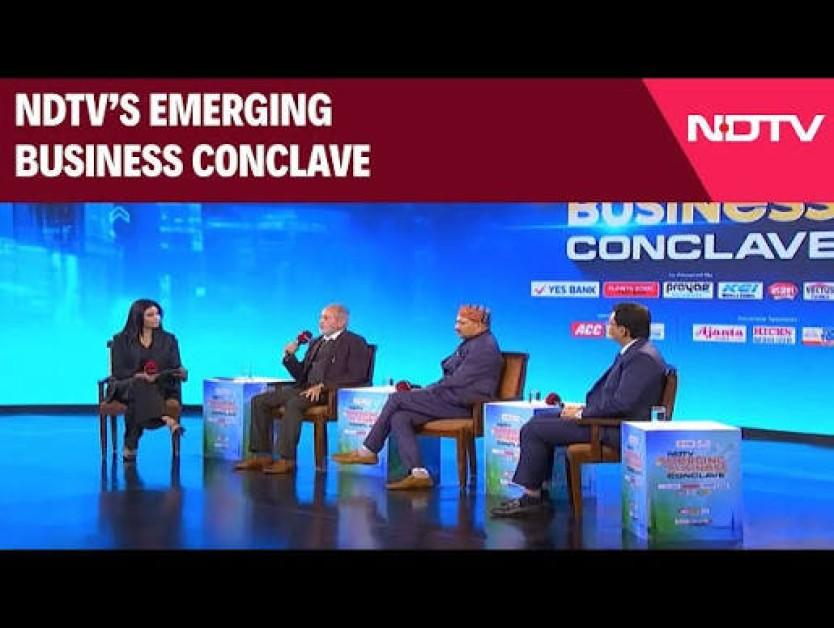
NDTV Emerging Business Conclave Mumbai Brings Founders, Investors and Policymakers Together
The NDTV Emerging Business Conclave – Mumbai Chapter is bringing together policymakers, industry leaders and founders for discussions focused on the forces shaping the next phase of Indian business growth.
The Mumbai edition is positioned around themes including scaling capital, artificial intelligence, entrepreneurship, bold business ideas and transformational leadership, according to NDTV's official promotion for the conclave. (NDTV)
The event comes at an important point for corporate India.
Businesses are navigating rapid technological change, shifting global capital flows, new manufacturing opportunities and increasingly competitive consumer markets. At the same time, startups are being pushed to demonstrate sustainable economics alongside growth.
Against this backdrop, business conclaves are increasingly becoming platforms where founders, corporate executives, investors and policymakers can examine how India's next generation of companies will scale.
Mumbai Chapter Focuses on India Inc’s Next Leap

NDTV has positioned the Mumbai chapter around the theme of:
“Shaping India Inc.’s Next Big Leap.”
The agenda connects several forces currently transforming Indian business:
capital,
AI,
entrepreneurship,
and leadership. (NDTV)
These themes reflect a wider shift in India's corporate landscape.
The discussion is no longer simply about whether Indian businesses can grow.
It is increasingly about whether they can build globally competitive companies at scale.
Founders Are Central to India’s New Business Economy
India's startup ecosystem has created a large generation of founders building businesses across:
technology,
financial services,
consumer brands,
manufacturing,
healthcare,
logistics,
and enterprise software.
Many of these companies are moving beyond their startup phase.
They now face more complex questions around governance, profitability, leadership and access to growth capital.
Scaling Is Different From Starting
Launching a company requires finding an initial market.
Scaling it requires something different.
Businesses need:
professional management,
capital allocation,
technology infrastructure,
and operational discipline.
A company that succeeds with 100 employees may need completely different systems when it reaches 5,000.
This is why conversations around scaling increasingly matter to India's emerging businesses.
Capital Remains a Major Conclave Theme
NDTV has identified scaling capital as one of the themes surrounding the Mumbai edition. (NDTV Profit)
Capital remains fundamental to business expansion.
Companies need funding to:
build factories,
hire employees,
develop products,
enter markets,
and acquire competitors.
But the environment for raising capital has changed significantly.
Investors Are Becoming More Selective
The earlier startup funding environment often rewarded rapid expansion.
Investors today increasingly examine:
revenue quality,
cash generation,
unit economics,
and governance.
Growth remains important.
But companies are expected to demonstrate a credible path toward sustainable profitability.
Public Markets Are Becoming More Important
India's capital markets are increasingly providing another route for growing companies.
A larger pipeline of IPOs has encouraged founders and private-equity investors to view public markets as a realistic source of long-term capital.
Companies preparing for listings must, however, adapt to significantly greater scrutiny.
Public shareholders expect:
financial disclosure,
governance,
and predictable execution.
Mumbai Provides Natural Setting for Capital Discussions
Mumbai remains India's primary financial centre.
The city hosts:
major banks,
investment firms,
stock exchanges,
corporate headquarters,
and financial institutions.
That makes it a natural location for discussions connecting entrepreneurs with capital providers.
For emerging companies, access to capital is often inseparable from access to the networks surrounding it.
AI Is Another Major Focus
Artificial intelligence is also central to the conclave's positioning.
NDTV describes the Mumbai chapter as examining how businesses can unlock AI's potential alongside capital and leadership. (NDTV)
AI has rapidly moved from a technology-sector discussion into a boardroom issue across almost every industry.
Companies Are Moving From AI Experiments to Deployment
During the initial generative-AI boom, many businesses experimented with:
chatbots,
writing assistants,
and summarisation.
The next phase is more operational.
Companies increasingly want AI to improve:
customer service,
sales,
software development,
and internal workflows.
The question has shifted from what AI can demonstrate to what measurable business value it can create.
AI Agents Are Expanding Automation
AI agents represent one of the fastest-developing enterprise technology trends.
Instead of simply answering a question, an agent can potentially complete a workflow.
It might:
analyse information,
update software,
create tasks,
or trigger another process.
This could significantly change how companies organise knowledge work.
Indian Businesses Have Opportunity to Adopt AI Early
India has a large technology workforce and extensive digital infrastructure.
That gives companies an opportunity to deploy AI at substantial scale.
Banks can automate service operations.
Manufacturers can improve maintenance.
Retailers can personalise consumer experiences.
Technology companies can accelerate software development.
The economic opportunity extends well beyond dedicated AI startups.
AI Also Creates Workforce Questions
Automation inevitably raises questions about employment.
Some repetitive tasks can increasingly be handled by software.
At the same time, companies need employees capable of:
building AI systems,
supervising them,
and redesigning workflows around them.
The transition therefore involves both productivity gains and changes in workforce skills.
Leadership Becomes Critical During Technology Transitions
NDTV has also highlighted transformational leadership as part of the conclave's broader agenda. (NDTV Profit)
Technology alone does not transform a company.
Management needs to decide:
where to invest,
what to automate,
and how quickly to change.
Those decisions can determine whether established companies benefit from technological disruption or fall behind it.
Policymakers Influence the Business Environment
Bringing policymakers into business discussions adds another dimension.
Companies operate within systems shaped by:
taxation,
regulation,
infrastructure,
trade policy,
and labour rules.
Government decisions can therefore materially influence how quickly businesses scale.
Ease of Doing Business Remains Important
Growing companies frequently interact with multiple regulatory systems.
Simpler processes can reduce:
compliance costs,
delays,
and management time.
For emerging businesses, these savings can be particularly valuable because management teams are smaller and resources are limited.
Regulation Must Keep Pace With New Technologies
AI, fintech and digital commerce are evolving faster than many traditional regulatory frameworks.
Policymakers therefore face a balancing act.
Rules need to protect:
consumers,
competition,
and financial stability.
But excessive restrictions can slow innovation.
Dialogue between businesses and policymakers can help identify practical regulatory challenges earlier.
Investors Bring Market Discipline
Investors contribute a different perspective.
They evaluate companies through questions such as:
How large is the market?
Can the company scale?
Does it have an advantage?
Can management allocate capital effectively?
Is the valuation justified?
These questions force founders to translate ambitious visions into measurable business outcomes.
Founders Need More Than Funding
Capital alone rarely solves company-building problems.
A rapidly expanding business also needs:
talent,
governance,
and strategic discipline.
This becomes especially important when a founder-led startup evolves into a large corporation.
Founder-to-CEO Transition Can Be Difficult
A founder may initially make nearly every major decision.
That becomes impossible as the organisation expands.
Leaders eventually need to:
delegate,
hire executives,
and build institutional processes.
Learning how to make that transition is one of the most important challenges facing high-growth businesses.
India Is Producing More Mature Startups
India's startup ecosystem has existed at scale long enough for many companies to move into later stages.
Some have become:
large private companies,
listed businesses,
or acquisition targets.
That changes the ecosystem.
Founders can increasingly learn from entrepreneurs who have already navigated multiple stages of company building.
Profitability Has Returned to Centre Stage
Growth remains valuable, but investors increasingly distinguish between:
growth that creates economic value
and
growth purchased through unsustainable spending.
This has pushed companies toward greater focus on:
gross margins,
cash flow,
and capital efficiency.
That shift can create healthier businesses over the long term.
Manufacturing Is Becoming More Important
India's emerging-business story is also expanding beyond digital startups.
New opportunities are developing across:
electronics,
renewable energy,
defence,
electric mobility,
and advanced manufacturing.
These businesses have very different capital requirements from software companies.
A factory may require hundreds of crores before generating meaningful revenue.
That makes access to long-term capital especially important.
India’s GCC Expansion Adds Another Growth Engine
Global Capability Centres are also becoming increasingly important to India's business landscape.
Multinational companies are expanding Indian operations across:
AI,
product engineering,
finance,
analytics,
and research.
These centres create high-value employment while strengthening India's integration into global corporate operations.
Entrepreneurship Is Spreading Beyond Traditional Hubs
India's startup ecosystem is no longer limited to Bengaluru, Mumbai and Delhi-NCR.
Companies are emerging from:
Hyderabad,
Chennai,
Pune,
Ahmedabad,
Jaipur,
and other cities.
Digital distribution and remote work have reduced some of the historical geographic barriers to entrepreneurship.
Capital Is Also Becoming More Diverse
Founders can increasingly access multiple forms of financing.
These include:
venture capital,
private equity,
public markets,
and strategic corporate investment.
Each source of capital serves a different purpose.
Choosing the correct financing structure can significantly affect long-term company economics.
Private Credit Is Emerging as Another Option
India's private-credit market has expanded rapidly.
For businesses that do not want to dilute ownership through equity financing, private credit can provide an alternative.
However, debt creates fixed repayment obligations.
Companies therefore need predictable cash flows before using leverage aggressively.
India’s Public Markets Are Deepening
India's equity markets have developed a large domestic investor base.
Mutual funds and systematic investment plans have created substantial pools of domestic capital.
This has expanded opportunities for companies seeking to list.
A deeper public market can also provide exits for early investors, allowing capital to recycle into new businesses.
Business Events Can Connect Different Parts of the Ecosystem
Founders, investors and policymakers often approach the economy from different perspectives.
Founders think about:
customers and growth.
Investors think about:
returns and risk.
Policymakers think about:
economic development and regulation.
Bringing those groups together can create a more complete discussion about the conditions required for companies to scale.
The Mumbai Edition Fits a Broader NDTV Business-Conclave Series
The Mumbai chapter follows other editions of the Emerging Business Conclave focused on regional business and policy ecosystems.
For example, the Delhi edition brought political and business discussions together around issues including entrepreneurship, regulation, infrastructure and emerging technologies. (NDTV)
The Mumbai edition shifts the emphasis toward India's financial and corporate centre.
India Inc Is Entering a New Phase
The underlying question surrounding the conclave is larger than any individual company.
India now has:
large domestic capital markets,
a mature startup ecosystem,
strong digital infrastructure,
and expanding technology capabilities.
The next challenge is turning those advantages into companies capable of competing globally.
Scale Will Be the Defining Test
Building successful businesses inside India is increasingly achievable.
Building globally significant companies is harder.
It requires:
capital,
technology,
and management depth.
Those are precisely the areas around which the Emerging Business Conclave is positioned.
Conclusion
The NDTV Emerging Business Conclave – Mumbai Chapter brings together founders, policymakers and industry leaders around some of the most consequential questions facing Indian business.
NDTV has positioned the event around scaling capital, unlocking artificial intelligence, bold ideas and transformational leadership, with the broader theme of shaping India Inc.'s next major leap. (NDTV)
The timing is significant.
India's startup ecosystem is becoming more mature, domestic capital markets are deepening, AI is beginning to reshape enterprise operations and businesses are increasingly looking beyond domestic growth toward global scale.
These changes require more than funding.
They require stronger governance, sophisticated leadership, technological capability and a policy environment capable of supporting innovation without compromising market integrity.
Mumbai provides an appropriate setting for that conversation because it sits at the intersection of corporate India, entrepreneurship and capital.
The larger question emerging from the conclave is therefore not simply how India can create more businesses.
It is how founders, investors, corporations and policymakers can collectively build the conditions needed for the next generation of Indian companies to become globally competitive enterprises.
 NDTV Emerging Business Conclave Mumbai Brings India’s Business Leaders Together FAQs
POST A COMMENT (0)
All Comments (0)
Replies (0)