





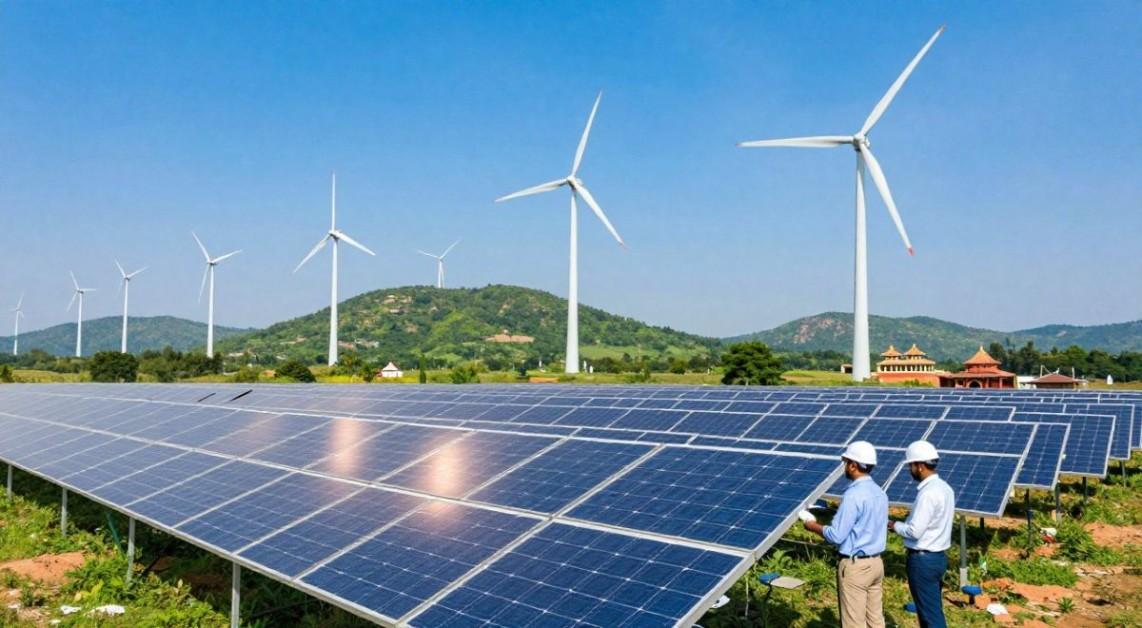
A significant breakthrough has been achieved by India's renewable energy sector, with a record addition of 44.5 GW in 2025. This remarkable feat has propelled the country's non-fossil fuel share to a notable 51.5%.
This development underscores India's commitment to renewable growth, positioning the country as a leader in the global transition to cleaner energy sources. The substantial increase in renewable energy capacity is a testament to the country's efforts in reducing its reliance on fossil fuels.
Key Takeaways
- Record 44.5 GW renewable energy added in 2025.
- Non-fossil fuel share reaches 51.5%.
- Significant step towards reducing fossil fuel reliance.
- India emerges as a leader in global renewable energy growth.
- Commitment to a cleaner energy future is evident.
Record-Breaking Achievement: Understanding the 44.5 GW Milestone
India's commitment to renewable energy yielded an unprecedented 44.5 GW addition in 2025, marking a significant milestone in the country's energy landscape. This achievement not only showcases India's dedication to sustainable energy but also underscores its position as a global leader in the renewable energy sector.
Breaking Down the Numbers: What 44.5 GW Represents
The 44.5 GW of renewable energy added in 2025 represents a substantial increase in India's clean energy capacity. To put this into perspective, this capacity is enough to power approximately 30 million homes, significantly reducing the country's reliance on fossil fuels. The addition includes a mix of solar, wind, hydro, and other renewable sources, demonstrating a diversified approach to energy production.
The Significance of Crossing the 50% Non-Fossil Threshold
Crossing the 50% non-fossil fuel threshold is a landmark achievement for India, indicating that more than half of the country's energy now comes from renewable sources. This milestone is crucial for reducing carbon emissions and mitigating climate change. It also reflects the success of India's policies and initiatives aimed at promoting renewable energy and reducing dependence on fossil fuels.
India Hits Record 44.5 GW Renewable Growth in 2025; Non-Fossil Share Now 51.5%
The renewable energy landscape in India underwent a significant transformation in 2025, with 44.5 GW of new installations. This record-breaking achievement has propelled India's non-fossil fuel share to 51.5%, marking a major milestone in the country's clean energy journey.
Key Factors Driving the Unprecedented Growth
Several factors contributed to the remarkable growth in India's renewable energy sector in 2025. Government policies and incentives played a crucial role, with initiatives such as tax exemptions and subsidies encouraging investments in clean energy. Additionally, technological advancements in solar and wind energy improved efficiency and reduced costs, making renewable energy more competitive with fossil fuels.
Regional Distribution of New Renewable Capacity
The distribution of new renewable capacity across India was not uniform, with some states emerging as leaders in clean energy adoption. A detailed breakdown of the regional distribution is provided in the table below:
| Region | New Capacity Added (GW) | Share of Total Capacity |
|---|---|---|
| North India | 12.5 | 28% |
| South India | 15.2 | 34% |
| West India | 10.3 | 23% |
| East India | 6.5 | 15% |
Month-by-Month Growth Analysis Throughout 2025
The growth in renewable energy installations was not consistent throughout 2025, with some months witnessing higher additions than others. A month-by-month analysis reveals that the second half of the year saw a significant surge in new capacity additions, driven by a rush to commission projects before the year's end.
Evolution of India's Renewable Energy Landscape (2015-2025)
Over the decade from 2015 to 2025, India witnessed a remarkable evolution in its renewable energy sector. This period was marked by significant policy initiatives, technological advancements, and increasing investment in the renewable energy domain.
Historical Growth Patterns and Trends
The growth of renewable energy in India over the past decade can be attributed to a combination of factors, including government policies, decreasing technology costs, and increasing demand for clean energy. Solar energy has been a major contributor, with India setting ambitious targets for solar capacity addition. The trend has been towards larger, more efficient solar projects, driven by competitive bidding and improved project bankability.
A detailed analysis of the historical growth patterns reveals a steady increase in renewable energy capacity, with some fluctuations due to policy changes and global market trends.
| Year | Renewable Energy Capacity Added (GW) | Cumulative Renewable Energy Capacity (GW) |
|---|---|---|
| 2015 | 2.5 | 35.7 |
| 2020 | 10.2 | 60.4 |
| 2025 | 44.5 | 150.8 |
Comparative Analysis with Previous Years' Achievements
Comparing the renewable energy additions in 2025 to previous years highlights the unprecedented scale of growth achieved. The 44.5 GW added in 2025 represents a significant increase over the annual additions seen in the preceding years, underscoring the success of recent policy measures and market dynamics.
This comparative analysis demonstrates the accelerating pace of renewable energy adoption in India, driven by both domestic policies and global trends.
Sector-Wise Breakdown of the 44.5 GW Addition
A detailed analysis of the 44.5 GW renewable energy added in 2025 reveals the diverse contributions of different sectors. This breakdown is crucial for understanding the dynamics of India's renewable energy growth.
Solar Power Contributions
Solar power was a significant contributor to the 44.5 GW addition, with a substantial portion coming from both utility-scale and rooftop solar installations.
Utility-Scale vs. Rooftop Solar Installations
Utility-scale solar installations accounted for the majority of the solar power contribution, while rooftop solar installations also saw significant growth, indicating a diverse approach to solar energy adoption.
Wind Energy Developments
Wind energy was another major contributor to the renewable energy addition, with both onshore and offshore wind projects playing a crucial role.
Onshore and Offshore Wind Projects
Onshore wind projects continued to dominate the wind energy landscape, although offshore wind projects are gaining traction, contributing to the overall growth.
Hydro, Biomass, and Other Renewable Sources
Hydro, biomass, and other renewable sources also contributed to the 44.5 GW addition, highlighting the comprehensive approach to renewable energy development in India.
According to recent renewable energy statistics, the distribution of the 44.5 GW addition across different sectors can be summarized as follows:
| Sector | Capacity Addition (GW) | Percentage Contribution |
|---|---|---|
| Solar Power | 25 | 56% |
| Wind Energy | 15 | 34% |
| Hydro, Biomass, and Others | 4.5 | 10% |
As noted by experts, "The diverse contribution of different renewable energy sectors is a testament to India's commitment to non-fossil energy growth."
"Renewable energy is the future, and India is making significant strides in this direction."

Government Policies and Initiatives Behind the Success
A significant factor behind India's success in renewable energy is the government's comprehensive policy framework. This framework has been instrumental in driving growth and achieving the milestone of 44.5 GW of renewable energy addition in 2025.
National Green Energy Policies Implemented in 2023-2025
The Indian government has introduced several national green energy policies between 2023 and 2025, aimed at promoting renewable energy. These policies include incentives for solar and wind energy projects, tax benefits, and subsidies for research and development in clean energy technologies.
Key policies include:
- Renewable Energy Deployment Goals
- Tax exemptions for renewable energy projects
- Subsidies for clean energy research
State-Level Initiatives Supporting Renewable Growth
State governments have also played a crucial role by implementing their own initiatives to support renewable energy growth. These initiatives include state-specific policies, land allocation for renewable projects, and additional incentives for investors.
Examples of state-level initiatives:
| State | Initiative | Impact |
|---|---|---|
| Rajasthan | Solar Policy 2023 | Attracted significant solar investments |
| Gujarat | Wind Energy Policy 2023 | Boosted wind energy capacity |
Public-Private Partnership Models
Public-private partnerships (PPPs) have been a driving force behind India's renewable energy success. These models have enabled the government to leverage private sector investment and expertise, accelerating the development of renewable energy projects.
The combination of national policies, state-level initiatives, and public-private partnerships has created a robust ecosystem for renewable energy growth in India. This ecosystem is expected to continue driving the country's transition to a more sustainable energy mix.
Technological Innovations Enabling the Renewable Surge
As India continues to push the boundaries of renewable energy, technological innovations have emerged as a key enabler. The country's record-breaking additions in renewable energy capacity are not just a result of policy initiatives but also of significant advancements in technology.
Advancements in Solar and Wind Technologies
The solar and wind energy sectors have witnessed substantial technological improvements. Advancements in solar panel efficiency and the development of more efficient wind turbines have significantly increased energy output. These technologies have not only improved performance but have also reduced costs, making renewable energy more competitive with fossil fuels.
Energy Storage Solutions and Grid Modernization
One of the critical challenges in renewable energy integration is energy storage. Innovations in battery technology and other energy storage solutions have been pivotal in addressing this challenge. Furthermore, grid modernization efforts, including smart grids, have enhanced the efficiency and reliability of renewable energy distribution.
Digital Technologies and Smart Grid Implementation
The integration of digital technologies has transformed the renewable energy landscape. Smart grid implementations have enabled real-time monitoring and management of energy distribution, improving grid stability and efficiency. Digital technologies have also facilitated better forecasting and management of renewable energy sources.
The synergy between technological innovation and renewable energy has been a driving force behind India's achievement of 44.5 GW of renewable energy additions. As the country continues to strive towards its renewable energy goals, technological advancements will remain at the forefront.
Economic Impact of India's Renewable Energy Boom
With a record 44.5 GW of renewable energy added in 2025, India's economy is reaping substantial benefits. The renewable energy sector has become a significant contributor to the country's economic growth, creating new opportunities and driving development.
Job Creation and Economic Benefits
The renewable energy boom has led to the creation of thousands of jobs across various sectors, including manufacturing, installation, and maintenance. According to recent reports, the sector has generated over 100,000 new employment opportunities, both directly and indirectly. This job creation has contributed to local economic growth, improving livelihoods and stimulating economic activity.
Investment Landscape and Foreign Direct Investment
India's renewable energy sector has attracted significant foreign direct investment (FDI), with over $10 billion invested in 2025 alone. This influx of capital has not only boosted the economy but also brought in new technologies and expertise, further driving growth in the sector. The investment landscape is expected to continue to evolve, with more opportunities emerging in the coming years.
Cost Reductions and Tariff Trends
The cost of renewable energy technologies has decreased significantly over the years, making them more competitive with fossil fuels. This reduction in costs has led to lower tariffs, benefiting consumers and industries alike. The trend is expected to continue, with costs projected to decrease further as technology advances and economies of scale are achieved.
Key Highlights:
- Over 100,000 new jobs created in the renewable energy sector
- $10 billion+ FDI in renewable energy in 2025
- Continued reduction in renewable energy tariffs
Environmental Benefits of the 51.5% Non-Fossil Milestone
India's achievement of 51.5% non-fossil fuel share marks a significant milestone in reducing environmental impact. This transition towards cleaner energy sources is a crucial step in mitigating climate change and improving air quality.

Carbon Emission Reductions Achieved
The shift to non-fossil fuels has led to a substantial reduction in carbon emissions. According to recent renewable energy statistics, India's carbon emission reduction is attributed to the increased share of solar and wind energy in the overall energy mix.
A detailed analysis of the emission reductions achieved is presented in the following table:
| Year | Carbon Emissions Reduction | Renewable Energy Share |
|---|---|---|
| 2023 | 10% | 40% |
| 2024 | 15% | 45% |
| 2025 | 20% | 51.5% |
Progress Toward Climate Commitments
India's progress toward its climate commitments is evident in its clean energy trends. The country has been actively working towards reducing its carbon footprint and achieving its Nationally Determined Contributions (NDCs) under the Paris Agreement.
"India's commitment to renewable energy is a significant step towards global climate action."
The achievement of the 51.5% non-fossil fuel milestone demonstrates India's commitment to environmental conservation and its role in global climate leadership.
Challenges Overcome in Achieving the 44.5 GW Target
Reaching the 44.5 GW milestone required overcoming numerous obstacles in the renewable energy market in India. The journey to achieving this non-fossil energy growth was marked by significant challenges that tested the resolve of policymakers, developers, and other stakeholders.
Infrastructure and Grid Integration Hurdles
One of the primary challenges faced was infrastructure and grid integration. The existing grid infrastructure in India was not always equipped to handle the variable output from renewable sources like solar and wind. Upgrading the grid to accommodate these changes was crucial. This involved implementing advanced grid management systems and enhancing transmission infrastructure to ensure reliable and efficient power delivery.
Financing and Policy Implementation Challenges
Financing renewable energy projects remained a significant hurdle. Despite decreasing costs, the initial investment required for renewable energy projects is substantial. Policy implementation challenges, such as ensuring timely payments to developers and addressing regulatory hurdles, were also critical. Streamlining these processes and providing clear policy guidelines helped mitigate some of these challenges.
Land Acquisition and Social Acceptance Issues
Land acquisition and social acceptance were other significant challenges. Large renewable energy projects require vast tracts of land, often leading to conflicts over land use. Engaging with local communities and ensuring that projects benefit them was key to overcoming these issues. Implementing projects in a way that minimizes environmental impact and maximizes local benefits helped in gaining social acceptance.
By addressing these challenges head-on, India was able to achieve its ambitious renewable energy targets, paving the way for continued growth in the non-fossil energy sector.
Global Context: India's Position in the Renewable Energy Race
India's record-breaking 44.5 GW renewable energy addition in 2025 has positioned it as a global leader in the renewable energy race. This achievement not only underscores India's commitment to reducing its reliance on fossil fuels but also highlights its role in the global transition to cleaner energy sources.
Comparison with Other Major Economies
To understand the significance of India's achievement, it's essential to compare it with other major economies. The table below provides a snapshot of renewable energy additions by major economies in 2025.
| Country | Renewable Energy Addition (GW) |
|---|---|
| India | 44.5 |
| China | 53.2 |
| United States | 31.4 |
| Germany | 22.1 |
As shown in the table, India's renewable energy addition is among the highest globally, demonstrating its competitive edge in the renewable energy sector.
India's Role in Global Climate Leadership
India's significant strides in renewable energy have implications for global climate leadership. By achieving 51.5% of its energy from non-fossil fuels, India is not only meeting its climate commitments but also setting a precedent for other nations. India's proactive approach to renewable energy adoption underscores its leadership in addressing global climate challenges.
The country's focus on renewable energy is expected to continue, driving further innovation and investment in the sector. As a result, India is poised to remain a key player in the global renewable energy landscape.
Conclusion: The Significance of India's Renewable Energy Achievement
India's remarkable addition of 44.5 GW of renewable energy in 2025, pushing the non-fossil fuel share to 51.5%, marks a significant milestone in the country's clean energy journey. This achievement underscores the success of India's clean energy trends in India, driven by a combination of government policies, technological innovations, and investments.
The renewable energy statistics now reflect a substantial shift towards a more sustainable energy mix, reducing dependence on fossil fuels and contributing to global efforts to combat climate change. As India continues to lead in renewable energy growth, the implications of this achievement are far-reaching, influencing not only the energy sector but also the broader economy and environment.
With a strong foundation established through policies and initiatives, India is poised to continue its trajectory in renewable energy adoption. The country's progress serves as a model for other nations, demonstrating the feasibility and benefits of transitioning to a cleaner energy paradigm.
 India Adds Record 44.5 GW Renewables 2025: 51.5% Non-Fossil FAQs
 India’s carbon trading platform records its first large-scale industrial participation.
POST A COMMENT (0)
All Comments (0)
Replies (0)