





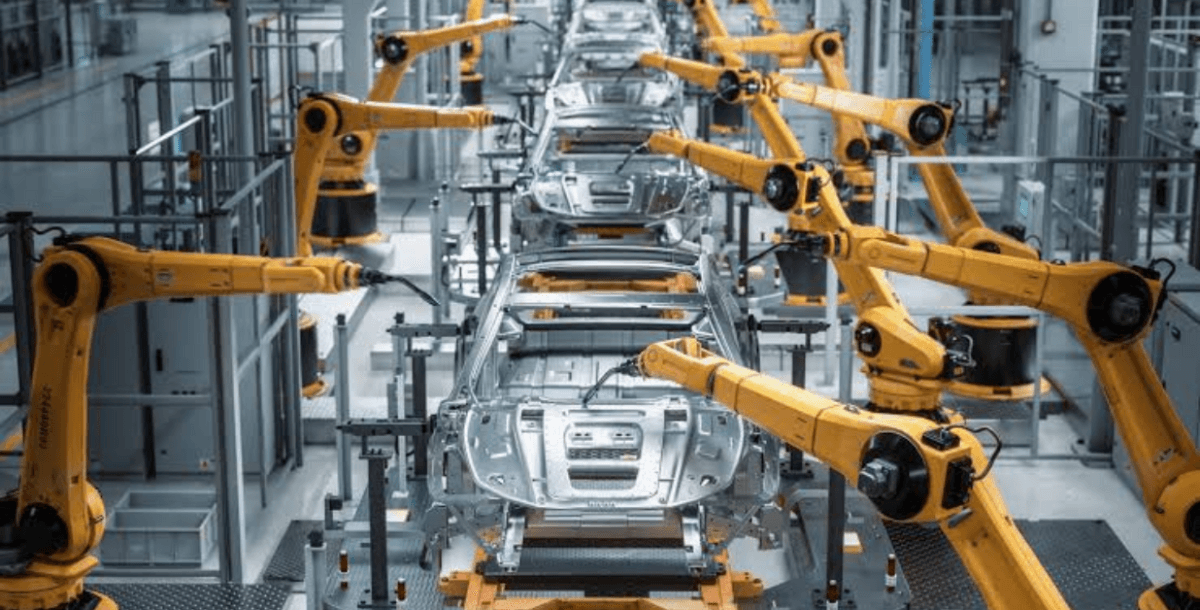
EV & Automotive Manufacturing in India
India's auto industry has entered its electric industrial phase — over two million units of EV capacity, marquee gigafactories, and billions in incentives — yet a stark gap between battery ambition and reality remains the sector's defining challenge.
By Naina, 7th July 2026
EV and automotive manufacturing in India has entered a decisive industrial phase in 2026, as the world's largest two-wheeler market and a major global auto producer scales up electric vehicle production. Backed by a comprehensive policy framework combining demand incentives and manufacturing subsidies, the country has crossed two million units of annual EV production capacity, with major automakers commissioning dedicated electric vehicle plants and gigafactories. The automotive sector, contributing over 7 percent of economic output, is undergoing a profound transformation as it shifts toward electric mobility. Yet a significant gap persists between ambitious targets and on-the-ground reality, particularly in domestic battery cell manufacturing, where localization has lagged. Here is a detailed look at India's EV and automotive manufacturing landscape, its drivers, key players, and the challenges ahead.
The transition is being driven by the need to reduce dependence on imported oil, decarbonisation goals, falling battery costs, and strong government support, alongside the opportunity presented by global supply-chain diversification. Domestic and global automakers are investing heavily in manufacturing capacity, while the government pushes to localise the entire value chain, from vehicles to battery cells and critical components. However, the sector remains heavily reliant on imported battery cells and Chinese technology, a strategic vulnerability the country is working to address. Segment adoption is uneven, and infrastructure and localization gaps persist. Here is an analysis of the industrial build-out, the policy architecture, the leading manufacturers, the critical battery challenge, and the road ahead for India's automotive and EV manufacturing sector.
The Industrial Phase
India's EV manufacturing has moved from experimentation to scale. Annual EV production capacity has crossed two million units, with vehicle assembly ramping up rapidly and domestic battery cell manufacturing beginning, albeit modestly. India is the world's largest two-wheeler market and ranks among the top global EV markets by two- and three-wheeler volume, with a growing passenger car segment. The automotive sector overall contributes over 7 percent of economic output, making its electric transformation strategically significant. Major automakers have commissioned dedicated electric vehicle plants, many powered entirely by renewable energy and equipped with advanced automation. This shift marks the sector's entry into a genuine industrial phase, moving beyond early adoption toward large-scale, structured manufacturing across multiple vehicle categories and a developing supply chain.
The EV Growth
Electric vehicle adoption is growing, though unevenly. Overall EV penetration has reached around 8 percent of total vehicle sales, but adoption varies sharply by segment. Two-wheelers lead by a wide margin, accounting for the majority of EV registrations, due to affordability and suitability for urban commuting, followed by three-wheelers and light commercial vehicles in logistics and last-mile delivery. Passenger electric cars, while growing, remain constrained by pricing sensitivity and charging infrastructure, with penetration in the low single digits. The government has set ambitious penetration targets for 2030 across all segments, implying a massive manufacturing build-out. The overall EV market is projected to grow rapidly over the coming years, positioning India as one of the world's fastest-growing electric vehicle markets, with domestic manufacturers leading in the two- and three-wheeler segments.
The Policy Framework
A dual policy framework underpins the transition. On the demand side, schemes have provided upfront purchase incentives to EV buyers, with the latest programme, backed by a substantial outlay, extending support to electric two-wheelers, buses, trucks, ambulances, and public charging infrastructure. On the supply side, a production-linked incentive scheme for automobiles and components, with a large outlay, targets advanced automotive technology including electric vehicles and power electronics, while a dedicated battery-cell manufacturing scheme aims to build significant domestic cell capacity with incentives tied to sales and domestic value addition. Together, these schemes represent tens of thousands of crores in support, aligning demand incentives with manufacturing expansion and localization mandates. This comprehensive framework has been central to making EV manufacturing structurally attractive across vehicle segments.
The OEM Build-Out
Automakers are building substantial manufacturing capacity. Tata Motors, with its luxury arm, opened a large greenfield electric vehicle plant designed for around 250,000 units annually, powered by renewable energy. Mahindra operates a dedicated, highly automated EV plant near Pune producing its Electric Origin SUVs. Hyundai is executing a major expansion at its Chennai operations, with models such as its electric compact SUV achieving very high domestic content, ranking among the highest-volume premium EV players. Ola Electric runs an integrated factory combining vehicle and in-house cell production, while established carmakers including Maruti Suzuki are launching localized electric models. Global automakers, including BYD, Tesla, and Vietnam's VinFast, are building or evaluating Indian facilities. This wave of investment across two-wheelers, cars, and commercial vehicles reflects strong confidence in India's EV manufacturing potential.
The Battery Reality
Battery manufacturing reveals a stark gap between ambition and reality. While government statements and industry announcements point to well over a hundred gigawatt-hours of planned cell manufacturing capacity, the commissioned domestic cell manufacturing capacity in early 2026 stood at only a fraction of that, largely from a single company, Ola Electric. The flagship battery-cell incentive scheme has seen limited delivery against its targets, with milestones missed and disbursements minimal, reflecting the capital-intensive and technologically complex nature of cell manufacturing. India continues to largely import lithium-ion cells and convert them into battery packs domestically through lower-value processes, with net localization remaining below 20 percent for several high-value components. Domestically produced cells also carry a significant cost premium over imported alternatives. Closing this battery gap is the sector's most critical and difficult challenge.
The Localization Push
A concerted push to localise is under way. Recognising that battery cells are the single largest cost component of any electric vehicle, multiple companies, including Tata's battery arm, Exide, Amara Raja, and Reliance, have committed to building large gigafactories, with several nearing commercial production over the coming years and domestic cell capacity projected to scale up dramatically by the late 2020s. A particular battery chemistry offering cost and safety advantages suited to Indian conditions has come to dominate the domestic pack market. Beyond cells, the government has moved to build domestic capacity in critical components, including approving funding for rare-earth magnet factories after export restrictions from a dominant supplier exposed a key dependency. Efforts also extend to the local processing of critical minerals. This localization drive is essential to reducing import dependence and building a resilient, self-reliant EV supply chain.
The Geography
EV manufacturing is concentrated in key automotive states. Tamil Nadu anchors much of the ecosystem, hosting vehicle assembly, cell manufacturing, and investments from domestic and global players, supported by attractive incentives. Karnataka serves as a premier research and advanced manufacturing hub, particularly for batteries, while Maharashtra remains the deepest and most diversified EV manufacturing market by investment. Gujarat hosts major greenfield vehicle and battery plants. These states compete through capital grants, electricity-duty exemptions, land concessions, and other incentives, though analysis suggests that supply-side support remains uneven and could be better targeted to each state's industrial strengths and the most capital- and technology-intensive parts of the supply chain. This geographic clustering is shaping the contours of India's emerging EV manufacturing base.
The China Factor and Challenges
India's EV ambitions face significant challenges, many linked to China. The country remains heavily dependent on Chinese battery cells, technology, and critical materials like rare-earth magnets, a reliance widely seen as practical but strategically risky, prompting the localization push. Trade tensions have also emerged, with China challenging India's manufacturing incentive schemes at the World Trade Organization, alleging they unfairly favour domestic goods, even as Chinese automakers eye India as an export market amid their own overcapacity. Beyond this, challenges include gaps in charging infrastructure, pricing constraints in the passenger car segment, the slow pace of battery localization, and the need to secure critical minerals. On the opportunity side, exports to South Asian, African, and South-East Asian markets are emerging as an additional driver, particularly for two- and three-wheelers and electric buses.
The Road Ahead
India's EV and automotive manufacturing sector stands at a pivotal moment, having built substantial vehicle production capacity and a supportive policy framework, but facing the critical task of localising its battery and component supply chains. The coming years will test whether the ambitious targets for EV penetration and domestic manufacturing can be realised, particularly in cell production, where progress has lagged. Success will depend on scaling up battery manufacturing, deepening component localization, securing critical minerals, expanding charging infrastructure, and navigating trade and technology dependencies. If these challenges are met, India could emerge as a major global hub for electric vehicle and battery manufacturing, reducing its oil import dependence and capturing a significant share of the global clean-mobility transition. The industrial foundation is in place, but completing the value chain remains the decisive task. This is analysis, not investment advice.
 India's EV & Auto Manufacturing: Growth and the Gaps FAQs
POST A COMMENT (0)
All Comments (0)
Replies (0)